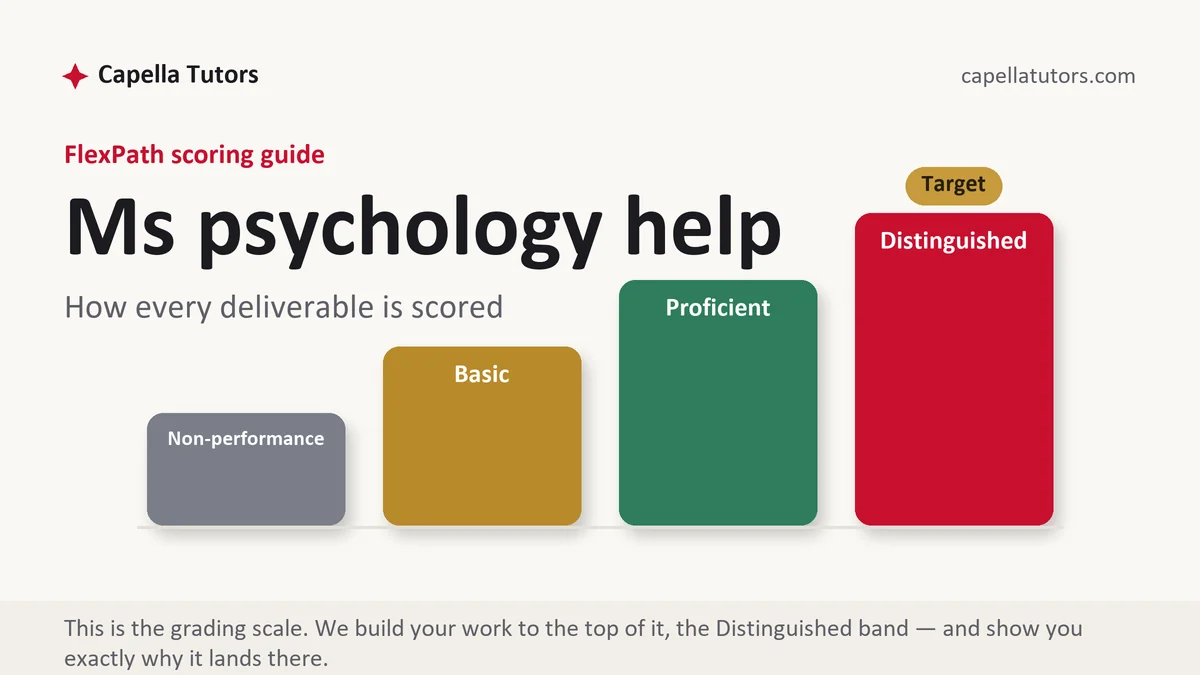
Capella's MS in Psychology is a graduate, non-licensure degree, and the second word reorganizes people's plans. It does not make you a counselor, a therapist, or a psychologist, and no specialization changes that. What it is: five FlexPath specializations on a shared core and a research spine, every course passed by written assessments scored Non-performance, Basic, Proficient, or Distinguished, inside flat 12-week billing sessions with up to two courses open at once. We draft to the top descriptor in your own scoring guide inside 24 to 48 hours and revise free until every criterion clears.
Non-licensure, and what that rules out
Say it before anything else, because some students enroll believing this degree ends in a counseling room. It does not. Non-licensure means the degree by itself does not authorize independent practice, does not entitle you to present yourself as a psychologist, and does not qualify you to administer restricted instruments on your own authority. A specialization does not change that. Neither does finishing with strong marks.
Licensure is granted by a state board, not by a university and not by a support studio. Each board sets its own rules on degree content, supervised hours, and examinations, and those rules move. If a license is your goal, put the question to your own state board in writing, name this program, and keep the reply. Do it before you enroll, or today if you are already partway in, because asking costs an afternoon and not asking costs a degree pointed somewhere you did not intend.
Where the degree does travel is real work: applied research and program evaluation, instructional and developmental roles, personnel and organizational functions, performance support, and preparation for doctoral study. Doctoral admission requirements belong to the receiving program, so verify anything you were told with them.
Choosing between the five FlexPath specializations
Most requests for Capella MS Psychology help arrive with the specialization already chosen, usually on a job title rather than the work the courses ask for. The five are General Psychology, Child and Adolescent Development, Educational Psychology, Industrial/Organizational Psychology, and Sport Psychology. All five share the same core and the same capstone, and none carries the same weekly labor for you.
| Specialization | The recurring deliverable | Who it goes quickly for |
|---|---|---|
| General Psychology | Theory application across ethics, social, learning, lifespan, and cognitive and affective material | Doctoral hopefuls, anyone without a target setting |
| Child and Adolescent Development | Developmental analysis from prenatal through adolescence, plus advocacy written for a decision maker | School staff, family services, child welfare |
| Educational Psychology | Learning and instruction analysis, then a program evaluation with a real question and a design | Teachers, instructional designers, training staff |
| Industrial/Organizational Psychology | Personnel and HR practice, leadership, and consultation written as advice a client could act on | HR, recruiting, learning and development, managers |
| Sport Psychology | Performance enhancement and applied intervention, on a biological and current-issues base | Coaches, trainers, athletic staff, performance coaches |
The tradeoff worth naming: Educational and Industrial/Organizational Psychology carry the most stakeholder-facing writing, faster if you already write for people who can say no, while Child and Adolescent Development and Sport Psychology lean harder on published literature and reward patient reading. General Psychology is the widest of the five, an advantage if doctoral study is in view and a disadvantage on a resume that needs to say something specific. Switching costs unevenly: the core and research courses count wherever you land, specialization courses do not, so a switch after three of them is three courses paid for and unused. The required set and the size of the program sit on your own degree audit for your catalog year, so read the lists below as pages we have published, not as a requirement list.
What master's psychology writing demands that undergraduate work does not
Students arriving from a bachelor's in psychology, including Capella's own, are usually competent at the move undergraduate rubrics reward: name a theory, apply it to a case, cite it in current APA. Graduate criteria assume that move and grade the next one. Our BS Psychology page covers the undergraduate fundamentals, so this page carries only the difference.
The reader changes first. Undergraduate work is written for a grader who already knows the answer; master's work is written as though a colleague might act on it, which is why the criteria keep asking you to bound a claim rather than display it. An undergraduate paper can cite a finding, a master's paper carries the design and sample behind it, because you are graded on judging evidence rather than relaying it. Participants were measured for anxiety stops being an acceptable sentence, since the question is which instrument, on whom, with what validity evidence.
Verb discipline is where the most credit quietly leaves. Was associated with, predicted, and caused are three separate claims, and the study's design decides which one you may write; a cross-sectional survey does not license a causal verb. Ethics moves from values to standards, so the American Psychological Association's code gets cited by standard number, and writing that confidentiality matters without the standard governing its limits reads as opinion. The last change is the scope sentence: assessments here ask what you, holding a non-licensure master's, may conclude or recommend, so write that boundary plainly rather than leaving it implied, since the judgment is what gets graded.
The research-methods spine every specialization sits on
Four courses carry the degree whichever specialization you chose. PSY FPX 5002, Foundations of Theory and Practice for Master's Psychology Students, is 2.5 program points and installs the apparatus everything later assumes. RSCH FPX 7860, Survey of Research Methods, is 2 points; PSY FPX 7610, Tests and Measurements, is 2.5; PSY FPX 5201, the Integrative Project for Master's Degree in Psychology, is 2.5 and comes last. RSCH FPX 7868, Qualitative Design and Analysis, is 2 points in the research core; confirm on your own audit whether your specialization requires it.
The spine keeps asking three questions, and every course above it inherits them. What is the design, and what conclusion does it permit? What was measured, with which instrument, and what evidence says the instrument works on people like these? What does the number mean, and has it been reported honestly?
Two habits do most of the work. Name your variables first: the one you think does the acting, the one you think is acted on, and the confounds you cannot rule out. That last group is the one students omit, and volunteering it separates Basic from Distinguished. Then state the assumptions your test rests on and whether you checked them, because a test run on data that violates them produces a number that looks fine and means little. Report what did not reach significance too, and give the effect size beside the p value. Sequencing follows: methods and measurement belong before the capstone, not in a final session, since PSY FPX 5201 assumes the spine rather than teaching it again.
Send the PSY or RSCH course you are in
The code, the prompt, and your specialization are enough. First premium sample free, back inside 24 to 48 hours.
Every MS Psychology course we cover
Twenty-five pages, grouped the way the catalog groups the courses. Each covers what its criteria grade and the mistakes that cost a level.
Core, shared by all five specializations
PSY FPX 5002, PSY FPX 7610, RSCH FPX 7860
Research core
Capstone, the final quarter
General Psychology
PSY FPX 5110, PSY FPX 5120, PSY FPX 6015, PSY FPX 6110, PSY FPX 7421
Child and Adolescent Development
PSY FPX 6010, PSY FPX 6020, PSY FPX 6025, PSY FPX 6030
Educational Psychology
Industrial/Organizational Psychology
PSY FPX 6710, PSY FPX 6720, PSY FPX 6730, PSY FPX 6740
Sport Psychology
PSY FPX 6810, PSY FPX 6820, PSY FPX 6830, PSY FPX 6840, PSY FPX 7310
Browse the full course catalog
Where MS Psychology students stall
Rarely in the first course. The stall lands in the pair where two evidence-heavy courses share the same weeks: open RSCH FPX 7860 beside PSY FPX 7610 and both want evenings spent appraising other people's studies. Submit an attempt in either and faculty have two business days to evaluate it, and under submit-on-grade the next assessment waits on that grade, so both courses idle at once. Pair one spine course with one specialization course instead.
- Assuming the degree ends in a license. The expensive version is discovering it in the capstone. Ask your state board now.
- Leaving the research spine to the last session. The capstone assumes those courses and does not teach them twice.
- Textbook citations for theories whose original papers sit in the library. A secondary attribution tells an evaluator which one you opened.
- A specialization chosen on job title and abandoned three courses in. Core work transfers between the five, specialization work does not.
MS Psychology questions students actually ask
Does the MS in Psychology lead to a counseling license?
No. The MS in Psychology is a non-licensure degree, and none of the five specializations changes that. Licensure as a counselor, therapist, or psychologist comes from a state board, under that state's own rules on degree content, supervised hours, and examinations. Put the question to your board in writing, name this program, and keep the answer. Capella marketing does not substitute for it.
Which specialization should I pick if I am not sure yet?
Start with the courses every specialization shares, PSY FPX 5002, PSY FPX 7610, and RSCH FPX 7860, and let the decision wait, because those count wherever you land while a specialization course completed and then abandoned is one you paid for and cannot use. If you have no preference after the research core, General Psychology is the broadest of the five. Confirm your own required set on your degree audit.
Can this master's get me into a PhD or PsyD program?
It can be a preparation step, and the research core is the part doctoral admissions committees read closely, since a candidate who can defend a design and report statistics honestly needs less remediation. What it cannot do is guarantee anything, because admission requirements belong to the receiving program: some want specific coursework, some want research output, some want a licensure-track master's for clinical training. Get the list from each program before you choose specialization courses.