Give us the prompt, the guide and the deadline, and a premium original sample arrives within 24 to 48 hours, argued at the level the graduate criteria are pitched at, with unlimited free revision until the guide is satisfied. The course appears on your record as PSY FPX 5120, Social Psychology, worth 2.5 program points, taken on the General Psychology specialization of the FlexPath MS in Psychology at Capella, a non-licensure graduate degree. In Capella's catalog the course code is written PSY-FPX5120.
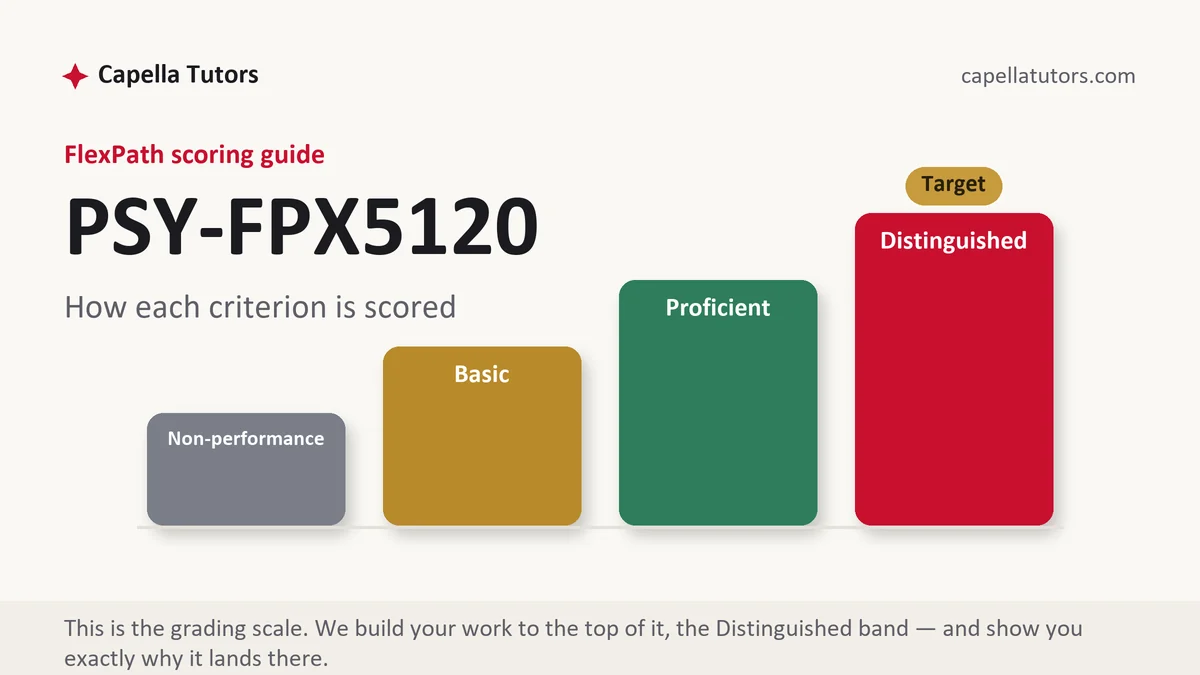
What PSY FPX 5120 actually grades
An undergraduate version of this subject asks you to recognize a phenomenon and give it its proper name. The master's version asks you to test a claim about why it happens, and the criteria are written accordingly. Naming the bystander effect, or conformity, or dissonance, earns almost nothing at this level. What earns credit is stating the process you think produced the behavior, saying which observation would follow if that process were operating, and saying which observation would follow if a rival process were operating instead. Social psychology has more competing explanations for the same behavior than almost any area of the discipline, and the graduate criteria exist to find out whether you can adjudicate between two of them rather than list five.
Design literacy is the second graded strand and it is where most drafts quietly fail. The criteria expect you to know whether the study you are citing manipulated its independent variable or measured it, whether participants were assigned at random or arrived in their groups, whether the outcome was behavior or a self-reported intention to behave, and whether the setting was a laboratory, an online panel or a real institution with consequences attached. Each of those choices changes the verb you are permitted. A field experiment with random assignment supports caused. A survey linking a social variable to an outcome supports predicted. Cover stories, manipulation checks and demand characteristics belong in your account of a study, because a manipulation that participants saw through did not manipulate anything.
The third strand is process and boundary, which is to say mediation and moderation, and the two are graded as different claims. A mediator is the mechanism the effect travels through, so a mediation claim is a claim about process and it requires the mediator to have been measured. A moderator is a condition under which the effect gets larger, smaller or reverses, so a moderation claim is a claim about scope. Graduate criteria reward candidates for both stated in advance, and they punish the habit of describing an outcome and then narrating a process nobody measured. Generalization sits alongside: who was in the sample, how many sites the effect has been observed in, and whether it has been reproduced outside the population it was discovered in.
The fourth strand is application, and it is graded harshly because it is easy to fake. Assessments here often ask you to take a social psychological finding into a real setting, and your scoring guide decides the form, whether that is an analysis, a program design, a critique or a memo to a decision maker. What separates the top column is arithmetic honesty about size. Most reliable social psychological effects are small, small effects applied to large populations can still be worth having, and a paper that promises a transformation from an intervention with a two point shift behind it has told a decision maker something untrue.
How we help in this course
Samples for 5120 are written as arguments with a testable shape. The explanation names one process and one rival, the evidence for each carries its design in the same sentence, mediation is claimed only where a mediator was measured, and every effect appears with a size rather than an adjective. Applied sections are written so a reader could actually run them, with the comparison condition specified and the outcome measure named. Send us the setting you work in or the population your specialization points you toward, and the sample will argue inside that context instead of inside a textbook chapter.
Delivery terms match the rest of the studio. A premium original sample per deliverable inside 24 to 48 hours, drafted and then read by eight people, with one pass reserved for checking that every causal verb in the document is supported by the design behind it. Revisions are free and uncapped, and anything faculty return after an attempt is folded back in at no charge. That matters for pacing, because faculty have two business days to evaluate a submitted attempt, and two returned attempts on the same criterion is most of a week you had budgeted for the next course.
The assessments, one by one
Assessment 1: Participating in Politics: Executive Summary
Executive Summary: a proposal to a civic client that applies social psychology to increase political participation, with objectives, solution, deliverables, risks. Read the full Assessment 1 manual.
Assessment 2
A middle deliverable in this course is normally an evidence appraisal: a contested applied claim, the body of studies behind it read for design and size rather than for conclusion, and a judgment about what the accumulated work actually supports. Read the full Assessment 2 manual.
Assessment 3: Aggression Intervention Training
Design a training program for a setting such as a school, with its focus, goals and objectives, research-based interventions and preventive measures. Read the full Assessment 3 manual.
How to actually write PSY FPX 5120: where to begin
Start by sorting the criteria into three kinds, because they want different paragraphs and blending them is the most common structural error in this course. Some criteria ask you to explain, which means a mechanism. Some ask you to evaluate evidence, which means designs and effect sizes. Some ask you to apply or recommend, which means a specified intervention with a measurable outcome. In current courserooms the assessments include "Participating in Politics: Executive Summary" and "Aggression Intervention Training" among others, and your scoring guide decides the exact format of each. Put the Distinguished sentence under each heading before you write a word of content, then delete nothing until there is evidence sitting under every one of them.
Then build one mechanism claim properly, since a single well-built one outscores four gestures. Say the criterion asks you to explain the psychological process behind a behavior change program, and the program in front of you posts the actual percentage of students at a campus who intervene when they witness harassment. The Basic answer writes that social norms influence behavior, which is true and explains nothing. The graduate answer specifies the process as a correction of a misperception: students systematically underestimate how many peers disapprove of the behavior and overestimate how many tolerate it, so publishing the real figure changes the perceived norm and the perceived norm changes what people are willing to do in the moment. That specification immediately buys you three things a criterion can reward. It predicts who should change most, namely the students whose baseline estimates were furthest from the truth. It tells you what to measure, which is the perceived norm before and after, not just the behavior. And it tells you what would falsify the process claim, which is a program that moved behavior without moving the perceived norm at all. Write the falsification sentence. Almost nobody does, and it is the clearest signal in the paper that you understand what a mechanism is.
Then put sizes on the evidence and explain what the sizes cost you. Take intergroup contact, which is the best supported applied claim in this literature. Meta-analytic work across hundreds of samples reports a mean correlation near negative .21 between contact and prejudice, which is a dependable result and also about four percent of the variance in the outcome. Most of the studies behind it are cross-sectional, and the ordering problem is obvious once you say it out loud, because people who are less prejudiced to begin with seek out more contact. The designs that answer the objection are the ones that take assignment out of the participant's hands, and university roommate allocation is the standard example, since a random draw of who lives with whom is a real experiment nobody had to construct. Write that chain in the paper: the association, its size, the confound, and the design that addresses it. Then say what remains unresolved.
Then be careful with attitude measurement, because it is where applied claims in this field are most often overstated. Self-report attitudes predict behavior best when the measure matches the behavior in specificity, target and time frame, which is why a general attitude toward the environment predicts recycling poorly and a specific intention to recycle at home this month predicts it much better. Implicit measures are not a shortcut around that problem. Reported test-retest figures for the best known reaction-time measure cluster around .5, and meta-analytic associations with behavioral criteria have come in near .1 to .2, which is a real but modest signal and not a diagnostic instrument for an individual. Say what your measure can carry, say what it cannot, and never write a recommendation for a person from a group-level instrument.
| Section | What goes in it | What Distinguished looks like |
|---|---|---|
| The behavior and the question | The behavior described observably, and the explanatory question stated so an answer could be wrong. | A question narrow enough that two named theories give different answers to it. |
| The mechanism proposed | One process, its steps, and the prediction that follows from it. | The falsifying observation stated by you, in your own sentence, before faculty look for it. |
| The rival account | A second serious explanation of the same behavior and the evidence that favors it. | A rival taken at its strongest and adjudicated on evidence rather than dismissed. |
| Evidence and design | Each study with its manipulation or measurement, its assignment, its outcome and its setting. | Verbs matched to designs throughout, with effect sizes and intervals rather than adjectives. |
| Scope and generalization | Who was studied, where, how often the finding has been reproduced, and where it has not. | Boundary conditions written as moderators, with the untested populations named. |
| Application and references | The intervention, its comparison condition, its outcome measure, its expected size, current APA both ways. | A plan that could be run, with a stated null result and an honest projection of its size. |
Developing the synthesis
The synthesis a graduate criterion is hoping for here is structural rather than partisan. Over the last fifteen years this discipline has re-run a large number of its own published effects in coordinated multi-laboratory projects, and the result is a spread rather than a verdict: some effects came back at close to their published size, several returned much smaller, and a handful did not appear. The interesting question for a paper is not which side won but what explains the spread, and four features do most of the explaining. Original samples were often small enough that only a large estimate could reach significance, so the published figure was inflated by the filter it passed through. Analysis decisions were made after the data arrived, which quietly multiplies the number of tests actually run. Effects that depend on a specific setting or a specific population will not travel to a different site, which is a moderation finding rather than a failure. And publication practice preferred the surprising to the mundane. Take one contested effect in the area your assessment covers, apply those four features to it, and state where you land. A paper that explains heterogeneity reads as graduate work; a paper that either defends every classic or dismisses the field reads as an opinion column.
Citations that survive faculty review
Sort your reading list by what each item can prove. Primary empirical articles in the discipline's own journals, reached through PsycINFO and the Capella library, are the only sources that can establish that a particular effect exists, and each one enters your text with its design attached. Meta-analyses and systematic reviews are the correct citation for how large an effect is across studies, and they outrank any single experiment for that purpose, including a celebrated one. Theoretical statements belong to their authors, so a dissonance claim is cited to the theory's own literature rather than to a summary chapter, and a norms claim is cited to the papers that formalized the distinction between what people do and what people approve of. Registered protocols and multi-site reports are worth citing directly when your assessment turns on whether an effect replicates, because they say what was planned before the data existed. What does not survive review is equally predictable: business books built on influence research, conference talks, news coverage of a single study, and any claim that arrives with a name attached but no year and no sample. Then run current APA both ways and confirm every year in the text against its entry in the list.
The mistakes that land Basic instead of Distinguished
- A phenomenon named instead of a process explained. Labeling the behavior answers the vocabulary question the graduate criterion did not ask.
- Mediation asserted without a measured mediator. A process claim built on an unmeasured variable is a story about the data rather than a finding in it.
- Causal verbs on correlational designs. Influenced, produced and led to all require assignment the study did not perform.
- One study treated as the field. A famous experiment is a data point, and the criterion is asking what the accumulated evidence supports.
- Applied sections with no measure. An intervention with no outcome variable and no comparison condition cannot be evaluated, which is what the recommendation row evaluates.
PSY FPX 5120 questions students actually ask
How much method detail belongs in a social psychology paper?
Enough that a reader could tell whether the study can support the verb in your sentence, which is usually one clause rather than a paragraph. For an experiment that means the manipulation, the assignment procedure and the outcome measure. For a survey it means who was sampled, how the constructs were measured and whether anything was measured twice. The test is functional: if you have written that a manipulation caused an effect, the method clause has to show random assignment, and if it does not, the verb has to change to predicted or was associated with. Long method summaries are not what the criteria reward. Method detail placed exactly where a claim needs defending is.
My sources report the same effect at different sizes. Which one do I write?
Write the range and then explain it, because the disagreement is usually the most gradeable material you have. Start with the best available synthesis, since a meta-analytic estimate with a confidence interval outranks any single study, including a famous one. Then look at what separates the high estimates from the low ones, and in this literature four things account for most of it: sample size, whether the outcome was behavior or an intention to behave, whether the setting was a laboratory or a field, and whether the analysis plan was fixed before the data arrived. Say which of those you think drives the spread, and say what evidence would settle it. A paper that reports one convenient number and calls the matter closed loses the row the paper reporting the spread wins.
Can I build a persuasion campaign out of the classic influence principles?
You can use them as a checklist for generating options, but a graduate deliverable is graded on what happens after that. Pick one principle, state it as a mechanism rather than a slogan, and commit to a prediction it makes that a competing principle does not. Then specify the measurement: what the outcome is, when it is collected, what the comparison condition receives, and what a null result would look like. Then size the claim honestly, since a two percentage point shift is a real result in a field campaign and is not a transformation. The gap between an undergraduate campaign paper and a graduate one is not vocabulary. It is that the graduate version could be run, and it says in advance what would count as failure.
Social psychology deliverable due?
Upload the prompt, the criteria and the effect you have been told to explain. First premium sample free, written with one mechanism, one rival, and every effect carrying its size.