Send the prompt with its scoring guide and any faculty comments you are working from, and a premium original sample reaches you inside 24 to 48 hours, written against the Distinguished column your own guide prints, with revisions at no cost until the criteria are satisfied. The registrar line reads PSY FPX 6810, Principles of Sport Psychology, worth 2.5 program points, one of the Sport Psychology specialization courses in Capella's MS in Psychology, delivered in FlexPath and carrying no license to practice at the end of it. In Capella's catalog the course code is written PSY-FPX6810.
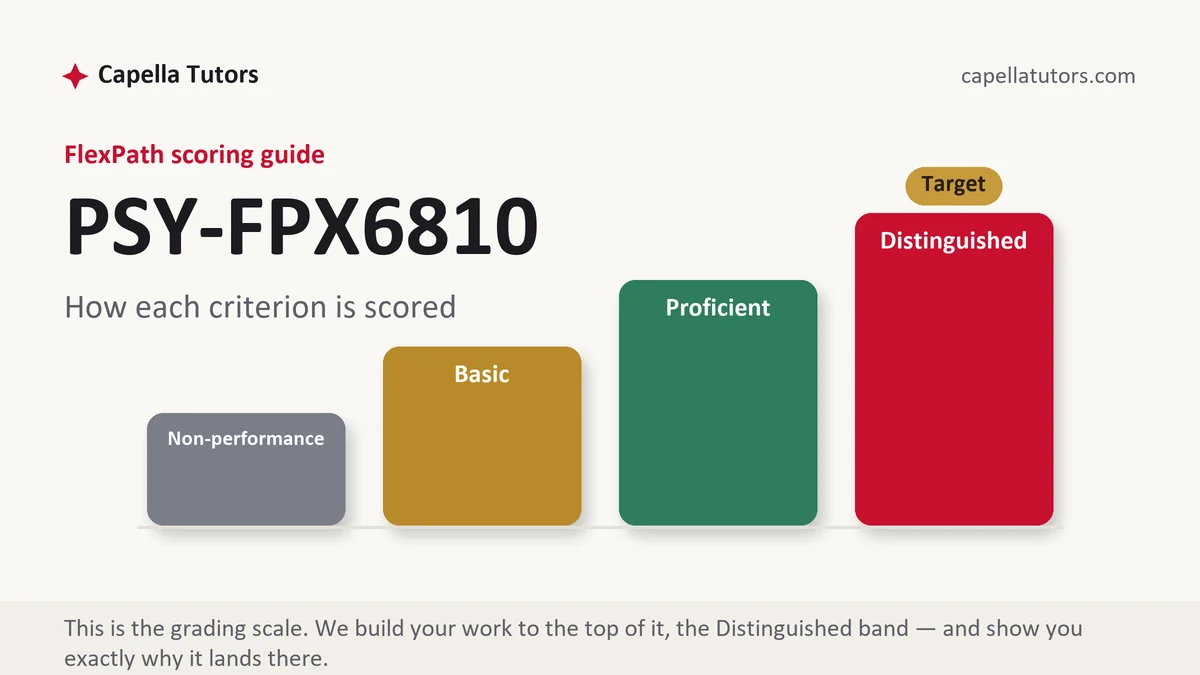
What PSY FPX 6810 actually grades
Two vocabularies compete for this course and only one of them scores. One is the language of coaching, built from mental toughness, killer instinct and wanting it more. The other is the language of a research field, built from constructs that have been operationalized, models that make competing predictions, instruments with published reliability, and effects that arrive with a size attached. The criteria reward the second and quietly penalize the first, so a paper that opens on an inspirational premise and then hunts for citations to decorate it has surrendered the analysis criterion before its second page.
Arousal, anxiety and performance are the technical core, and the models here were built to disagree. The inverted-U hypothesis predicts a single optimum with performance falling away on either side of it. Multidimensional anxiety theory splits competitive anxiety into a cognitive component and a somatic one and then predicts a different relationship for each, with worry degrading performance roughly in proportion to itself while physiological activation follows a curve. The individual zones of optimal functioning approach discards the group curve and asks instead where this athlete has performed well before. The catastrophe model treats cognitive anxiety as a moderator and predicts a sudden collapse rather than a gradual decline. A Distinguished treatment says which model the case fits and which prediction the case would falsify. A Basic treatment draws the inverted U and stops.
Motivation is graded through named theory as well. Self-determination theory works from autonomy, competence and relatedness, and it predicts what happens when a scholarship turns a game into a job. Achievement goal theory separates task orientation from ego orientation and then lays the motivational climate a coach creates over the athlete's own disposition. Attribution work explains what a defeat does to the next performance, depending on whether the athlete reads the cause as stable and internal. Group content is the second strand: task cohesion and social cohesion behave differently, and the relation between cohesion and performance runs both ways, since winning teams enjoy each other partly because they are winning. Putting that direction problem into your analysis is one of the cheapest ways to read as a graduate student.
Measurement and scope close the course out. The instruments have names, formats and known weaknesses: the Competitive State Anxiety Inventory 2 with its cognitive, somatic and self-confidence subscales, the Sport Competition Anxiety Test for the trait side, the Task and Ego Orientation in Sport Questionnaire, the Group Environment Questionnaire, and the Profile of Mood States, whose iceberg pattern was once read as a talent screen and does not survive being used as one. State against trait is the distinction that decides which instrument is even eligible for your question. Scope is graded too. This degree does not license you, so the work you can describe yourself doing is educational and performance focused, and anything resembling disordered eating, a mood disorder or suicidal risk belongs in a referral sentence rather than inside a mental skills plan.
How we help in this course
Samples for 6810 are built model first. The theory gets named and its prediction gets stated before any application appears, competing models get the paragraph they earn rather than a mention, instruments are introduced with their format and their published limits, and the scope boundary shows up in the athlete-facing sections where faculty look for it. Tell us the sport, the competitive level and whether your case is real or constructed, and the draft argues from that sport's literature rather than from generic athletics.
The commercial side is identical across every course we cover. One premium original deliverable inside 24 to 48 hours, routed through an eight-person pipeline where one pass exists purely to confirm that every empirical claim still matches the design of the study behind it, aimed at the top descriptor and revised free until it lands there, with faculty feedback handled in the same cycle at no charge. Pacing matters here, because FlexPath bills in flat 12-week sessions and allows two courses at a time, and faculty have two business days to evaluate an attempt, so a resubmission turning on one mislabeled instrument costs a week you had already spent.
The assessments, one by one
Assessment 1
Assessment 1 of PSY FPX 6810, Principles of Sport Psychology, asks for theory doing work: a named model with its primary source, a case described concretely enough to test it on, a prediction the model actually makes, and a competing account given the paragraph it earns. Read the full Assessment 1 manual.
Assessment 2
Assessment 2 of PSY FPX 6810, Principles of Sport Psychology, is the measurement deliverable: an instrument chosen because the question is about a state or about a trait, reported with its format and its published weaknesses, interpreted against a named normative sample, and never asked to carry a. Read the full Assessment 2 manual.
Assessment 3
Assessment 3 of PSY FPX 6810, Principles of Sport Psychology, turns a model into a plan: a competitive anxiety problem defined behaviorally, a mental skills program built from components with a dose and a schedule, a referral boundary written before anyone needs it, and measures fixed in advance so. Read the full Assessment 3 manual.
How to actually write PSY FPX 6810: where to begin
Start by taking the scoring guide apart and letting it set the shape of the document. Each criterion becomes a heading, the Distinguished sentence goes underneath it while you draft, and every paragraph you write gets attached to one of them. Read the verb in each criterion, since analyze and evaluate ask for different work and only one of them wants a judgment behind a standard. Your scoring guide decides the sections and their order. The assessments in this course usually ask for some mixture of explaining a theoretical model, applying it to an athlete or a team, and appraising the evidence or the instrument behind the claim.
Then work one case the whole way through, since that is where the analysis criterion is won. Take a constructed springboard diver who scores 26 on the cognitive subscale of the Competitive State Anxiety Inventory 2, 15 on the somatic subscale and 20 on self-confidence, with each nine-item subscale running from 9 to 36. The inverted-U hypothesis cannot use those numbers, because it has one arousal axis and this athlete has three readings pointing in different directions. Multidimensional anxiety theory can: high worry with modest physiological activation predicts attentional narrowing and a hurried approach rather than a gross motor failure, which is precisely the error a coach would describe as rushing the hurdle step. The catastrophe model earns its place only if this diver has a history of sudden collapse in finals rather than of gradual decline. Now the paper has said something a coach could act on, and it arrived there through a model rather than around one.
Then hold the line on measurement language. Name the instrument, say how many items it has and what the response scale is, report the reliability your source gives, and interpret the score only after all of that. A single administration is a snapshot of a state, not a diagnosis and not a trait, and a self-report score is a report about a self, which is a limitation you should raise before your evaluator raises it for you. When you compare an athlete against a normative sample, say which sample, since norms built on collegiate men in team sports do not transfer to a fifty-year-old competitor in an individual event.
| Section | What goes in it | What Distinguished looks like |
|---|---|---|
| The case and the question | The athlete or team described concretely, with sport, level, and the performance problem stated behaviorally. | A problem defined in observable terms, so a reader could tell whether it improved. |
| The theoretical model | One named model, its assumptions, its variables, and the prediction it makes about this case. | Competing models weighed, with the prediction each one would fail on identified. |
| The evidence | Peer-reviewed sport psychology research described by design and sample rather than by conclusion. | Evidence graded, with laboratory findings kept separate from field findings. |
| Measurement | The instrument, its format, what it claims to measure, and its reported weaknesses. | State and trait held apart, and the normative sample named. |
| Application and boundaries | What the model implies for practice, and what falls outside a non-licensure role. | A referral pathway written before it is needed, in plain sentences. |
| APA mechanics and references | Current APA formatting, citations matched to entries, primary sources for every theory. | Original theory sources cited under their own year, with a reference list that survives a two-way check. |
Developing the synthesis
Synthesis in this course means holding a disagreement open and explaining its structure. Take the cohesion and performance question, which looks settled in textbooks and is not. Meta-analytic work reports a positive association, that association is stronger for task cohesion than for social cohesion, and it is stronger in interactive sports such as basketball than in coacting sports such as swimming. Most of the underlying studies measured both variables at the same moment, which leaves the causal arrow unresolved, and the work that followed teams across a season suggests it points both ways. Explain the inconsistency through sport type, the timing of measurement and which cohesion subscale was used, then state the position you hold and the finding that would move you off it. A paragraph closing on an argued uncertainty scores above one that manufactures a consensus the field has not reached.
Citations that survive faculty review
Three source families carry a 6810 paper. Peer-reviewed sport and exercise psychology journals supply every empirical claim, and they are reached through PsycINFO, SPORTDiscus and the Capella library rather than a search engine, which in practice means the Journal of Sport and Exercise Psychology, Psychology of Sport and Exercise, the Journal of Applied Sport Psychology and The Sport Psychologist, where this field argues with itself. Primary theory sources carry the conceptual claims, so self-determination theory goes to Deci and Ryan, achievement goals to Nicholls and then Duda, the multidimensional account of competitive anxiety to Martens and colleagues, individual zones of optimal functioning to Hanin, and cohesion to Carron, each under its own year, since a citation from the 1980s is provenance rather than a lapse. Instrument papers are the third family, because the article that developed a questionnaire is the only place its intended use and its weaknesses are set out. Coaching blogs, popular performance books and a textbook standing in for the study it summarizes all read as a search that stopped on the first page of results.
The mistakes that land Basic instead of Distinguished
- The inverted U drawn and left there. One curve cannot carry a course whose later models were built to contradict it, and reproducing the picture is not the same as testing a prediction.
- Motivation described without a theory. Writing that an athlete lacks drive gives an evaluator nothing to grade, while naming the type of regulation, the goal orientation and the climate does.
- A trait instrument used to explain one bad final. Trait scores cannot account for a single afternoon, and the mismatch shows you did not check what the tool was built to measure.
- Cohesion treated as one thing. Task and social cohesion behave differently, and collapsing them costs the analysis criterion whichever way your argument runs.
- Clinical material handled as a performance problem. Restricted eating, depressed mood and suicidal thinking require a referral sentence, and a non-licensure plan that absorbs them reads as a scope violation.
PSY FPX 6810 questions students actually ask
Is the inverted-U hypothesis still taken seriously?
It survives as a teaching heuristic and fails as an explanation, and saying both is the graded answer. The shape is intuitive and it fits some coacting endurance tasks tolerably well, but it treats arousal as one dimension when competitive anxiety separates into cognitive and somatic components that behave differently, it puts every athlete on one curve when optimal ranges are individual, and it predicts a smooth decline where athletes describe sudden collapse. Use it to introduce the problem, move to a model that makes a prediction you can test on your case, and add one sentence naming what the curve cannot account for. Faculty are not waiting for the curve to be attacked, they are waiting for evidence that you know what it leaves out.
Can I write about my own competitive experience?
Use it to frame the question and never to answer it. A season you lived through tells you which problem is worth studying, which sport-specific detail matters and which coaching behavior is realistic, and that is genuine value in a case-based course. It cannot serve as evidence, because a sample of one with no measurement and a decade of hindsight is the weakest design available. Put the experience in the framing paragraph, label it as yours, then let the literature and the instruments do the arguing.
Do I need a real athlete to write about?
No, and a constructed case is often the stronger choice as long as you label it. Build the athlete with the parameters the analysis needs: the sport, the competitive level, how long they have been training, the specific performance pattern you intend to explain, and any scores you are treating as observed. Then say in one line that the case was constructed for the assessment. Real athletes bring consent obligations a course paper is not the place to test. Your scoring guide decides whether a real case is required.
Sport psychology deliverable due?
Send the prompt, the scoring guide and the sport. The first premium sample is free, and it arrives with its model named and its instruments described properly.