Upload the prompt with its scoring guide and a premium original sample lands inside 24 to 48 hours, built row by row against the top descriptor that guide prints, revised at no charge until each row clears. The course records as PSY FPX 5110, Ethics and Individual Differences in Psychology, worth 2.5 program points, carried on the General Psychology specialization of Capella's FlexPath MS in Psychology, a graduate degree that does not lead to licensure. In Capella's catalog the course code is written PSY-FPX5110.
What PSY FPX 5110 actually grades
The title joins two subjects, and the criteria grade the joint rather than either half alone. Papers that read as an ethics essay stapled to a personality essay lose the integration rows even when both halves are accurate. The link is not decorative. Almost every ethical question a psychology graduate faces is a question about measurement confidence: whether an instrument was validated on people like this one, whether a single score can carry the decision being hung on it, whether a difference between two groups says anything about the person in front of you. Write the two subjects as one problem and the paper starts in the upper columns.
The ethics half has a structure students routinely flatten. The American Psychological Association's Ethical Principles of Psychologists and Code of Conduct opens with five General Principles, from beneficence and nonmaleficence through to respect for people's rights and dignity, and those are aspirational statements no one is charged under. The numbered Ethical Standards that follow are enforceable, and those are the ones a criterion wants cited. The standards that carry most course scenarios are few enough to know by number: 2.01 on boundaries of competence, 3.05 on multiple relationships, 4.01 and 4.02 on protecting confidential information and discussing its limits at the outset, 8.02 on informed consent to research, and the ninth section on assessment, where 9.02 requires instruments used for purposes and populations their validation supports, 9.04 governs release of test data, and 9.06 requires interpretation to account for the test-taking circumstances and characteristics that could change what a score means.
The individual differences half is graded on one habit above all others, which is reading a person as a position in a distribution rather than as a kind of person. Trait scores are continuous, error-laden, and normed against a reference sample that you can name; types are claims about categories, and most commercial instruments that hand out types have cut a continuous variable somewhere near its middle and given each side a label. The criteria expect you to keep reliability, standard error and the reference sample in the same paragraph as any score you interpret, to separate a trait from a state, and to treat the five-factor structure, cognitive ability, interests and psychopathology dimensions as constructs with measurement histories rather than as facts about human nature.
The third graded strand is scope, and it is the strand that connects back to the degree. The MS in Psychology is a non-licensure master's, which means you are not authorized to practise independently, to call yourself a psychologist, or to sign off on an assessment battery on your own judgment, and test publishers restrict the purchase of many instruments by qualification level for the same reason. Assessments in this course frequently place you in an applied situation with an instrument in it, and the scoring guide decides what form the answer takes. What earns credit is naming the limit of your own authority in the situation, saying who the decision belongs to, and describing the consultation and documentation you would produce rather than the conclusion you would announce.
How we help in this course
Drafts for 5110 are written with the code open. Every ethical obligation arrives with its standard number, competing obligations are set against each other rather than resolved by assertion, and the decision paragraph says what the writer would do, who would be consulted, and what would be recorded. On the differences side, every score in the sample carries its instrument, its reference sample and its error band, and every group comparison carries an effect size and the overlap that effect size implies. Tell us which applied setting your specialization points you toward and the sample argues inside that setting rather than in the abstract.
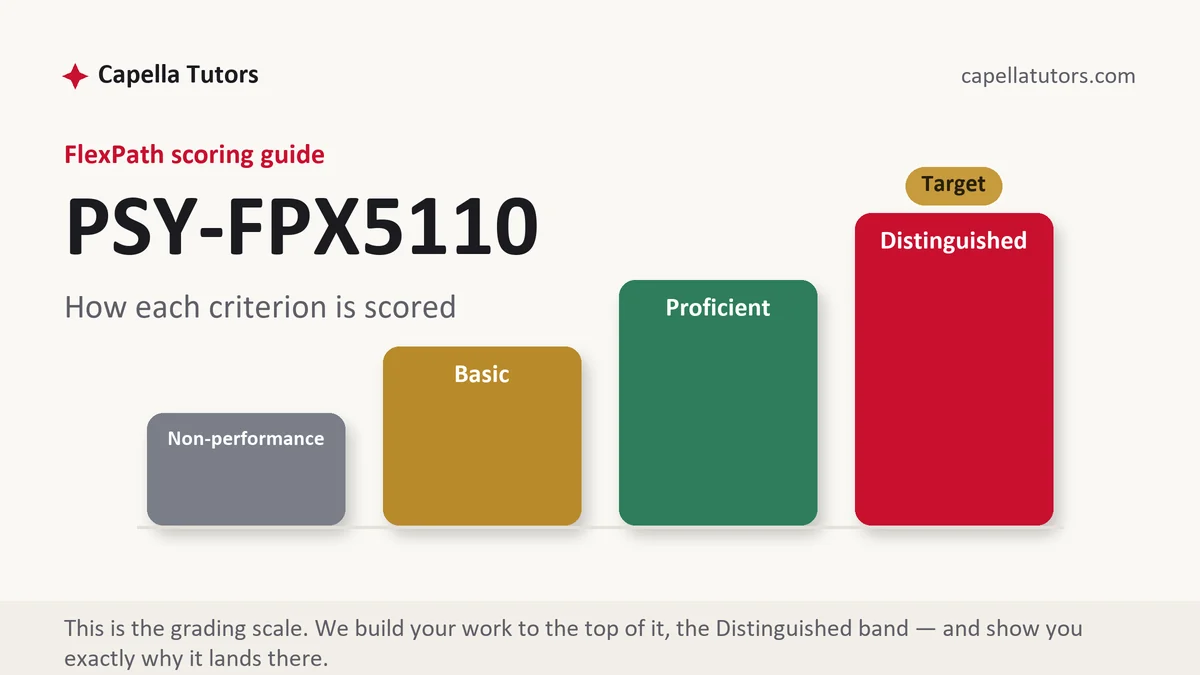
Commercial terms here are the ones that apply across the studio. One premium original sample per deliverable inside 24 to 48 hours, moved through eight people from the source pull to the final read, with one pass reserved for verifying that each cited standard number matches the obligation described in the text. Revisions stay free until the work sits where you want it. FlexPath grades every criterion at one of four levels, from Non-performance through Basic and Proficient to Distinguished, so a single soft row is the whole difference between a returned attempt and a finished course, and that row is what we rewrite for you without argument.
The assessments, one by one
Assessment 1
Analyze a counseling case study for cultural differences between practitioner and client, relevant biases. Read the full Assessment 1 manual.
Assessment 2
Prepare a multicultural in-service on a case study, covering cultural differences, biases and ethical considerations, with best practices for working with the client. Read the full Assessment 2 manual.
Assessment 3: Ethical Dilemma in the Workplace Setting
Analyze a workplace case, the ethical concerns, compare deontology and utilitarianism, and apply an ethical decision-making model to resolve it. Read the full Assessment 3 manual.
How to actually write PSY FPX 5110: where to begin
Read the guide before the scenario, because the scenario will pull you toward storytelling and the guide is what pays. Turn each criterion into a heading and copy the Distinguished sentence beneath it, then mark which criteria want a standard cited, which want a measurement judgment, and which want a decision defended. The assessments in this course usually ask for some combination of an ethical analysis, an evaluation of how a difference or an instrument is being used, and a recommendation you can justify to someone who disagrees, and your scoring guide decides the number of sections and the order they arrive in. Anything in your draft that is neither a standard, a measurement fact nor a defended judgment is filler that costs you space.
Then write the ethical analysis as a procedure rather than as an opinion. Take a scenario of the kind these deliverables use. A regional employer has been screening applicants with a personality inventory, a hiring manager asks you for the item-level responses of three finalists because he wants to know which of them is unstable, and you hold a master's degree and no licence. The weak answer says this would be unethical and stops. The strong answer moves in order. It names the standards engaged, which here include competence for the interpretation being requested, use of an assessment for a purpose its validation supports, and the rules governing release of test data. It names the parties and what each is owed, so the applicants are owed confidentiality and a fair process, the employer is owed useful information, and the profession is owed instruments that keep working. It states the misuse precisely, since a general inventory of normal-range traits is not an instrument for detecting instability and item responses are not a clinical opinion. It gives the alternative, which is a structured, job-related report of the dimensions the validation study actually links to performance in that role. Then it states what you would do, whom you would consult, and what you would document, in that order.
Then handle numbers with the honesty the differences criteria are testing. Two conversions do most of the work. First, turn every group difference into overlap: a difference of half a standard deviation means the higher group's average sits above about 69 percent of the other group and the two distributions still share most of their range, which is the sentence that keeps a real finding from turning into a stereotype. Second, put an interval around every individual score before you interpret it. An ability score reported as 108 with a standard error of measurement of three points means a 95 percent interval running roughly from 102 to 114, so the person is somewhere in the average band and the difference between 108 and 112 is nothing you may build an argument on. Faculty do not require statistical showmanship. They require that no sentence in your paper claims more precision than the instrument has.
Then check your language against the same standard your evidence is held to. Current APA style asks for terms the people described actually use, for person-first or identity-first phrasing chosen deliberately rather than by habit, and for the specific rather than the collective label, so a paper writes participants who scored in the lowest quartile rather than low scorers. Name the reference sample whenever you use a norm, since a percentile is meaningless until a reader knows who was in the comparison group. Finish by reading the paper once for a single question: does every claim about a person rest on data about that person, and does every claim about a group stay a claim about the group?
| Section | What goes in it | What Distinguished looks like |
|---|---|---|
| The situation or the construct | The scenario stated in its facts, or the individual difference defined as a measured variable. | Facts separated from inferences, with the decision at stake named in one sentence. |
| Standards engaged | The enforceable standards the situation triggers, cited by number, with the obligation paraphrased. | Two or more standards in genuine tension, with the harder obligation acknowledged as the harder one. |
| Evidence on the difference | What the research reports about the trait or group comparison, with design, sample and effect size. | Effect sizes translated into overlap, and the limits of a group finding for an individual stated. |
| Measurement quality | The instrument, its reference sample, its reliability, its standard error, and the use it was validated for. | Scores written as intervals, with any mismatch between validation population and this case named. |
| The decision and its record | The course of action, the consultation, the documentation, and the scope limit you are working inside. | A decision defensible to the party it disadvantages, with the non-licensure boundary written plainly. |
| Language and references | Bias-free terminology, current APA in text and list, the code cited as a document. | A reference list that survives a two-way check, with the code and the testing standards cited directly. |
Developing the synthesis
The synthesis this course rewards is an argument about how much a heritability figure can carry, because that number is misread more often than any other in differential psychology. A heritability estimate near .5 for a trait is a statement about how much of the variance in a particular population, under that population's range of environments, tracked genetic variance in that study. It is not a statement that half of any individual's score is genetic, and it is not a statement about how changeable the trait is, which is why estimates for the same trait shift with the age and the circumstances of the sample. The classical twin and adoption designs that produced most of these figures rest on assumptions worth naming: that identical and fraternal pairs share their environments to a comparable degree, and that placement in adoptive homes is unrelated to the child's own characteristics. Gene-environment correlation complicates both, since people with a given disposition are steered toward, and actively seek out, the environments that develop it. Say what the estimate establishes, say what it cannot, and then commit to a position on the trait you are writing about with the evidence you have.
Citations that survive faculty review
Four kinds of source do four jobs in this course and mixing them is where the source rows are lost. The Ethical Principles of Psychologists and Code of Conduct is the authority for every ethical obligation and it is cited by standard number, not paraphrased from a chapter. The Standards for Educational and Psychological Testing, produced jointly by the American Educational Research Association, the American Psychological Association and the National Council on Measurement in Education, is the authority for validity, reliability and fairness claims, and it is the document that distinguishes bias from a mean difference. Peer-reviewed journals in personality, assessment and differential psychology, reached through PsycINFO and the Capella library rather than an open web search, support every empirical claim about how people vary, and each one goes into your sentence with its design and its sample attached. Technical manuals supply norms, reliability coefficients and standard errors for named instruments, and they are the correct citation for a reference sample. What fails review is the predictable set: a textbook standing in for the code, a personality-quiz site standing in for an instrument, a popular science article about genes, and any figure whose sample you cannot describe.
The mistakes that land Basic instead of Distinguished
- Ethics argued from principles rather than standards. Writing that integrity matters, where the enforceable standard has a number, reads as opinion to the criterion doing the grading.
- A group difference reported without overlap. An effect size with no translation invites the reader to imagine two separated populations that do not exist.
- Bias equated with a mean difference. Fairness is tested at the item and prediction level, and a paper that skips that distinction has answered a different question.
- Scores treated as exact. An interpretation that turns on four points of an ability score is reading noise as information.
- Scope left unstated. A decision written as though you could authorize it yourself contradicts the degree the assessment is being submitted inside.
PSY FPX 5110 questions students actually ask
Do I have to cite the ethics code by its standard numbers?
In this course, yes, and the numbers are the cheapest points on the page. An evaluator reading that a practitioner should protect client information has read an opinion. An evaluator reading that Standard 4.01 obliges the psychologist to take reasonable precautions to protect confidential information, while 4.02 obliges a discussion of its limits at the outset of the relationship, has read a citation with an address. Quote sparingly, paraphrase the obligation, and put the number in parentheses the way you would put a page number. Then cite the code itself as a reference entry rather than the textbook chapter that described it, because the chapter is one reader's account of a document you can open.
A group mean difference sits in my source. How much can I conclude from it?
Less than the sentence in front of you implies, and the correction is arithmetic rather than diplomacy. Convert the difference into an effect size, then translate the effect size into overlap. A gap of half a standard deviation puts the average member of the higher group above roughly 69 percent of the other group, which also means that if you draw one person from each group at random the pair runs against the group difference about 36 times in 100. Write both numbers. Then say what the difference does not license: it does not predict an individual, it does not identify a cause, and it does not survive as an argument for treating members of either group differently, since a decision about one person has to be made from that person's own data.
What actually counts as test bias?
Bias is a property of measurement rather than a property of an average. Three technical findings count. Differential item functioning means two respondents with the same standing on the trait have different odds of answering an item in the keyed direction because of their group, which is an item problem you can locate. Differential prediction means the same score forecasts a criterion differently across groups, so one regression line does not fit both. Failed measurement invariance means the items are not loading on the construct the same way in each group, which puts the score comparison itself in question. A mean difference between groups is none of those three on its own. Say which of the three your source tested, and if it tested none, say that.
Ethics scenario or differences paper due?
Give us the scenario, the guide and the instrument if one is named. The first premium sample is free, and it arrives with the standards numbered and the effect sizes translated.