Drop the prompt and the guide into chat and a premium original sample is written inside 24 to 48 hours, pitched at the graduate descriptors your guide prints, with free revisions until the criteria are clear. The course records as PSY FPX 6030, Adolescent Psychology, worth 2.5 program points, sitting in the Child and Adolescent Development specialization of the FlexPath MS in Psychology at Capella, a non-licensure graduate degree. Capella also runs an undergraduate course with the same title under a different code, so check the code on your enrollment before you build a reading list. In Capella's catalog the course code is written PSY-FPX6030.
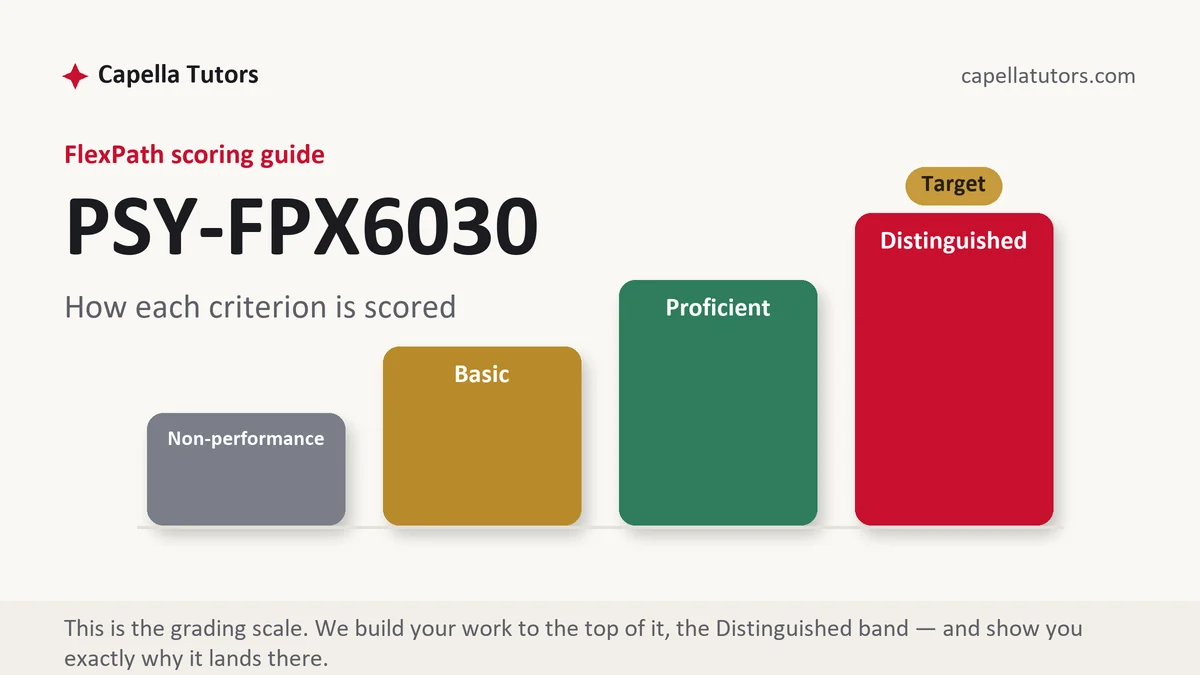
What PSY FPX 6030 actually grades
The criteria in a graduate adolescence course are looking for causal caution and measurement literacy applied to a population that is unusually easy to write badly about. Everyone arrives with a theory of teenagers, formed partly from having been one, and the fastest way to lose these rows is to defend that theory with citations. What the guide is grading is narrower and more useful: whether you can tell an association from an effect in a literature that is mostly observational, whether you know who reported the data and how that shaped it, and whether the intervention you propose could plausibly do harm.
The first substantive strand is peers, and it is graded on one distinction that most drafts miss entirely. Adolescents resemble their friends, and there are two reasons for that: they became similar because they spent time together, and they became friends because they were similar to begin with. Cross-sectional data cannot separate the two, so a study reporting that adolescents whose friends use a substance are more likely to use it themselves has measured a mixture. Longitudinal designs that collect friendship nominations at more than one point, and that model the network rather than treating friends as a fixed attribute of a person, produce estimates of influence that are reliably smaller than the raw similarity. The criteria reward that correction because it changes what you would recommend.
The second strand is timing and continuity, written as mechanism rather than as description. Pubertal timing does much of its work as a moderator, which means its consequences depend on the setting a young person is in and on how the people around them respond. Developmental cascades matter here too: a difficulty in one domain becomes a difficulty in another because it changes the environment the adolescent occupies, so an academic problem in early adolescence can produce a peer problem later without any new disposition arriving. And the same underlying propensity presents differently at different ages, which is why continuity in this literature is often continuity of the propensity rather than of the behavior. A graduate paper that names those mechanisms is doing what the analysis criterion asks.
The third strand is measurement, and the field's central problem is that different informants disagree. Studies comparing reports from parents, teachers and adolescents themselves consistently find correlations near the low end, often around .3 between different kinds of informant, and that is not a defect to be averaged away. Adolescents are usually the better source for internal states they alone can observe, adults are usually the better source for behavior that occurs where they are watching, and the discrepancy itself carries information about context. Assessments here often ask you to interpret data of exactly this kind, and your scoring guide decides the form, but the graded move is to report the discrepancy and explain it rather than to collapse it into one score.
The fourth strand is ethics, and it is heavier in this course than in most because the participants are minors with a genuine claim to privacy from the adults who must give permission for their participation. Lawful research needs guardian permission plus the young person's assent, and a study asking about substance use, sexual behavior or self-harm has to decide in advance what happens if a disclosure is made, what will be reported, and to whom. That decision has to be told to the participant before the first question, not discovered afterward. The criteria also expect you to know your own limits: a non-licensure graduate student is not the person who manages an acute risk, and the professional answer is escalation to someone qualified rather than a response improvised in the room.
How we help in this course
Samples for 6030 are written so the causal language matches the design. Peer findings arrive with the selection problem named, every rate arrives with its population and its reporting source, discrepancies between informants are treated as findings rather than as noise, and program proposals carry a monitoring plan and a stopping rule. Where the assessment involves talking to an adolescent, we build the protocol, the assent language and the analytic structure, and you have the conversation. Tell us the age band you are working with and the setting, because a plan for fourteen-year-olds in a school and a plan for seventeen-year-olds in a workforce program share almost nothing.
The commercial arrangement is the one the studio applies everywhere. One premium original sample per deliverable inside 24 to 48 hours, produced by eight people from the source pull through to the final read, with one pass reserved for checking that no sentence about adolescents in general rests on a study of a narrower group. Revisions are free and uncapped. FlexPath allows up to two courses at a time, which is where the pacing gain lives: a course whose deliverables come back in a day rather than a fortnight is a course you can run alongside another one without either of them stalling.
The assessments, one by one
Assessment 1
The opening deliverable in Adolescent Psychology is normally the analytic one: take an association reported about young people and work out how much of it could be an effect, which means naming the design, the sample and the confounds before the finding gets repeated. Read the full Assessment 1 manual.
Assessment 2
The middle deliverable in Adolescent Psychology is the applied one: a programme or intervention plan for a defined group of young people, with the target written as a measurable behaviour, the content chosen from evaluation evidence, the group composition decided on purpose, and the risk of making. Read the full Assessment 2 manual.
Assessment 3
The closing deliverable in Adolescent Psychology is usually the synthesis: a case where the adults and the young person report different things, and the paper has to decide what the pattern means, where the case sits against the developmental literature on temporary and persisting difficulty, and. Read the full Assessment 3 manual.
How to actually write PSY FPX 6030: where to begin
Open the guide, convert every criterion into a heading, and then write the age band and the setting at the top of the document, because a claim about a fifteen-year-old in secondary school and a claim about a nineteen-year-old in a first job are different claims and the literature treats them as such. Sort the criteria by what they demand: an explanation, an appraisal of evidence, a design, or a communication written for a specific adult audience. The assessments in this course usually ask for some combination of those four, and your scoring guide decides the deliverable, the section count and how much of it must be sourced.
Then work one association into a defensible causal statement, since this is the paragraph the analysis rows are scored on. Take the finding that adolescents whose close friends drink are substantially more likely to drink. The Basic write-up treats that as peer pressure and moves to a recommendation about resisting it. The graduate write-up decomposes it. Some of the association is influence, meaning the friends changed the adolescent's behavior. Some is selection, meaning an adolescent already inclined to drink chose friends who drink. Some is a shared cause, since friends are usually drawn from the same school, neighborhood and family income band, and those settings supply access and norms independently of any interpersonal effect. Then say what design would separate them, which is repeated measurement of both behavior and friendship ties with the baseline held constant, and report what such work finds, which is an influence effect that exists and is smaller than the cross-sectional figure. Then let the recommendation follow the decomposition: if selection carries much of the association, a program aimed at refusal skills is aimed at the wrong mechanism, and the more promising targets are the settings that determine who spends time with whom and what is available when they do.
Then use informant discrepancy as evidence rather than apologizing for it. Suppose your case material has a parent reporting few difficulties, a teacher reporting frequent disruption, and the adolescent reporting persistent worry that neither adult mentions. A weak paper picks the report it finds most credible or averages them into a summary judgment. A strong paper says all three are probably accurate about what each can see, and then reads the pattern: behavior that appears at school and not at home points toward something about the school setting, and an internal state reported only by the adolescent is exactly the kind of information adults are known to under-detect. Then write what each source implies for the plan, and name the additional information that would resolve the remaining ambiguity, such as observation in the setting where the behavior occurs.
Then design any program with its harm case attached, because this is the literature that most clearly documents interventions making things worse. Grouping high-risk adolescents together for treatment has produced worse outcomes than no intervention in several evaluations, and the mechanism is not mysterious: in a group of peers, risky behavior earns attention and status, and the group provides both practice and an audience. Scared-straight style programs have a similar record. So write the composition of your groups deliberately, prefer designs that work with individuals, families or mixed-risk groups, and specify what you would measure to detect deterioration and at what point you would stop. Then finish with the communication section written as adult behavior with a schedule attached, since a recommendation that no adult could perform on a Tuesday is not a recommendation.
| Section | What goes in it | What Distinguished looks like |
|---|---|---|
| The adolescent, band and setting | Age band in years, the setting, the family and school context, and the behavior or outcome in question. | A narrow band held for the whole document, with the outcome defined before it is explained. |
| Mechanism proposed | The developmental process claimed, including timing, moderation or cascade where relevant. | A mechanism that predicts something specific about this case rather than about teenagers. |
| Evidence and confounds | Each study with its design, its sample, and the selection or shared-cause problem it leaves open. | Selection separated from influence, with a longitudinal estimate preferred over a raw association. |
| Data sources and informants | Who reported what, by which instrument, and where the reports disagree. | Discrepancy explained by context, with each informant used for what they can observe. |
| Plan or program | The target behavior, the content, the group composition, the measure, and the harm case. | A monitoring plan and a stopping rule, with the iatrogenic risk named by the writer. |
| Ethics and references | Permission, assent, disclosure limits, escalation route, current APA in text and list. | Limits stated before data collection, with escalation to a qualified person written into the protocol. |
Developing the synthesis
The synthesis worth building here concerns how much of adolescent risk behavior is developmental and how much belongs to a smaller group with a longer history, because the answer changes both the explanation and the response. The taxonomic argument in this literature holds that most antisocial behavior in adolescence begins in adolescence and ends with it, while a much smaller group shows difficulties from early childhood that persist into adulthood, and that the two have different causes and different prognoses. The evidence for two distinguishable patterns is reasonably good, and the evidence that the boundary between them is sharp is weaker, since trajectory groups are produced by statistical models that have to be told how many groups to look for, and the same data will often support a smooth continuum. What follows for a paper is a defensible middle position: the distinction is useful because it predicts persistence better than severity alone does, the groups should be written as tendencies rather than as types, and the practical implication is that intensive intervention aimed at the persistent pattern applied to the temporary one is expensive, unnecessary and, given what group treatment can do, possibly harmful. Take that position, name the modeling assumption behind the taxonomy, and say what evidence would move you.
Citations that survive faculty review
Four source types carry the argument in this course. Primary empirical articles in adolescence, developmental psychopathology and adolescent health journals, reached through PsycINFO, PubMed and the Capella library, support every claim about behavior or outcomes, and each one carries its design, its sample and its age range in your sentence. Longitudinal cohorts and network studies are worth citing directly rather than through a summary, since the details of the waves and the attrition are what allow you to claim influence rather than similarity. National surveillance and survey programs supply prevalence and trend figures, cited by survey name and data year rather than by the year you read them, and reported with the population and the definition attached. Evaluation registries and systematic reviews are the correct source for whether an intervention works and for whether it has harmed anyone, and a review that reports null and negative trials is more valuable to your argument than a promotional program description. Popular commentary about the teenage generation is a subject for analysis rather than a source. Then check current APA both ways and confirm that each rate in the text matches the figure in the entry it came from.
The mistakes that land Basic instead of Distinguished
- Peer similarity written as peer influence. Friendship is chosen as well as formative, and the criterion is looking for that decomposition.
- Informant reports averaged into one truth. Disagreement between a parent, a teacher and an adolescent is data about contexts, not a measurement error to be smoothed.
- An age band that drifts. A paper that opens on fourteen-year-olds and cites studies of college students has changed populations without saying so.
- A program with no harm case. Interventions in this field have made outcomes worse, and a plan that cannot detect that is not a plan.
- Confidentiality promised without limits. Disclosure and reporting obligations have to be stated before the first question rather than after a difficult answer.
PSY FPX 6030 questions students actually ask
Are my peers-and-behavior findings actually about influence?
Partly at most, and saying so is the single easiest way to write above the middle columns in this course. Adolescents choose their friends, and they choose them partly on the basis of what they already do, so a cross-sectional similarity between an adolescent and their friends contains selection as well as socialization. The designs that separate the two collect friendship nominations and behavior on more than one occasion and ask whether the behavior of the friends at the first wave predicts change in the adolescent by the second, holding the starting point constant. Estimates from that kind of work are consistently smaller than the raw similarity implies. Write the raw association, name the selection problem, cite a longitudinal estimate if you have one, and then be careful in your recommendation, because the intervention implied by selection is different from the one implied by influence.
The assessment asks for a program for adolescents. What makes one defensible?
Three things, and the third is the one that separates graduate work. It needs a target stated as a measurable behavior or symptom rather than as an attitude. It needs content with evidence behind it, which in this literature usually means structured skill practice with feedback rather than information delivery, because the assumption that adolescents behave dangerously out of ignorance has been tested repeatedly and does not hold. And it needs a stated risk of harm. Programs that gather high-risk adolescents into a group so they can work on their behavior together have in several evaluations produced worse outcomes than no program, because the group becomes a setting where risky behavior earns status. So specify the composition of your groups, say what you would monitor to detect a program making things worse, and name the point at which you would stop it.
A teenager disclosed something serious during my interview. What am I obliged to do?
Follow the protocol you disclosed at the start, which is why the protocol has to exist before the interview does. Practically: do not promise confidentiality you cannot keep, stop the data collection, stay with the young person, and contact the responsible adult your protocol names, which in a school is usually a counselor or an administrator and in a research setting is your named supervisor. Reporting duties for suspected abuse or neglect are set by state law and apply to many professionals and volunteers, so find out before you begin whether they apply to you in your role, and follow them rather than deciding case by case. Then document what was said and what you did, in the words the young person used where possible. And do not manage risk on your own authority: a non-licensure student is not the clinician here, and the correct action is escalation to someone who is.
Adolescence deliverable due?
Send the prompt, the guide and the age band. First premium sample free, with selection separated from influence and every rate carrying its source.