Send the qualitative deliverable with its scoring guide and whatever transcript or protocol you have drafted, and a premium original sample returns inside 24 to 48 hours with the tradition named, the analytic steps auditable, and trustworthiness argued rather than asserted, revised at no charge until the criteria are met. The course reads RSCH FPX 7868 on the transcript, Qualitative Design and Analysis, worth 2 program points, a research core requirement inside Capella's FlexPath MS in Psychology. In Capella's catalog the course code is written RSCH-FPX7868.
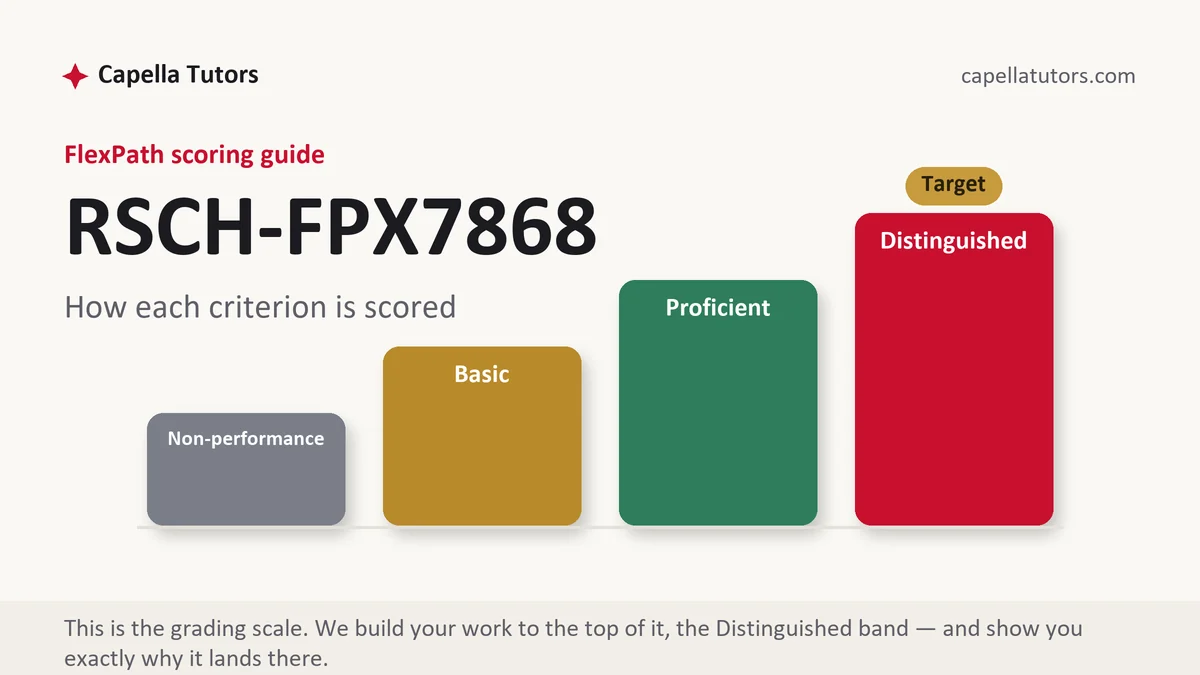
What RSCH FPX 7868 actually grades
This course grades whether your method could be followed by somebody else. Qualitative work is often assumed to be the softer half of the research core, and the criteria exist to correct that assumption: they ask for a question that genuinely needs words, a tradition chosen for a reason, a sampling logic stated in advance, a coding procedure documented step by step, and trustworthiness demonstrated through specific moves rather than promised in a paragraph. An analysis section reporting that themes emerged has told the evaluator nothing about how, and emerged is the most expensive verb in the course.
Question and tradition come first, and they have to agree with each other. Qualitative questions ask how people experience something, how a process unfolds over time, what meaning a group assigns to an event, or how one case works in its own context. Each tradition answers a different one of those. Phenomenology stays with lived experience and what participants share of it, splitting into descriptive work that brackets the researcher's assumptions and interpretive work that treats those assumptions as part of understanding. Grounded theory builds an explanation of a process out of the data, which commits you to theoretical sampling and constant comparison instead of a sample fixed at the start. Case study bounds a system and examines it from several sources. Generic qualitative description is legitimate as long as you name it and stop borrowing vocabulary from traditions you are not working in. Questions about how much or how often belong next door, to RSCH FPX 7860.
Sampling and data collection form the second strand, and the standards there are different from the quantitative ones rather than looser. No power calculation applies, so the argument is information power: a narrow aim, a sample selected for direct experience, strong theoretical grounding, and rich dialogue all let a smaller sample carry more. Purposive selection is the point, whether by criterion, maximum variation, or snowball, and every route needs its rationale written down. Six to eight open questions with planned probes, ordered from the concrete toward the abstract, nothing double-barrelled, and nothing that tells the participant which answer you want, since asking how the new policy frustrated you produces frustration while asking what it was like working under the new policy produces data.
Analysis and trustworthiness are the third strand and the one that separates the columns. A code labels a segment of data, a category groups codes that belong together, and a theme carries an analytic claim about meaning across the set, which is why a theme called communication is a topic rather than a finding. Name the analytic approach and cite it, because reflexive thematic analysis, codebook thematic analysis, and grounded theory coding rest on different assumptions. Then earn credibility, transferability, dependability, and confirmability with named actions: an audit trail of dated memos and codebook versions, triangulation across sources, peer debriefing, a deliberate search for negative cases, and description thick enough for a reader to judge transfer.
How we help in this course
Qualitative drafts leave this studio with an auditable spine. The tradition is named and cited, the sampling logic is argued in the language of information power, the coding path is shown from raw segment to code to category to theme, and each theme arrives with an analytic claim and one well-chosen quotation rather than a gallery of them. If you have transcripts we work from your data, keeping participant wording intact while stripping identifiers. If you do not, the sample is written as a plan whose procedure is specified tightly enough that you could run it.
Terms match the rest of the studio without exception. One premium original sample per deliverable in 24 to 48 hours, moved through an eight-person pipeline where one pass exists purely to confirm that every claim in the findings can be traced back to something in the data, and revised at no charge until the criteria are met. Faculty feedback returns into the same free cycle. That matters in qualitative work, where a lost criterion is usually a procedural gap you can document in an hour rather than an argument you have to rebuild.
The assessments, one by one
Assessment 1: Developing a Research Topic for Qualitative Studies
Develop a topic with background and rationale, write research questions, and compare qualitative methodological approaches for studying it. Read the full Assessment 1 manual.
Assessment 2: Research Theory for Qualitative Studies
Explain a theory that supports your qualitative study, its key elements, concepts, constructs, propositions and models, and how it supports the proposed research. Read the full Assessment 2 manual.
Assessment 3: Data Analysis Strategies for Qualitative Research
Plan the data collection process and the key elements of qualitative analysis, such as coding, themes and trustworthiness, for your study. Read the full Assessment 3 manual.
How to actually write RSCH FPX 7868: where to begin
Start with the criteria and the tradition in one sitting, since choosing a tradition after the question is written usually means rewriting the question. Copy each criterion into the draft as a heading with its Distinguished sentence, then write one paragraph explaining why your question needs qualitative data at all, and expect that paragraph to be graded. In current courserooms the assessments include "Developing a Research Topic for Qualitative Studies", "Research Theory for Qualitative Studies" and "Data Analysis Strategies for Qualitative Research" among others, and your scoring guide decides the exact format of each.
Then show a coding path instead of describing coding in the abstract. Say you have interviewed 14 school counselors about after-hours contact from families. Open coding produces segments labelled checking the phone at dinner, keeping a second calendar, feeling responsible for a crisis nobody reported. Those gather into a category, boundary management, which is still only a topic. The theme is the claim the whole set will support: counselors describe unpaid boundary work as proof of professionalism, which keeps the labour invisible to the people who schedule it. That sentence contains an argument, and every part of it can be traced to coded data.
Then decide in advance what saturation will mean for you and report where it happened. Saturation is a claim about your data rather than a word you place at the end of the method section, so define the criterion before collection begins: no new codes across three consecutive interviews and no new categories across five, for instance, with the last two interviews producing only confirmations of codes you already had. In grounded theory the criterion is theoretical: the categories explaining the process stop changing, which requires theoretical sampling. If you stopped because the timeline ended, write that instead and treat it as a limitation.
Then write reflexivity as method rather than as apology. Name your position, your prior relationship to the setting, and the assumptions you carried into the protocol, then show one specific decision that position shaped, such as the probe you added after an early interview or the code you split because your first label imported a judgment. Finish with the ethics qualitative work makes harder: small samples let colleagues recognise each other, a quotation can identify a speaker after the name is gone, and consent for a two-hour recorded interview should say what becomes of the recording.
| Section | What goes in it | What Distinguished looks like |
|---|---|---|
| Question and tradition | The question, why it requires qualitative data, and the tradition chosen with its primary citation. | Question and tradition aligned, with the traditions you rejected briefly accounted for. |
| Design and sampling | Setting, participants, purposive strategy, inclusion criteria, recruitment, and the information power argument. | Sample size justified by aim and richness, with theoretical sampling where the tradition requires it. |
| Data collection | The protocol or observation guide, its probes, the sequence, the recording method, and field notes. | Open questions free of leading wording, with probes matched to the constructs in the aim. |
| Analysis procedure | The named analytic approach, its steps, the coding decisions, and how codes became themes. | A traceable path from segment to code to category to theme, cited to the method's author. |
| Trustworthiness | Credibility, transferability, dependability, and confirmability, each with the action taken. | Specific moves reported, including negative case analysis and a dated audit trail. |
| Reflexivity, ethics and reporting | Positionality, consent, confidentiality with small samples, storage, and current APA reporting. | One reflexive decision traced through the analysis, with identifiability handled explicitly. |
Developing the synthesis
Synthesis in qualitative work means putting your findings into conversation with a literature that will not always agree with them, and the criteria reward the conversation rather than a list of matches. Locate two or three studies close enough to yours to argue with, then say where your themes converge with theirs and where they diverge, and explain divergence with something concrete: a different setting, another recruitment route, or a tradition with other assumptions. Resist the pull toward frequency as evidence, since a code appearing in twelve transcripts is not more true than one appearing in two, and the single negative case that will not fit your theme is often the most valuable thing in the dataset. Then be precise about transferability, because your job is to describe the context densely enough for a reader to judge whether it resembles theirs, not to assert that the findings generalize.
Citations that survive faculty review
Qualitative method claims go to the people who built the methods. Cite the primary methodologists rather than a summary chapter: Braun and Clarke for reflexive thematic analysis and its phases, Lincoln and Guba for the four trustworthiness criteria, Charmaz or Corbin and Strauss for whichever version of grounded theory you are running, Moustakas or van Manen for descriptive and interpretive phenomenology, Yin or Stake for the two competing case study logics. The Journal Article Reporting Standards for qualitative research in the current Publication Manual of the American Psychological Association state what a qualitative method section owes a reader, and the Standards for Reporting Qualitative Research and the consolidated criteria for reporting qualitative research both work as pre-submission checklists. Substantive literature comes from peer-reviewed qualitative psychology work located through PsycINFO, and reading two or three studies in your tradition end to end teaches more than any methods chapter. For ethics, cite the research standards of the Ethical Principles of Psychologists and Code of Conduct.
The mistakes that land Basic instead of Distinguished
- Themes that emerged. Passive discovery language hides the procedure the criteria are grading, and no credit exists for a finding whose derivation is invisible.
- Topics presented as themes. A heading naming a subject, with quotations stacked underneath, has organized the data without interpreting it.
- Quotation used in place of analysis. Three quotations in a row leave the reader to build the argument, which is the work you were supposed to show.
- Trustworthiness promised in the abstract. Claiming rigor with no audit trail, no triangulation, and no negative case reads as vocabulary rather than method.
- Traditions mixed without noticing. Bracketing your assumptions in one paragraph and theoretically sampling in the next borrows from two incompatible logics.
RSCH FPX 7868 questions students actually ask
How many interviews do I need?
Enough to answer your question, and the number has to be argued rather than looked up. Published work offers a rough orientation, with phenomenological studies often running from six to a dozen participants and grounded theory studies frequently needing twenty or more because the design keeps sampling until the categories settle. What earns the criterion is the reasoning: a narrow aim, a sample selected for direct experience of the phenomenon, interviews long enough to produce depth, and a stopping criterion you can show you met. A defended twelve beats an undefended thirty.
What is the difference between a code, a category, and a theme?
They sit at three levels of abstraction, and doing the middle one badly is what flattens a findings section. A code is a short label on a specific segment of data, close to the participant's own words. A category collects codes that share a subject, which makes it a filing decision rather than a finding. A theme states something about meaning that holds across the dataset, so it needs a subject and a verb, it needs to hold in more than one participant's data, and it should survive an attempt to disprove it from the transcripts. If your theme can be printed as a single noun, it is still a category.
Can I run thematic analysis on a phenomenological question?
Yes, provided you say which thematic analysis and keep the assumptions consistent. Reflexive thematic analysis treats the researcher as part of the interpretation and produces themes as analytic outputs, which sits comfortably beside interpretive phenomenology. A codebook approach with two coders and an agreement statistic assumes themes are waiting to be found reliably, which sits awkwardly beside a descriptive phenomenology asking you to bracket your assumptions. Name the version, cite its author, and describe the phases you actually performed. The failure faculty catch is a paper claiming phenomenology in the introduction, describing grounded theory coding in the method, and counting themes in the findings.
Qualitative design or analysis due?
Send the guide, the aim, and any transcripts or protocol drafts. The first premium sample is free, and its coding path is visible from segment to theme.