Send the deliverable with its scoring guide and a premium original sample lands inside 24 to 48 hours, written against the Distinguished descriptors printed in your own guide, with free revisions until the criteria are satisfied. Your transcript shows PSY FPX 7310, Biological Basis of Behavior, worth 2.5 program points, carried in the Sport Psychology specialization of Capella's FlexPath MS in Psychology, which is a non-licensure graduate degree. In Capella's catalog the course code is written PSY-FPX7310.
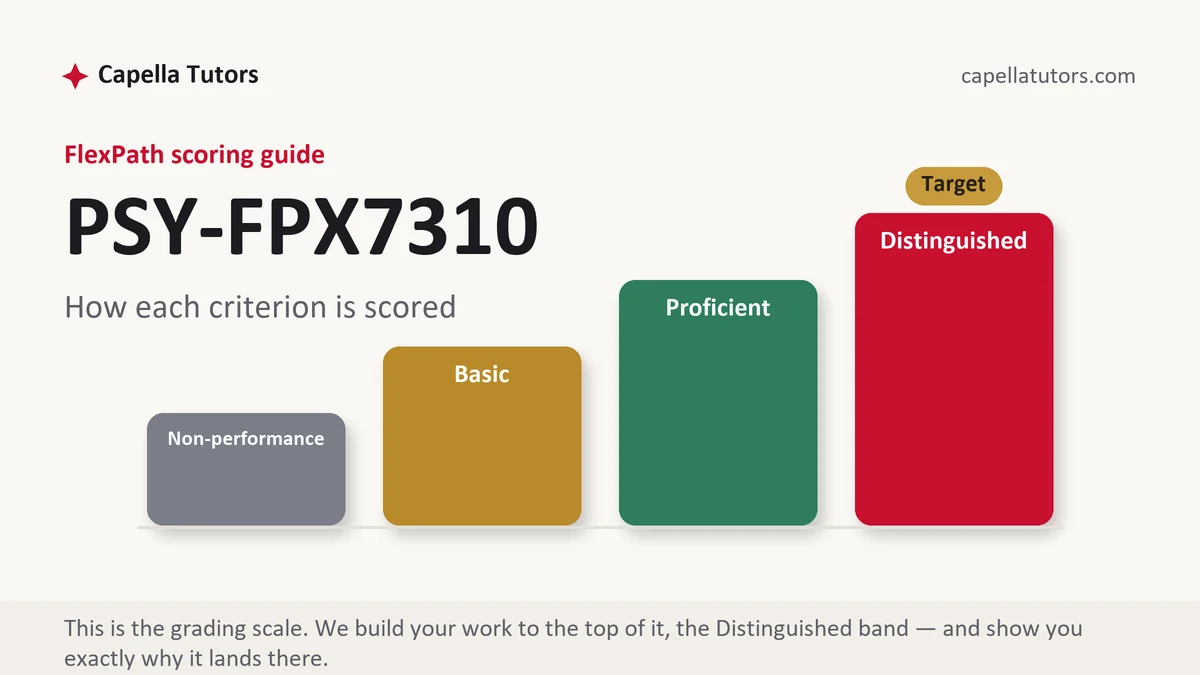
What PSY FPX 7310 actually grades
This course grades restraint. Biological explanation is the easiest place in psychology to overclaim, and the criteria are built to catch it. You are asked to describe a mechanism accurately, to name the method that produced the evidence, and to say what that method cannot support, and the third of those is where most of the available credit sits. A paragraph asserting that a brain region is responsible for a behavior, sourced to a study that observed a correlation between an imaging signal and a task, has failed the criterion however correct the anatomy happens to be.
The content runs from cells to systems. Resting potential, the action potential, synaptic transmission, reuptake and receptor subtypes are the base layer, and the drug and hormone arguments later in the course are unintelligible without them. Each transmitter system needs a specific rather than a folk description: dopamine as a signal about prediction error and effort rather than a pleasure chemical, serotonin as a modulator whose relation to mood is not the simple deficiency story that survives in popular writing, norepinephrine in arousal and vigilance, glutamate and GABA as the excitatory and inhibitory workhorses, and the endocannabinoids, which matter inside this specialization because they are the current candidate for what sustained exercise does to mood. The hypothalamic pituitary adrenal axis and cortisol handle the slow stress response, the autonomic branches the fast one, and heart rate variability is the number the sport literature reaches for when it wants an index of autonomic state.
Methods are graded as content in their own right. Functional imaging measures blood oxygenation, which is a slow and indirect proxy for neural activity, so it locates rather than explains, and it cannot be run backwards: activity in a region during a task does not establish that the task engaged whatever else that region has been associated with. Electroencephalography reverses the tradeoff, resolving events by the millisecond while locating them poorly. Lesion and stimulation work supports stronger causal statements in narrow circumstances. Animal models permit manipulations no human study could, at the cost of a species gap you have to name out loud. Heritability estimates describe how variance is distributed in a population and say nothing about any individual, which is the most common misreading in student papers on this material.
Because this course sits inside the Sport Psychology specialization, the applications lean athletic, and they are useful precisely because the evidence is mixed. Sleep is the strongest case: slow wave and rapid eye movement stages do different consolidation work, restriction degrades reaction time and mood reliably under laboratory conditions, and extension studies in athletes report performance gains from small and often uncontrolled samples. Exercise and neuroplasticity is the second case, where animal work on growth factors is strong, human trials are smaller and shorter, and one well known randomized trial in older adults reported a hippocampal volume difference on the order of one to two percent, which is a real result and a modest one. Fatigue is the third, where peripheral and central accounts have been argued for decades without resolution.
How we help in this course
Drafts for 7310 are written to the level of analysis they can support. Every mechanism claim carries the method that produced it, animal findings are labeled as animal findings, imaging results are described as localization rather than as explanation, and each section ends with the limit a careful reader would otherwise have to supply. Tell us the behavior your assessment specifies and we will build the chain from measure to mechanism to inference rather than asserting the middle and hoping nobody checks.
The delivery terms are the same ones every course here gets. A premium original per deliverable inside 24 to 48 hours, an eight-person pipeline in which one reviewer exists to confirm that each biological claim is stated at the strength its source allows, drafting to the top descriptor, and revisions free until the criteria are met, with faculty comments included. That matters in a course where a single overstated verb can pull an otherwise sound paper down two criteria, and where the repair is usually one rewritten sentence rather than a rewritten paper.
The assessments, one by one
Assessment 1
Explain a brain structure or neural circuit, such as the Papez circuit, its pathway and functions, and the behavioral and memory effects of its dysfunction. Read the full Assessment 1 manual.
Assessment 2: The Drive States
Explain the biological basis of motivational drive states such as hunger, thirst or sex, the brain and hormonal systems involved, and how they shape behavior. Read the full Assessment 2 manual.
Assessment 3
Explain a neurological disorder such as Alzheimer's disease, its effects on brain structure and function, the consequences for learning, memory and behavior. Read the full Assessment 3 manual.
How to actually write PSY FPX 7310: where to begin
Start with the scoring guide and turn each criterion into a heading before you read a single article. Then adopt a sentence template and use it every time you make a biological claim: the measure, the level of analysis, the inference the design permits. Written out, that produces sentences of the form, in a sample of this size this measure differed under this condition, which is consistent with this mechanism and does not establish it. The guide fixes the section list. The assessments in this course usually ask you to explain a biological mechanism and then relate it to a behavior with the evidence handled honestly.
Then practice honest reporting on a study small enough to hold in your head. The best known sleep extension work with athletes had players extend time in bed for several weeks and reported faster sprint times, better shooting accuracy and improved mood. Written badly, that becomes a claim that sleep extension improves athletic performance. Written properly, it becomes a claim that in a small sample of collegiate players, with no control group, no blinding and a measurement period that included ordinary training improvement, extended time in bed was followed by better performance on several measures, which is suggestive and not a controlled demonstration. The second version is two clauses longer and it is the version that scores, because it shows you can read a design.
Then police the verbs and the localization language. Activation is greater in a region, a region is recruited during a task, a signal correlates with a behavior: those are the sentences available to you. A region as the seat of a function, an area as responsible for an emotion, and a chemical as the cause of a mood are not. Watch for the reverse inference trap, where a region known to be active during pain turns up active during a social task and the paper concludes the task hurt. Watch the direction of effect in correlational imaging, where a structural difference between groups can be a consequence of the behavior as easily as a cause of it. And keep the levels apart, since a molecular finding does not license a claim about a person's motivation.
| Section | What goes in it | What Distinguished looks like |
|---|---|---|
| The behavior specified | The behavior or performance stated in observable terms, with the population it concerns. | A behavior narrow enough that a mechanism could plausibly account for it. |
| The mechanism | The cells, transmitters, structures or systems proposed, described accurately. | Mechanism described at one level, with the step from that level to behavior made explicit. |
| The evidence and its method | The studies, their designs, their samples, and the measures they actually used. | Human and animal work separated, with the strongest available design identified. |
| Inference limits | What the design cannot support, and the alternative explanation for the same result. | Limits written by you inside the section, not appended as a closing paragraph. |
| Application | What follows for practice, training or behavior if the mechanism holds. | An application scaled to the certainty of the evidence behind it. |
| References and mechanics | Current APA formatting, primary research for findings, reviews for orientation. | Original studies cited for results, with review articles used only to frame the question. |
Developing the synthesis
The runner's high is the ideal synthesis exercise in this course, because the popular explanation and the evidence have come apart. The endorphin story became common knowledge from studies measuring beta endorphin in blood after exercise, and the objection to it is physiological: peripheral beta endorphin does not readily cross into the brain, so a rise in plasma does not demonstrate a central effect on mood. The endocannabinoid account has better support, with circulating levels rising during moderate intensity exercise and rodent work in which blocking cannabinoid receptors removes behavioral effects that blocking opioid receptors leaves intact. That is stronger evidence and it is still not settled, since the human work is largely correlational, the intensity and duration that produce the effect vary between studies, and mood after exercise has social and expectancy components no assay measures. Write the paragraph in that order, the popular claim, the physiological objection, the better supported alternative, the residual uncertainty, and you have demonstrated exactly the appraisal the criteria describe.
Citations that survive faculty review
Primary research articles from behavioral neuroscience, psychophysiology and exercise science journals carry every finding in a 7310 paper, and PubMed alongside PsycINFO is where they are found rather than a general search. Review articles have one job, orienting you and defining the terrain, and they should be cited for the state of a question rather than for a result. Methods sources are worth citing directly whenever you make a limitation argument, because the papers that named the reverse inference problem are stronger support for your caution than a textbook aside. A current physiological psychology textbook is a legitimate citation for standard anatomy and for definitions, and it is not a citation for a contested effect. Press releases, science news summaries and popular books about the brain describe research without reporting it, and a paper leaning on them announces that the primary literature was never opened.
The mistakes that land Basic instead of Distinguished
- Chemical imbalance framing. Describing a mood state as a serotonin deficiency repeats a simplification the evidence abandoned, and evaluators in this course know it.
- Reverse inference. Concluding what a person experienced from which region showed activity runs the logic backwards, and it is the classic imaging error.
- Animal findings stated as human facts. A receptor blockade result in mice is strong evidence about mice, and the species gap belongs in the sentence rather than in a caveat at the end.
- Heritability read as personal destiny. A population variance statistic says nothing about any individual, and treating it as a forecast is a category error.
- A mechanism with no measure. Asserting that cortisol drove a behavior without saying what was sampled, when, and against which baseline is an unsupported claim in physiological clothing.
PSY FPX 7310 questions students actually ask
Can I write that low serotonin causes depression?
No, and knowing why is part of what the course is assessing. The simple deficiency account came from indirect evidence, mainly that drugs affecting serotonin transmission relieve symptoms in some people and that depleting a precursor can lower mood in people with a history of depression. Neither establishes a deficiency as the cause, treatment response does not identify a mechanism, and reviews of the direct evidence for a serotonin abnormality in depression have not supported it. The defensible sentence is that serotonergic signalling is involved in mood regulation and in the action of several antidepressants, while the causal account remains unsettled and current models work across several levels at once.
How do I write about an imaging finding without overstating it?
Describe the measure, then stop where the design stops. Say that the blood oxygenation signal differed between conditions in a named region, in a sample of a stated size, during a stated task. Do not say the region caused, controlled or represented anything, and do not infer a participant's experience from the location of a signal. Two additions raise the paragraph further: give the sample size, since small imaging samples produce inflated and unstable effects, and say what design would establish causation, usually a lesion, a stimulation or a pharmacological manipulation. The habit to build is writing the limitation into the same sentence as the finding rather than into a paragraph at the end.
Do I need a biology background for this course?
You need a working vocabulary and a method for checking yourself, not a prior degree. Learn the cell level material properly first, because everything above it depends on it: how a neuron fires, how a synapse transmits, what reuptake does, and what an agonist and an antagonist are. From there, look up each structure the first time you use it and write its function in your own words before citing anything, since a copied definition tends to arrive with a claim attached that you did not intend to make. The other half is reading discipline, which means checking the method section before believing the discussion.
Biological basis paper due?
Send the prompt, the guide and the behavior in question. The first premium sample is free, and every mechanism arrives with its method and its limits.