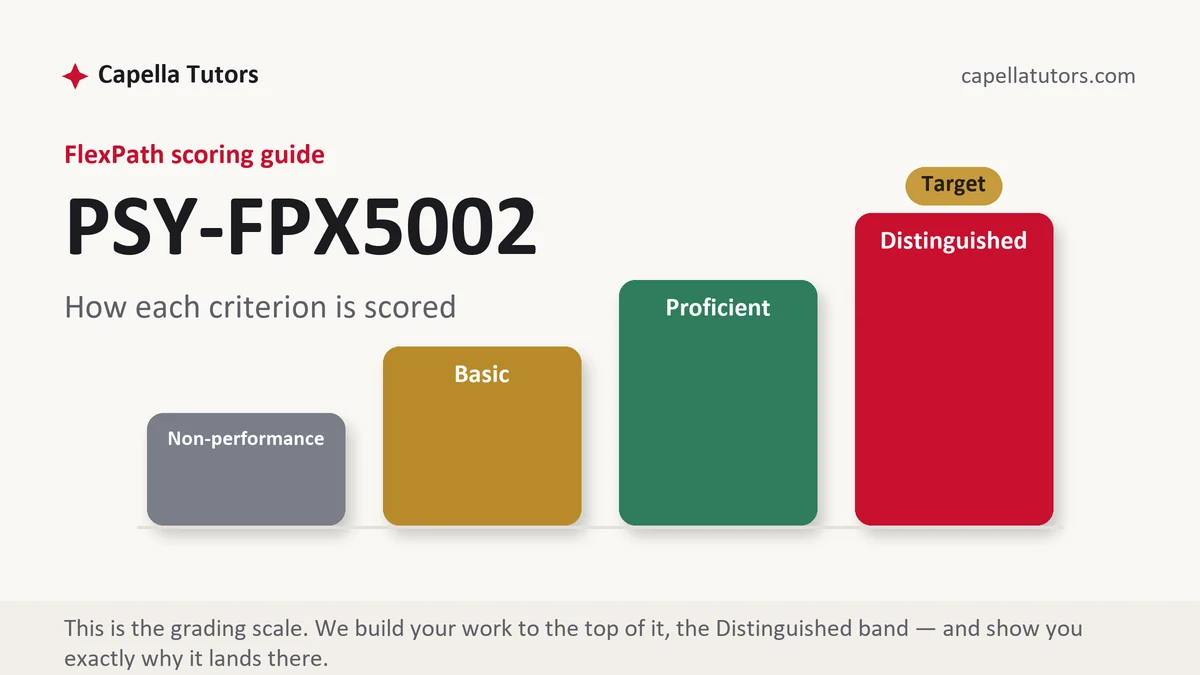
Send the deliverable with its scoring guide and any feedback you have already collected, and a premium original sample comes back inside 24 to 48 hours, written against the Distinguished descriptors your own guide prints, with revisions at no charge until every criterion is satisfied. The transcript line reads PSY FPX 5002, Foundations of Theory and Practice for Master's Psychology Students, worth 2.5 program points, a core requirement carried by all five FlexPath specializations in Capella's MS in Psychology, which is a non-licensure master's degree. In Capella's catalog the course code is written PSY-FPX5002.
What PSY FPX 5002 actually grades
The word foundations invites learners to treat this as an orientation module, and that misreading costs more credit than anything else in the course. The criteria are pitched at master's level from your first attempt. They ask you to handle published research as evidence with a design attached to it, to argue from a theory you have named rather than from general agreement, to produce current APA formatting without a template propping it up, and to say what a non-licensure psychology master's does and does not authorize. A paragraph that reports what four articles said, in the order the database returned them, is the most common Basic performance in the course.
Theory is the graded object rather than the backdrop. Keep four things apart: a theory explains why behavior happens, a model represents how parts relate, a framework organizes the variables you plan to study, and a hypothesis is a sentence a single study can refute. Behavioral, psychodynamic, humanistic, cognitive, biological, and sociocultural accounts each begin from a different assumption about where behavior comes from, so the higher scoring level goes to the learner who states that assumption before applying the lens and then admits what the lens cannot reach. Social learning belongs to Bandura's own statement of it, self-actualization to Maslow's, and a secondary source introduced with as cited in is an admission that the original was never opened.
The professional strand is graded harder than students expect, because most write it as a career essay. The MS in Psychology is non-licensure, which means the degree does not qualify you to practice independently, to present yourself as a psychologist, or to administer and interpret restricted instruments on your own authority. Write that boundary in plain sentences, then describe where the degree does travel: applied research and evaluation, program and instructional work, organizational and personnel functions, teaching support, and preparation for doctoral study. The ethical half runs on the American Psychological Association's Ethical Principles of Psychologists and Code of Conduct. Competence, informed consent, confidentiality and its limits, and multiple relationships are the standards most course scenarios turn on, and each carries a number you can cite instead of a value you can gesture toward.
The fourth strand is mechanical and cheap to lose. You are expected to search rather than browse, which means PsycINFO and PsycArticles with the peer-reviewed limiter set and search terms built from the constructs in your question instead of from its sentence. And you are expected to deliver a document that obeys the seventh edition unaided, from heading levels that step down in order to a reference list where every entry has a citation and every citation has an entry.
How we help in this course
Drafts for 5002 are built in the order the criteria are read. The theory gets named, its assumptions get stated, its limits get volunteered. Every claim resting on research carries the design and the sample that produced it, so a reader can see whether the claim has earned its verb. Sources are primary wherever a primary source exists, ethical reasoning cites the APA code by standard rather than paraphrasing its spirit, and the professional section states the licensure boundary in the register the rubric is grading. Tell us which of the five specializations you enrolled in and the sample argues from that specialization's literature instead of from general psychology.
The commercial terms are the studio's usual ones. A premium original sample per deliverable inside 24 to 48 hours, moved through an eight-person pipeline in which two separate passes exist to check citation integrity and seventh-edition mechanics before anything leaves, aimed at the top descriptor in your guide, with revisions free until it lands there. Faculty comments come back into the same cycle at no cost. That is worth more in a first course than learners assume, since faculty have two business days to evaluate a submitted attempt, and a resubmission spent on reference formatting is a week you had allocated to the next course.
The assessments, one by one
Assessment 1: Your Vision as a Multicultural Practitioner-Scholar
Describe your professional vision in psychology, your role as a multicultural practitioner-scholar, the background that shapes it. Read the full Assessment 1 manual.
Assessment 2: My Career in Psychology
Apply your vision and goals to a career path, explain how research shapes them, identify the professional competencies and requirements, and set an action plan. Read the full Assessment 2 manual.
Assessment 3
Refine your vision, goals and plans as a multicultural practitioner-scholar, covering research, supervision and ethical training, professional and ethical competencies. Read the full Assessment 3 manual.
How to actually write PSY FPX 5002: where to begin
Open the scoring guide before you open a search window and let it set the shape of the document. Paste each criterion into the draft as a heading, put the Distinguished sentence directly beneath it, and refuse to delete either until evidence is sitting under both. Read the verb in each criterion, because the verb fixes the depth you owe: describe wants an accurate account, analyze wants the parts separated and then related, evaluate wants a judgment with a stated standard behind it, and apply wants a theory doing work on a case rather than being defined near one. Your scoring guide decides the order and the section count. In current courserooms the assessments include "Your Vision as a Multicultural Practitioner-Scholar" and "My Career in Psychology" among others, and your scoring guide decides the exact format of each.
Then settle the difference between a summary and a synthesis, which is worth more of your grade here than any other single skill. A Basic paragraph gives each study its own sentence and its own verb. A Distinguished paragraph opens with the claim and then recruits the studies to it, saying what kind of evidence each one supplies. Watch the same three sources handled twice. Summarized, it reads: one study found a link between short sleep and working memory, a second reported the same association, a third did not. Synthesized, it reads: the association between short sleep and weaker working memory performance holds across cross-sectional undergraduate samples and thins out in the one longitudinal community sample, which is what you would expect if part of the effect is a same-day state rather than a stable difference between people. Same three studies, and only the second version contains an argument. Design and sample go in front of the finding every time.
Then read your sources in the order that protects you. Method first: how many participants, recruited from where, measured with which instrument, under which design. Results second. Discussion last, and read that section the way a hostile reviewer would, since the standard overreach in psychology writing is a correlational study whose discussion recommends a program. Keep the verb honest when the source enters your paper, because associated with, predicted, and caused are three different claims and the design decides which one you may use.
| Section | What goes in it | What Distinguished looks like |
|---|---|---|
| Framing the question | The topic narrowed to a question with defined constructs, and the reason it matters inside your specialization. | Constructs defined precisely enough that a reader could find the same literature you found. |
| The literature located | Peer-reviewed sources described by design and sample, not only by conclusion. | Sources grouped by what they establish, with the weakest evidence labeled as weak. |
| The theory applied | One named theory, its assumptions, and the case or problem it is being used to explain. | The theory explains something specific, and its blind spot is stated by you rather than found by faculty. |
| Ethical reasoning | The scenario, the standards it engages, the competing obligations, and the decision you defend. | APA standards cited by number, with the harder of the two obligations acknowledged. |
| Professional identity and scope | What the non-licensure degree permits, the settings that use it, and the competencies you will build next. | The scope limit written plainly, and the plan tied to skills this program actually develops. |
| APA mechanics and references | Seventh-edition formatting, heading levels, in-text citations, and a matched reference list. | A reference list that survives a two-way check, with primary sources wherever primary sources exist. |
Developing the synthesis
Synthesis at master's level means holding several studies inside one sentence and saying what the set amounts to. Choose a question in your specialization where the literature disagrees, and disagreement is not hard to find: whether mindset instruction transfers beyond the classroom it was taught in, or whether grit predicts anything conscientiousness has not already predicted. Then explain the disagreement structurally instead of declaring a winner. Sample composition, how the construct was operationalized, the length of follow-up, and whether the study was preregistered account for most of the inconsistency you will meet in this literature. A paragraph ending in an unresolved position with a stated reason reads higher than one that manufactures an agreement the field does not have.
Citations that survive faculty review
Three kinds of source carry this course. Peer-reviewed psychology journals, reached through PsycINFO, PsycArticles, and the Capella library rather than a web search, support anything you claim about how people behave, and only empirical articles can support a claim about a particular effect. Primary theory sources carry the theoretical strand, which means the original statement of whatever theory you apply, cited under its own year, since a date from the 1940s or the 1970s is information rather than a mistake. Authority documents govern the remainder: the Publication Manual of the American Psychological Association in its current edition for mechanics, the APA Style site for cases the manual leaves open, and the Ethical Principles of Psychologists and Code of Conduct for every ethical claim, cited by standard number. Student-facing summary sites, encyclopedia entries, a course textbook standing in for the study it describes, and undated pages with no named author all read as evidence that the search stopped early.
The mistakes that land Basic instead of Distinguished
- A literature section built one study per paragraph. Faculty read that layout as a reading log, and the synthesis criterion is scored against the claim your paragraphs never made.
- A theory named and then abandoned. Defining a theory in paragraph two and never using it on the case is the difference between mentioning and applying.
- Ethics answered with values instead of standards. Writing that confidentiality matters, without the standard that governs its limits, scores as opinion.
- Secondary attribution for a primary idea. Citing a textbook for a theory whose original paper sits in the library tells an evaluator which of the two you read.
- A reference list that does not match the text. Entries with no citation, and citations with no entry, cost the APA criterion on their own no matter how strong the argument was.
PSY FPX 5002 questions students actually ask
Can I write in the first person in a psychology paper?
Yes, and the seventh edition prefers it when you are describing what you did or where you stand. Write I selected these three studies rather than the studies were selected, since the passive version hides the person making the choice and the criteria are grading your choices. Two limits still apply. The editorial we, meaning people in general, is out, because it smuggles in agreement you have not demonstrated. And first person does not license anecdote: your experience can frame why a question matters, it cannot serve as the evidence that answers it.
How current do my sources have to be?
Treat five years as the working rule for empirical support and then break it deliberately. Three exceptions are defensible and expected. The original statement of a theory is cited by its own date, because provenance is the point of that citation. The paper that developed an instrument stays current for as long as the instrument is in use. What faculty penalize is not an old date, it is an old date supporting a claim about the present when newer work exists.
The assessment asks about my professional identity and I do not have one yet. What do I write?
Write the boundary, the setting, and the next competency, in that order. Start with what a non-licensure master's in psychology permits, which is applied and analytic work rather than independent clinical practice. Name two settings that actually employ the specialization you chose, described concretely enough that a reader believes you looked. Then commit to two competencies this program builds that those settings pay for, such as reading measurement evidence before adopting an instrument, or writing an evaluation question a stakeholder can answer. Identity in this context means a defensible scope plus a direction, not a feeling about your career.
First master's deliverable due?
Send the prompt, the scoring guide, and your specialization. The first premium sample is free, and it arrives with its theory named and its sources primary.