Post us the prompt, the guide and the issue you have been assigned, and a premium original sample comes back inside 24 to 48 hours, written to the top descriptors in that guide, with free revision until the criteria are satisfied. Your record will read PSY FPX 6020, Advocacy in Child and Adolescent Development, worth 2.5 program points, part of the Child and Adolescent Development specialization inside Capella's FlexPath MS in Psychology, a non-licensure graduate degree. In Capella's catalog the course code is written PSY-FPX6020.
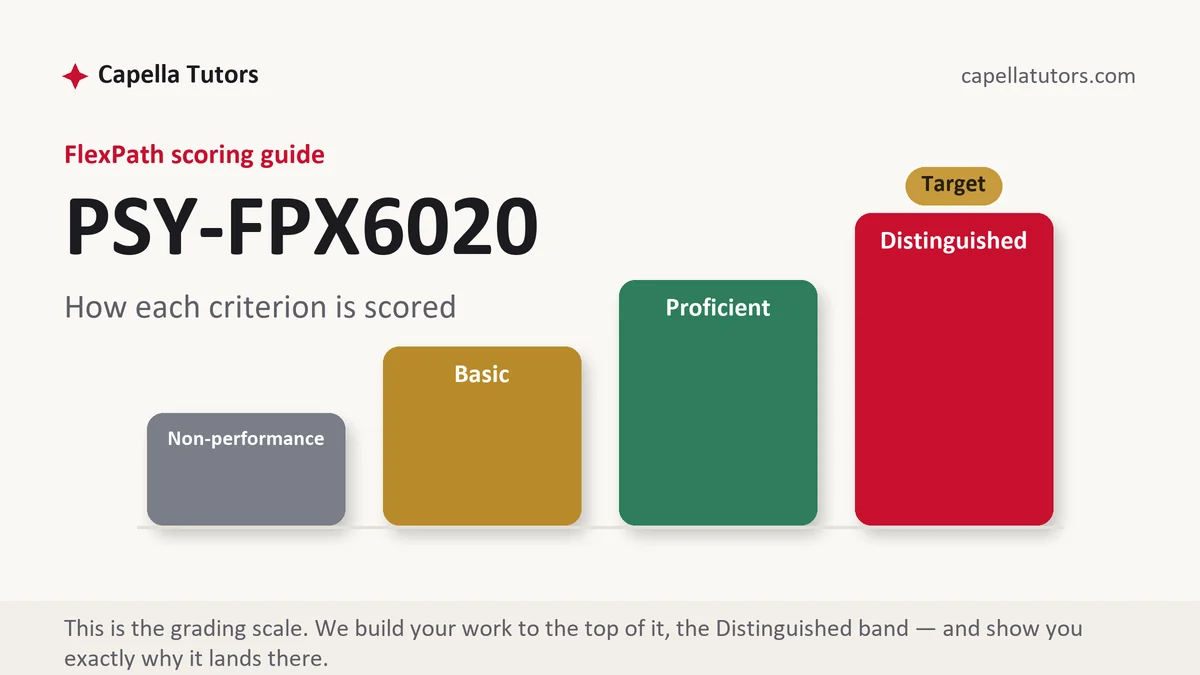
What PSY FPX 6020 actually grades
This is the course where developmental knowledge has to become a request. The criteria are not asking whether you care about children, and they are not asking for another literature review with a hopeful closing paragraph. They are asking whether you can put a specific proposal in front of a named person who has the authority to say yes, in language that person uses, at a moment when the decision is actually being made. Two kinds of draft fail here for opposite reasons. One is written entirely in conviction and never states what anyone should do. The other summarizes twelve studies competently and then asks for awareness, which is not an action anybody can fund, schedule or vote on.
The craft being graded has parts, and each of them tends to be its own criterion. There is the decision, which means the concrete thing that could change: a line in a budget, a rule out for comment, a bill in committee, a district policy, a staffing pattern at an agency. There is the decision maker, who is a person or a body with a name rather than the government or society. There is the venue and its calendar, since a request that arrives after a budget is adopted or after a comment period closes has failed on timing alone. There is the ask, which needs an actor, an action, an amount and a date. And there is the coalition, because decision makers count support as well as read arguments, and a proposal with three named allies is a different object from the same proposal with none.
The evidence strand is graded harder in this course than students expect, because advocacy is where overstatement is most tempting and most expensive. The criteria want developmental research used as a warrant for the specific claim you are making, with the effect at the size the research reports. They also want the problem quantified with a denominator, since a count of affected children means nothing until a reader knows out of how many, over what period, and how the category was defined. Administrative data usually exist for this and are usually better than a national estimate, because a school board responds to its own district's numbers in a way it will not respond to a national figure.
The fourth strand is the ethics of speaking on behalf of people who cannot appear at the hearing. Children and adolescents are the subject of these proposals and almost never the audience, which puts an obligation on the writer that the criteria do check. A story about a child requires the guardian's permission and the child's own assent, in terms the child can follow, with identifying detail removed and a clear statement of where the material will appear. Professional confidentiality does not lift because the purpose is worthy, and reporting obligations for suspected harm stay in force. Where youth participation is part of the plan, the paper should say what actual power young people hold in it, because inviting adolescents to a panel and then deciding without them is a familiar failure this literature has a name for.
How we help in this course
Samples for 6020 are written from the decision backward. We name the body that can act, the instrument it would act through, and the calendar it works to, then build the ask with a cost and a date attached. The problem is quantified with a denominator and a local source wherever one exists, the evidence carries the effect size the study actually reported, and the opposition gets a paragraph in which its strongest objection is stated fairly and answered. Tell us your state, your county or your district and the sample will use that jurisdiction's structures rather than a generic reference to policymakers.
Studio terms do not change for this course. One premium original deliverable per assessment inside 24 to 48 hours, built by eight people from the source pull to the final read, with one pass reserved for checking that every number carries a denominator and a citation. Revisions are free with no limit, and faculty feedback comes back into the same cycle at no charge, which is worth planning around because faculty have two business days to evaluate a submitted attempt and an advocacy deliverable returned for a missing cost figure is a week you did not need to lose.
The assessments, one by one
Assessment 1: Bronfenbrenner's Theory on Development
Explain bioecological theory and its systems, how it applies in practice, and how it informs advocacy for children and adolescents today. Read the full Assessment 1 manual.
Assessment 2: The Microsystem, Mesosystem and Development
Analyze two children's cases through the microsystem and mesosystem, compare them, and explain the effects on development. Read the full Assessment 2 manual.
Assessment 3: Advocacy Action: An Outreach to the Community
An Outreach to the Community: a community outreach on a child welfare policy such as the Child Abuse Prevention and Treatment Act, with goals, planned action. Read the full Assessment 3 manual.
How to actually write PSY FPX 6020: where to begin
Read the guide and identify the audience before you identify the topic, because in this course the audience determines the document. A brief for a legislative aide, testimony for a public hearing, a memo for an agency director and an education piece for parents are four different genres with different lengths, different evidence conventions and different tolerances for technical language. In current courserooms the assessments include "Bronfenbrenner's Theory on Development", "The Microsystem, Mesosystem and Development" and "Advocacy Action: An Outreach to the Community" among others, and your scoring guide decides the exact format of each. Write the audience and the decision at the top of your draft and check every paragraph against them.
Then convert your issue into an ask that could be granted. Watch the difference on one example. The weak version says the county should invest more in early childhood mental health, which no one can act on and no one can refuse. The strong version reads: the county board should fund two full-time early childhood mental health consultants, at a stated annual cost including benefits and travel, assigned to the 34 subsidized child care centers in the two districts with the highest rates of removal from care, beginning with the fiscal year that opens in July, with the program reporting removals per 100 enrolled children each quarter to the board's health committee. Every element in that sentence is doing work. The actor can vote. The amount can be checked. The population is bounded. The metric is something the centers already record, which matters because a metric that requires new data collection is a second request hiding inside the first. And the date attaches the request to a real decision point instead of to a wish.
Then handle the money argument carefully, since it is the argument decision makers respond to and the one most often written badly. Return-on-investment figures for early childhood programs circulate widely and are frequently quoted at their most flattering, and a graduate paper is expected to know why the numbers vary so much. The largest ratios come from a small number of intensive demonstration programs run decades ago with small samples, serving children in circumstances that differed from today's, and delivered at a staffing intensity most current programs do not match. The ratio also depends heavily on the discount rate applied to benefits that arrive twenty or thirty years later, which is an assumption rather than a finding, and a benefit stream valued at three percent looks very different at seven. So write the cost case in the form that survives scrutiny: the cost of your proposal this year, the cost of the current situation this year in the same units, the evidence that the response reduces the problem and by how much, and the assumptions behind any longer-term figure you cite. A modest claim you can defend is worth more than a large one an analyst can dismantle in a hearing.
Then write for the venue and finish with the objection. Briefs put the ask in the first paragraph, keep paragraphs short, use a small table rather than a paragraph for anything numeric, and stop. Testimony is spoken, so it needs a plain opening that says who you are and what you want, one number, one concrete illustration, and a thank you inside the time limit. Both need a named opponent's best argument answered on its own terms, whether that is cost, precedent, existing staff capacity or evidence quality. Then check the language once for advocacy inflation: crisis, epidemic and devastating are words a reader discounts, and every one of them can be replaced with the figure that made you want to use it.
| Section | What goes in it | What Distinguished looks like |
|---|---|---|
| The issue defined | The problem stated as a measurable condition affecting a specified group of children or adolescents. | Counts with denominators, periods and definitions, drawn from the jurisdiction being addressed. |
| Decision and decision maker | The body with authority, the instrument it would use, and the point in its calendar you are aiming at. | A named body and a real instrument, with the timing tied to an actual decision date. |
| The ask | Actor, action, amount, population, start date, and the measure that will show it worked. | An ask that could be granted as written, using data the target already collects. |
| Evidence warrant | The developmental and evaluation research supporting this response, with designs and effect sizes. | Effects reported at their published size, with the weaker evidence labeled by the writer. |
| Cost and opposition | Current-year cost, cost of inaction in the same units, and the strongest objection answered. | Discount and intensity assumptions declared, and the objection answered rather than dismissed. |
| Ethics, allies and references | Permissions for any personal material, the coalition, and current APA in text and list. | Consent and assent documented, identifying detail removed, allies named with their standing. |
Developing the synthesis
The synthesis this course asks for is a position on what to do when the need is urgent and the evidence is thin, which is the situation most child advocacy actually faces. The honest structure separates three claims that advocates habitually merge. The first is that a harm exists and is documented, which is often the strongest thing you have. The second is that a particular response reduces that harm, which is usually supported by a smaller and weaker body of work than the first. The third is that the response is worth its cost, which depends on assumptions you can list. Keeping them apart lets you write a defensible argument in a weak evidence environment: the harm is established, the proposed response is the best supported of the available options, the effect expected is modest, and here is how we would know within two years whether to continue. The alternative, which is to borrow the certainty of the first claim for the second, wins some hearings and costs more than it wins, because a decision maker who discovers that your central number was the most favorable available discounts everything else you bring, including the parts that were solid.
Citations that survive faculty review
Four kinds of source carry an advocacy deliverable and they are not interchangeable. Peer-reviewed developmental and evaluation research, reached through PsycINFO, ERIC and the Capella library, is the only support for a claim that an intervention works, and each study enters the text with its design and its sample. Law and regulation are cited as legal authority, which means the statute, the section and the year rather than a summary of it, since a proposal that misstates what a program is already required to do fails in front of anyone who administers it. Public administrative data from state education agencies, health departments, courts and census products supply the local numbers, cited with the collection year and the exact indicator, because two similar-sounding indicators often count different children. Professional and agency guidance from pediatric, early childhood and behavioral health bodies establishes what the field recommends, cited with the issuing organization and the edition. Advocacy organizations are useful for locating a figure and are not the citation for it: follow the footnote to the study or the dataset and cite that. Then run current APA both ways, and verify that every number in the document appears with the same value everywhere it appears.
The mistakes that land Basic instead of Distinguished
- An ask with no actor. A recommendation addressed to policymakers cannot be granted, and the criterion is grading whether it could be.
- Counts without denominators. A number of affected children with no population, period or definition attached is unusable in a hearing and unscoreable in a rubric.
- The best available figure quoted as the typical one. A return ratio taken from the most favorable study invites an analyst to reject the whole proposal.
- A child's story used without permission. Consent, assent and de-identification are conditions rather than courtesies, and confidentiality obligations from work do not lift.
- No opposition paragraph. A plan that has not answered its strongest objection reads as unfinished to anyone who has sat on the other side of the table.
PSY FPX 6020 questions students actually ask
Is advocacy the same thing as lobbying?
No, and a graduate paper is expected to know which one it is proposing. Advocacy is the broad activity of arguing for an interest, and it includes public education, professional testimony, coalition work, media, and the ordinary business of putting evidence in front of people who make decisions. Lobbying is a narrower legal category that covers attempts to influence specific legislation, it is defined differently at the federal and state level, and organizations that hold charitable tax status face limits on how much of it they may do and reporting obligations when they do it. Practically, this means an advocacy plan written for a nonprofit needs one sentence naming the category of each activity it proposes, and a plan that recommends unrestricted legislative campaigning for an organization that cannot legally run one has failed on feasibility rather than on values.
How long should a policy brief be, and what goes in it?
Unless your guide says otherwise, write it to be read in three minutes by someone who is not going to reach the second page. The ask goes in the first paragraph with its cost and its actor, because a reader who has to hunt for what you want will decide you do not know. Then the problem in numbers, with a denominator and a source. Then the evidence that this response addresses that problem, at the size the research actually reports. Then the objection a reasonable opponent will raise and your answer to it. Then who else supports the request, since a decision maker is counting rather than reading. Length is set by your scoring guide and by the venue, and a two-page brief with a table beats a six-page paper with a literature review every time.
Can I use a child's story in an advocacy piece?
Only with permission, only with the identifying detail removed, and only where it is doing work the numbers cannot. A parent or guardian has to agree, the child's own assent should be sought in language they understand, and both should be told where the material will appear, because a public hearing and a course assignment are different exposures. Strip the school name, the neighborhood, the diagnosis if it is not the point, and anything that would let a local reader identify the family. Then check that the story is illustrating a documented pattern rather than substituting for one, since a single case used as evidence invites the reply that it is unrepresentative. If the material came to you through work, professional confidentiality applies whatever the parent says, and reporting obligations for suspected harm are not suspended because you are writing about it.
Advocacy deliverable due?
Send the prompt, the guide and your jurisdiction. First premium sample free, with a real ask, a real cost and the objection already answered.