Hand over the assessment prompt and the scoring guide and a premium original sample is back with you inside 24 to 48 hours, written to the Distinguished descriptors in that guide, with free revision for as long as it takes to land there. The transcript entry is PSY FPX 6010, Human Prenatal Development, worth 2.5 program points, part of the Child and Adolescent Development specialization in Capella's FlexPath MS in Psychology, which is a non-licensure graduate degree. In Capella's catalog the course code is written PSY-FPX6010.
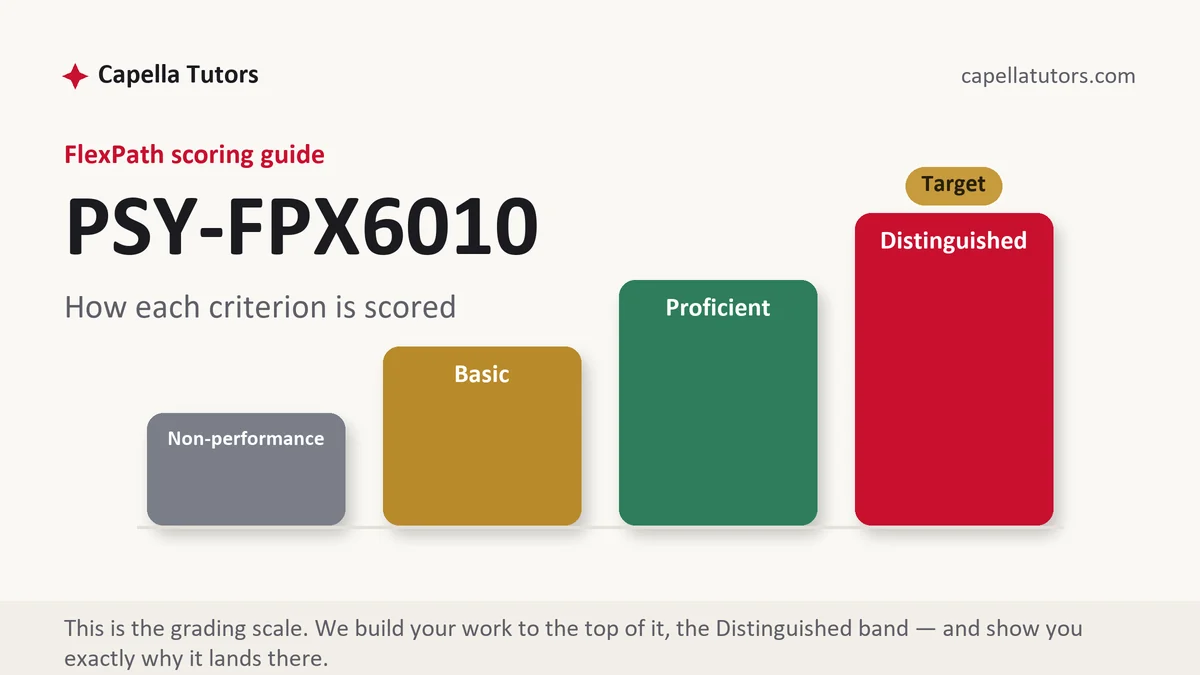
What PSY FPX 6010 actually grades
The first thing the criteria test is whether you can write time precisely, and it is the strand that separates competent papers from vague ones before any argument begins. Two clocks run through this literature. Clinical dating counts from the first day of the last menstrual period, and embryology counts from fertilization, and the difference between them is roughly two weeks. A paper that writes at six weeks without saying which clock has given a reader nothing to check. The staging itself is graded too: the germinal weeks of cell division and implantation, the embryonic period in which the organ systems are laid down, and the long fetal period of growth, differentiation and functional maturation that follows. Get the sequence and the reference point right and the rest of the paper has somewhere to stand.
The second strand is teratology, and it is a set of principles rather than a list of substances. Susceptibility depends on timing, so the same agent produces structural damage during organ formation and functional or behavioral effects later, which is why the embryonic weeks carry the highest risk of malformation while the fetal months carry risk to growth and to the developing nervous system. Susceptibility depends on dose, and the dose that matters is the amount reaching the embryo rather than the amount consumed. Susceptibility depends on genotype, both the pregnant person's and the embryo's, which is why exposed pregnancies produce a range of outcomes rather than a single one. Neural tube closure inside the first month after fertilization is the standard demonstration of a narrow window, and it is the reason adequate folate has to be in place before a pregnancy is usually recognized rather than after.
The third strand is the evidence problem, and it is the intellectual centre of the course. No review board will assign a pregnant participant to a suspected harm, human subjects regulation treats pregnant participants, fetuses and neonates as a category needing additional protection, and the consequence is that almost the entire human literature on prenatal exposure is observational. Exposures arrive with company: tobacco travels with income and with other substances, alcohol travels with tobacco, stress travels with housing insecurity and with the quality of care available afterward. The criteria reward a writer who names the confound instead of hoping the reader misses it, and who knows which designs push back against it, which are sibling and within-family comparisons, dose-response gradients, natural experiments created by famine or by policy, and animal work read for mechanism rather than for a human dose.
The fourth strand is outcome measurement, where imprecision costs whole rows. Gestational age and birth weight are separate variables and conflating them is the most common error in submitted work: preterm means born before 37 completed weeks, low birth weight means under 2,500 grams, small for gestational age means below the expected weight for the number of weeks completed, and an infant can be any one of those without being the others. Screening and diagnosis are also separate, and a positive screen is a change in probability rather than a finding. The criteria expect you to hold those distinctions while writing about developmental risk, because a paper that treats a screen as a diagnosis has misinformed the reader it was written for.
How we help in this course
Samples for 6010 are written with the clock declared in the first paragraph and held for the whole document. Every exposure claim carries its window, its dose relationship and the confound the design could not remove. Every outcome is named with the variable that defines it, so weeks are weeks and grams are grams. Where the assessment asks for guidance or education material, the sample writes risk as probability with a comparison group rather than as a warning, since that is what the higher descriptors describe. Tell us the population your specialization work sits in and the sample argues from studies of that population rather than from a general chapter.
Commercial terms follow the studio's standard pattern. One premium original sample per deliverable inside 24 to 48 hours, built by eight people from the literature pull through to the final proofread, with one pass reserved for verifying that every gestational figure in the document uses the same reference point. Revisions are unlimited and free. FlexPath lets you submit an attempt the moment the work is ready rather than on a fixed date, so the practical value of a fast turnaround is that it converts an idle week into a graded one, and anything faculty send back re-enters our cycle at no cost.
The assessments, one by one
Assessment 1
An informational overview of a prenatal testing or screening method for expectant parents, with its benefits, limitations and the role of genetic counseling. Read the full Assessment 1 manual.
Assessment 2
A white paper on a teratogen, covering exposure routes, developmental risks across prenatal periods, implications and ways to minimize exposure. Read the full Assessment 2 manual.
Assessment 3: Topical Expert Presentation
Present research on a prenatal or postnatal topic, such as outcomes for infants of adolescent mothers, as an expert to an audience, with evidence and recommendations. Read the full Assessment 3 manual.
How to actually write PSY FPX 6010: where to begin
Open the scoring guide first and convert it into headings, then write your dating convention at the top of the document where you will keep seeing it. Mark which criteria want a mechanism, which want an evaluation of evidence, and which want something written for a non-specialist reader, because those three want different sentence styles and mixing them is why strong material lands in the middle columns. The assessments in this course usually ask you to explain a developmental process, appraise the evidence on an exposure or a screening practice, or produce guidance for a family or a practitioner, and your scoring guide decides the form and the sections. Anything in your draft that is true of development in general rather than of the period you were asked about belongs somewhere else.
Then take one exposure and carry it to the end, since depth on one earns more than coverage of six. Say the criterion asks you to explain how prenatal alcohol exposure affects development. The Basic answer is that drinking during pregnancy harms the baby, which no reader can act on. The graduate answer separates the components. It states that the outcomes sit on a spectrum rather than in a category, with growth restriction, a specific pattern of facial features and central nervous system involvement making up the classic presentation while the majority of affected individuals do not show the facial pattern at all. It attaches each component to a window, since the facial features arise from exposure during a narrow early period of craniofacial development while effects on the nervous system can arise across gestation, which is why the timing of drinking changes the presentation and not the presence of risk. It states the dose relationship honestly, including that heavy and binge patterns carry the clearest evidence and that no threshold has been established below which risk is known to be absent, which is the reason official guidance is abstinence rather than moderation. Then it names the measurement problem, which is that exposure is nearly always self-reported and under-reported, and the recall problem biases estimates downward rather than upward. One exposure, four components, and every row the criterion asked for is answered.
Then handle probability the way a graded risk-communication section demands, with arithmetic rather than adjectives. Screening deliverables in this course turn on one counterintuitive fact, which is that a very accurate test for a rare condition still produces many false alarms. Work an illustrative case with your assumptions stated. Suppose a condition occurs in about 1 in 1,500 pregnancies, and a screen detects 99 percent of affected pregnancies while wrongly flagging 1 in 1,000 unaffected ones. Out of 1.5 million pregnancies, roughly 1,000 are affected and about 990 of those screen positive, while about 1,499 of the unaffected pregnancies also screen positive. That means a positive result is correct only about four times in ten, and the correct next sentence in any counselling material is that a positive screen indicates further diagnostic testing rather than a confirmed finding. Numbers change with prevalence and with the test, so state your assumptions and cite the performance figures you used. That paragraph is worth more than any amount of careful phrasing about anxiety.
Then write the language as carefully as the evidence, because this course grades it. Current style asks for the person before the condition and for description before judgment, so a paper writes an infant with prenatal opioid exposure and neonatal withdrawal rather than an addicted baby, and a pregnant person who used a substance rather than an abuser. Where you write about a real family, remove anything that identifies a workplace, a clinic or a partner, and keep out material you learned in confidence that the criteria do not require. Then close the loop on evidence: every claim about a person's outcome should be traceable to a study of comparable people, and where your source studied animals or a different exposure level, say so in the sentence rather than in a limitation paragraph at the end.
| Section | What goes in it | What Distinguished looks like |
|---|---|---|
| Period and dating | The developmental period addressed, with the clock named and the weeks specified. | One dating convention declared and honored, with borrowed figures converted rather than copied. |
| The process or exposure | The biological process, or the agent, its route, its dose relationship and its window. | Timing and dose separated, with the mechanism stated rather than the outcome restated. |
| Evidence and design | The studies behind each claim, their designs, their samples and their confounds. | Convergence argued across designs, with the unresolvable confound named by the writer. |
| Outcomes and measurement | The outcome variables defined, with gestational age, weight and screening results kept distinct. | Definitions used consistently, and a screen described as a probability rather than a result. |
| Application or guidance | What a family, clinician or program should do, and the reasoning a reader can follow. | Risk expressed as numbers with a comparison group, and the next step named rather than implied. |
| Language and references | Non-stigmatizing terminology, protected detail removed, current APA both ways. | Person-first phrasing throughout, with authoritative guidance cited by body and year. |
Developing the synthesis
The synthesis worth writing here is about how far the developmental origins argument can be pushed. The claim that conditions before birth shape adult health rests substantially on cohorts nobody designed, and the famine cohorts are the strongest of them, because a short, severe and geographically bounded shortage assigned exposure by calendar rather than by choice and left records good enough to identify who was in which trimester. Those cohorts report that timing mattered, which is exactly the fingerprint a developmental mechanism should leave. What they cannot do is isolate one pathway, since a famine changes nutrition, stress, infection and family circumstances at once, and the outcomes being measured are decades downstream. Molecular work adds mechanism and also adds ambition faster than it adds evidence, since human epigenetic findings are usually measured in accessible tissue rather than in the organ of interest, and the association between a methylation pattern and a behavior is not proof that the pattern produced it. Take a position: the developmental origins framework has good evidence that early conditions matter and thinner evidence for any specific molecular route, and a paper that says so precisely reads stronger than one that says either less or more.
Citations that survive faculty review
Four source types carry a prenatal deliverable, and each has a job. Peer-reviewed obstetric, pediatric and developmental journals, reached through PubMed, PsycINFO and the Capella library, support every empirical claim about an exposure or an outcome, and each enters your sentence with its design and sample. Embryology and human development reference texts supply staging, timing and anatomical sequence, which is the one place a current textbook is the correct citation rather than a shortcut. Authoritative guidance documents from the public health agencies and the professional colleges supply what practice currently recommends, and they are cited with the issuing body and the year, because recommendations on screening and on substance use have moved and will move again. Animal studies are citable for mechanism and must be labeled as animal studies in the sentence that uses them. What fails review is the pregnancy internet: advice sites, supplement marketing, wellness posts, and secondhand summaries of studies you could open yourself. Then check current APA in both directions and confirm that every gestational figure in the reference list means what your text says it means.
The mistakes that land Basic instead of Distinguished
- Weeks written without a reference point. A figure that could mean either clock cannot be verified, and the timing criterion is scored on verifiability.
- An exposure blamed with its confounds unmentioned. Observational evidence carries the exposure's social circumstances, and a paper that ignores them overstates the effect.
- An animal dose imported as a human one. Species, route and exposure level all have to be carried across or the citation misleads.
- A positive screen written as a diagnosis. The arithmetic of rare conditions makes that error consequential rather than merely imprecise.
- Stigmatizing description. Language that names the substance before the person costs the professional communication row on its own.
PSY FPX 6010 questions students actually ask
The assessment names a stage of gestation. Which weeks am I actually writing about?
Decide which clock you are using and say so in the sentence, because the two clocks in this field run about two weeks apart. Clinical dating counts from the first day of the last menstrual period, so a pregnancy described as ten weeks along in a chart is roughly eight weeks past fertilization. Embryology counts from fertilization, which is the clock the staging tables and the teratology literature use. Neither is wrong and mixing them inside one paper is. Write postmenstrual weeks or postconception weeks the first time you give a number, keep that choice for the whole document, and convert any figure you borrow from a source using the other convention rather than importing it unchanged.
May I use my own pregnancy history as the case?
You can, and it is worth deciding what the paper gains before you do. Personal material is useful for framing a question and for describing a clinical encounter honestly. It is not evidence about how development works, and a criterion asking for research support will not accept it as such. If you use it, write it as one case, keep out identifying detail about a partner, a clinician or an employer, and hold the analytic claims to the literature rather than to what you remember being told. If the material is difficult, write about someone else. A course deliverable is not worth revisiting a loss in order to satisfy a rubric row you could satisfy with a published case series.
How do I write about a prenatal exposure when the research cannot randomize it?
Say the design out loud, then build the case out of convergence rather than out of one study. No ethics board will assign a pregnant participant to a suspected harm, so the human evidence is observational and arrives with the exposure's social company attached. What raises confidence is a pattern: a dose gradient, an effect concentrated in the developmental window the mechanism predicts, sibling or within-family comparisons that hold family circumstances constant, natural experiments created by a policy or a shortage nobody chose, and animal work that supplies the mechanism while being labeled as animal work. Write the convergence in one paragraph and name the confound you cannot rule out. That paragraph is usually the difference between the middle columns and the top one.
Prenatal development paper due?
Upload the prompt, the guide and the exposure or screen in question. First premium sample free, back in 24 to 48 hours with the windows, the doses and the design limits all in place.