Hand over the evaluation deliverable, its scoring guide, and whatever program paperwork you may share. A premium original sample returns inside 24 to 48 hours, argued against the Distinguished wording your own guide prints, revised at no charge until every criterion clears. The transcript line reads PSY FPX 5140, Program Evaluation, worth 2.5 program points, a specialization course in the Educational Psychology track of Capella's MS in Psychology, taught in FlexPath inside flat 12-week billing sessions where two courses may run at once. In Capella's catalog the course code is written PSY-FPX5140.
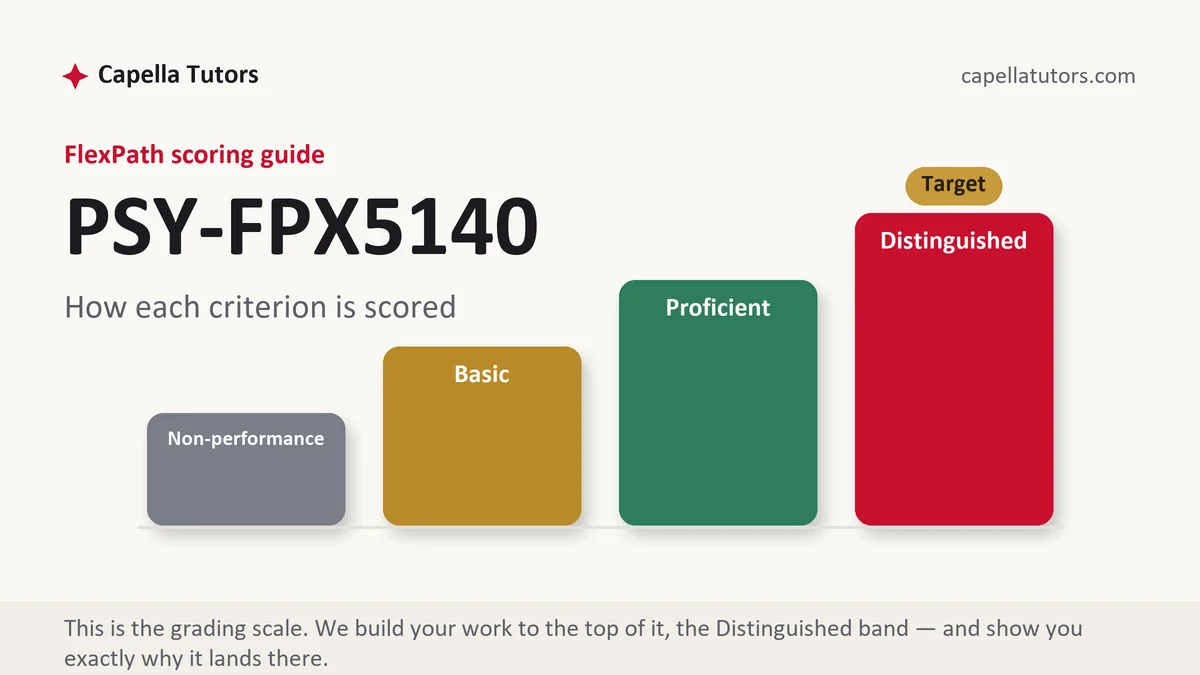
What PSY FPX 5140 actually grades
The first thing graded here is whether you can tell evaluation apart from research. A research question asks whether a kind of intervention works for people in general. An evaluation question asks whether this program, in this building, with this staff and this budget, is doing what somebody funded it to do, and it answers to a person who has a decision on a calendar. The learner who writes a literature review with a program bolted on has answered a question nobody asked.
The program logic is the load-bearing element. You lay out inputs, the activities those inputs pay for, the outputs those activities produce, and then short, intermediate and long-term outcomes, each linked to the next by a claim you are willing to defend. Confusing an output with an outcome is the most common error in submitted work: sessions delivered, tutors trained and families contacted are outputs, and none of them is evidence that anybody learned anything. Michael Scriven's distinction between formative and summative purposes decides what your report is for, Daniel Stufflebeam's CIPP model gives you context, input, process and product as four separable objects of evaluation, and Michael Quinn Patton's utilization-focused position adds the test that matters most in practice, which is whether a named person will use the finding. Attribute those to their authors rather than to a textbook that summarizes them.
Design is the second graded strand, and the criteria are realistic about what schools permit. Random assignment is usually unavailable, so the question becomes which rival explanations survive your design and whether you said so. A single group measured before and after is vulnerable to maturation, to history, to regression toward the mean when entry was based on low scores, and to the fact that children get better at reading across a school year whether or not you tutor them. A matched comparison group, an interrupted time series with enough pre-period points to establish a trend, or a comparison of change across participants and non-participants each buy back part of that credibility. Name the comparison and say where those people stop resembling your participants.
The fourth strand is propriety, graded as procedure rather than as good intentions. The Program Evaluation Standards from the Joint Committee on Standards for Educational Evaluation organize the field into utility, feasibility, propriety and accuracy, and the American Evaluation Association's guiding principles cover what you owe participants and the public. The person who pays for the evaluation is rarely the person whose data you are reading, so write down who receives the report and who was promised anonymity. Student education records are governed by the Family Educational Rights and Privacy Act, and the office that interprets it is the district's rather than yours, so confirm the disclosure route before requesting a file. A table cell holding four students identifies those students to anyone in the building, and suppressing it is competence.
How we help in this course
Evaluation drafts leave this studio with their logic visible. The program is written as a chain from resources to outcomes with the weak link marked, each evaluation question has a decision attached, the design states the threat it could not remove, and every rate carries the denominator and the window that produced it. Tell us the program's size, how participants entered it, what the site already measures, and which of the two purposes your report serves.
Delivery follows the studio's standard clock. One premium original sample per deliverable inside 24 to 48 hours, moved through an eight-person pipeline in which one reader does nothing but recompute the numbers and check the narrative against the tables, aimed at the top descriptor in your guide, then revisions at no cost until it lands there. Returned faculty comments re-enter the same cycle free. Faculty have two business days to evaluate an attempt, so a resubmission spent on a mislabeled outcome is a week you had reserved for the next course.
The assessments, one by one
Assessment 1: Needs Assessment Document
Propose a needs assessment for a community program, with stakeholders and outcomes, program procedures, the proposed evaluation. Read the full Assessment 1 manual.
Assessment 2
The middle deliverable in Program Evaluation usually turns your plan into a design: the comparison you will use, the outcome measures and their windows, the records and instruments the data will come from, the fidelity information that tells a reader whether the program actually happened, and the. Read the full Assessment 2 manual.
Assessment 3
The closing deliverable in Program Evaluation usually asks you to report findings and recommend action, written for the person who commissioned the work rather than for a grader: the results with their denominators and windows, the comparison and the uncertainty around it, the fidelity picture. Read the full Assessment 3 manual.
How to actually write PSY FPX 5140: where to begin
The scoring guide decides the architecture, so read it before you read anything about the program. Each criterion becomes a heading, the Distinguished sentence sits directly beneath it, and nothing gets deleted until evidence is standing under both lines. Read the verb first, because design wants a defensible plan, analyze wants findings taken apart, and recommend wants an action with an owner. The assessments in this course usually ask for some combination of a program description, a logic model, a set of evaluation questions with their design and data sources, and a report of findings written for a stakeholder rather than for a grader. Your scoring guide decides how many sections that becomes and how much weight each one carries.
Then do the comparison arithmetic, because it separates a report from an opinion. An after-school literacy program enrolls 180 third and fourth graders across four campuses. On the district benchmark, the share of participants meeting grade level rises from 41 percent in the fall to 53 percent in the spring, a gain of 12 points, and a draft that stops there has credited the program with a whole year of instruction. Bring in the non-participating students in the same grades at the same campuses, who moved from 39 percent to 46 percent, a gain of 7 points. The difference between the two changes is 5 points, which on 180 participants is about nine additional children reaching benchmark, and that is what the program can plausibly claim. Then say the uncomfortable part: entry was by teacher referral, so the groups were never equivalent at baseline, and referral could bias the estimate in either direction.
Then fix the denominator before you write a rate. Of the 180 enrolled, 118 attended 20 sessions or more, and 63 of those 118 reached benchmark, which is 53 percent and is the figure a director will want on the cover. Count every enrolled student instead, adding the 18 of the remaining 62 who reached benchmark anyway, and you have 81 of 180, or 45 percent. Both are true and they answer different questions, so report both, label which is intention to treat and which is dose based, and give the window as fall benchmark to spring benchmark of one academic year.
Then write the recommendation as something a director could start on Monday: what changes, who owns it, what it costs in staff hours, what should move, and when you would check. Separate the two failures that look identical in a results table. A theory failure means the program ran as designed and the outcome did not follow. An implementation failure means the outcome did not follow because half the intended sessions never happened. Recommending redesign for what was really an attendance problem is the most expensive mistake available here.
| Section | What goes in it | What Distinguished looks like |
|---|---|---|
| Program and setting | What the program does, who it serves, how participants enter, how long it has run, and what it costs. | Entry route described precisely, because it decides which comparison is available later. |
| Stakeholders and questions | Who commissioned the work, who is affected, and the questions each group needs answered. | Every evaluation question tied to a decision a named person is waiting to make. |
| Logic model | Inputs, activities, outputs and staged outcomes, with the assumption behind each arrow. | Outputs and outcomes kept strictly apart, with the weakest link in the chain identified by you. |
| Design and data sources | The comparison, the measurement points, existing records to be used, and the fidelity data. | The strongest feasible comparison, with the surviving rival explanation named rather than hidden. |
| Findings | Results with denominators, windows, subgroup counts, and the fidelity picture beside them. | Program change reported net of what happened without the program, with uncertainty attached. |
| Use, reporting and ethics | Who gets the report, in what form, plus consent, confidentiality, and small-cell handling. | Standards cited by name, an unfavorable finding reported plainly, and a use plan with dates. |
Developing the synthesis
Synthesis in an evaluation paper means using the outside literature to set an expectation for your own program rather than to decorate the introduction. Take the program type you are evaluating, ask what the accumulated evidence predicts, then ask why published results for that type scatter so widely. Implementation usually explains more of that scatter than program choice does, which is why fidelity data belongs in a findings section instead of an appendix. The counterfactual matters just as much, since a tutoring program compared against nothing looks stronger than the same program compared against the small-group instruction it replaced. An evaluator who reports a smaller effect than the literature and explains it structurally reads as more competent than one who reports a larger effect and celebrates.
Citations that survive faculty review
Four kinds of source do the work here. The standards documents govern the practice: the Program Evaluation Standards from the Joint Committee, the American Evaluation Association's guiding principles, and the Centers for Disease Control and Prevention framework for program evaluation, which is public, citable, and clearer on stakeholder engagement than most textbooks. Method sources carry your design decisions, meaning an evaluation text such as Rossi and Lipsey's Evaluation: A Systematic Approach, and Patton's Utilization-Focused Evaluation when your criterion is whether the finding gets used. Substantive evidence about your program type comes from peer-reviewed work located through ERIC, PsycINFO and the Capella library, with American Journal of Evaluation, Evaluation and Program Planning and Educational Evaluation and Policy Analysis the outlets an evaluator is expected to know. Program documents are legitimate primary sources when cited as what they are, so a grant application or an attendance export gets named and dated rather than quietly absorbed into your prose.
The mistakes that land Basic instead of Distinguished
- Outputs presented as outcomes. Sessions delivered answers how busy the program was, and the outcome criterion is scored against a change in the people it served.
- A pre-post design with no comparison and no confession. When maturation and history are both live explanations, name them, because faculty will.
- Stakeholders listed and never consulted. A table of interested parties with no question traced back to any of them fails the utility standard.
- Findings reported without fidelity. A null result from a program that delivered half its planned sessions is a fact about attendance.
- The unwelcome finding softened. An evaluator who edits a result to protect a sponsor has traded the one thing the role is for.
PSY FPX 5140 questions students actually ask
The program I picked has no outcome data. Can I still evaluate it?
Yes, and two legitimate moves exist. The first is an evaluability assessment, which asks whether the program is coherent and stable enough to be judged at all, and produces a logic model, a list of what is currently measured, and the gaps that would have to be filled first. The second is a process evaluation, which asks whether the program is being delivered as designed, and answers with attendance, dosage, staffing, reach and fidelity checks rather than with test scores. Both score well when you say plainly which questions your evidence can answer. What loses credit is writing an outcome evaluation without outcome data and hoping the section reads as one.
Do I need a control group to get Distinguished?
You need the strongest comparison the setting allows, plus an honest account of what it leaves open. Rank the options and take the highest one available: random assignment where a waiting list already exists, a matched comparison built on the same baseline measure, a comparison of trends between participants and similar non-participants, an interrupted time series if the site has several years of one measure, and a single-group pre-post design only when nothing else can be had. If you land on the last option, use dose-response patterns as supporting evidence, because a stronger result among students who attended more sessions is at least consistent with the program having done something.
What do I do when the findings make the program look bad?
Report them, then make the report useful. Separate a program that did not work from a program that never happened, since those two conclusions carry opposite recommendations. Give the sponsor the context that belongs with a negative result, meaning how much of the intended service was delivered, whether the comparison group received something similar, and how precise your estimate is. Then pitch recommendations at the level the finding supports, which might be to fix attendance and re-evaluate in a year rather than to close the program. Faculty grading a propriety criterion are looking for the student who did not flinch.
Evaluation plan or report due?
Send the guide, the program you chose, and anything the site already measures. The first premium sample is free, and its logic model separates outputs from outcomes.