Send the prompt with its scoring guide and a premium original sample returns inside 24 to 48 hours, argued to the Distinguished descriptors your guide prints, and revised free until the criteria are met. The transcript entry is PSY FPX 6840, Current Issues in Sport Psychology, 2.5 program points, a Sport Psychology specialization course in the FlexPath MS in Psychology at Capella, taken inside a non-licensure master's degree. In Capella's catalog the course code is written PSY-FPX6840.
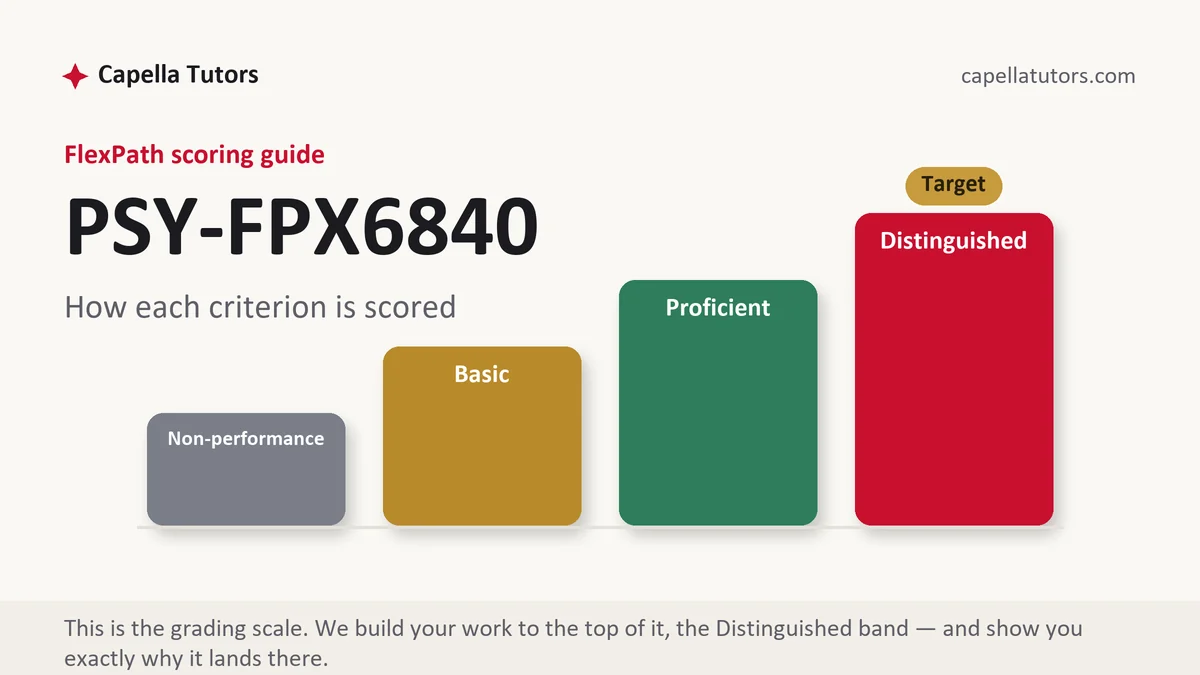
What PSY FPX 6840 actually grades
This is the course where you are graded on how you handle disagreement. The subject matter is deliberately unsettled, so the criteria cannot reward the right answer and instead reward the quality of the argument: an issue framed precisely, the strongest available version of each position, an appraisal of the evidence behind both, and a stated position with the conditions under which you would abandon it. A paper that picks a side in its first paragraph and spends the remainder collecting support is the standard Basic performance here, and it is easy to spot, because the opposing literature shows up only in a sentence conceding that some researchers disagree.
The issues themselves rotate, and the criteria are indifferent to which one you choose as long as it is live. Athlete mental health is the largest cluster, taking in prevalence claims, screening programs, help seeking and the pathways an athletics department is expected to have. Head injury supplies a second cluster, running from graduated return to play protocols through to the long term questions the evidence has not closed. Safeguarding covers abuse in sport and the reporting structures built after it. Energy availability, training load and sleep make up the physiology adjacent cluster. Identity, social media and the transition out of sport cover most of the rest, and access to services, which is distributed unevenly by competitive level and by money, is the issue students overlook most often.
Underneath every topic sits a methodological argument this course expects you to make. Sport and exercise psychology publishes many small studies, and small studies with flexible analysis produce findings that shrink when somebody repeats them. Ego depletion is the example worth knowing: a heavily cited effect, a large coordinated replication effort, and a pooled estimate near zero, which is not proof the phenomenon does not exist but is proof the original literature was overstating it. Preregistration, registered reports, power calculations and reported confidence intervals are the corrective, and noting whether a study did any of them is one of the fastest ways to demonstrate appraisal instead of summary.
Prevalence and screening claims carry arithmetic of their own, and running it separates a graduate paper from a briefing. Take an athletics department screening 1,000 athletes for a condition that genuinely affects 15 percent of them, using a tool with 85 percent sensitivity and 80 percent specificity. Of the 150 athletes who have the condition, about 128 screen positive. Of the 850 who do not, another 170 screen positive. That is 298 positive screens of which fewer than half are cases, so a positive result means a follow up conversation and never a label. Put that calculation in your paper and the screening debate stops being about good intentions, because the false positives, the staff hours spent resolving them and the trust an athlete loses after being wrongly flagged all become part of the argument.
How we help in this course
Papers we write for 6840 are built as arguments with both sides sourced. The issue gets narrowed to a claim rather than a topic, the opposing position is written from its own literature and at its strongest, the evidence on each side is appraised by design and sample size, and the position at the end carries the condition that would overturn it. Empirical questions and value questions are kept apart, because most current issues in sport mix the two and the criteria reward the paper that says which part data could settle.
Terms are unchanged from the rest of the studio. One premium original deliverable in 24 to 48 hours, an eight-person pipeline in which a reader checks every prevalence figure for its denominator and its window before delivery, written at the Distinguished descriptor, revisions free until it scores, and faculty comments handled inside the same cycle at no charge. Since faculty have two business days to evaluate a submitted attempt, a position paper returned for a weak counterargument is a manageable delay rather than a lost week.
The assessments, one by one
Assessment 1
The first deliverable in Current Issues in Sport Psychology is where you learn to narrow a controversy, and the assessment usually asks you to take a live dispute, frame it as a claim somebody could deny, and appraise the evidence on both sides before you commit to anything. Read the full Assessment 1 manual.
Assessment 2: Diversity in Sport Psychology
Examine multicultural competence in sport psychology practice, a diversity issue in sport such as representation in coaching, and the ethical considerations. Read the full Assessment 2 manual.
Assessment 3: Ethics in Sport Psychology
Explain what sport psychologists do, examine an ethical issue such as the use of biofeedback technology, and set out best practices to prevent ethical problems. Read the full Assessment 3 manual.
How to actually write PSY FPX 6840: where to begin
Take the scoring guide apart before you choose the issue, because some issues cannot satisfy some criteria. Each criterion becomes a heading, the Distinguished sentence goes underneath it, and the issue you select has to be one where a real literature exists on both sides. Then narrow it until it is a claim. Athlete mental health is a topic, while universal preseason mental health screening in collegiate athletics does more good than harm is a claim, and that is the difference between a paper that can be argued and one that can only be described. Your scoring guide decides the required sections. In current courserooms the assessments include "Diversity in Sport Psychology" and "Ethics in Sport Psychology" among others, and your scoring guide decides the exact format of each.
Then write the other side properly, which is the technical skill this course is really teaching. Find the strongest published version of the position you do not hold, state it in a form its own authors would accept, and give it its evidence rather than a summary of its conclusion. Then separate the two kinds of claim inside the dispute. Whether a screening program detects more cases than it misses is empirical, and a study can settle it. Whether a department should require screening as a condition of participation is an ethical and policy question about autonomy and consequences, and no dataset closes it. Papers that treat a values disagreement as a factual one read as though the writer never understood the argument, and papers that treat a factual question as a matter of opinion give the appraisal criterion away.
Then discipline the numbers. Every prevalence figure needs three things before it may appear: the population it came from, the window it covers, and the instrument that produced it. One in three athletes reporting symptoms above a screening cut off in one elite cohort is not the same claim as one in three athletes meeting diagnostic criteria, and the gap between those two sentences is where most citation errors in this course live. Consensus statements are useful and they are not studies, so cite them for what a body agreed and the primary work for what was found. When you use a systematic review, report how many studies it included and how consistent they were, since a pooled estimate drawn from six small trials that disagree deserves a hedge that a pooled estimate from thirty does not.
| Section | What goes in it | What Distinguished looks like |
|---|---|---|
| The issue as a claim | The dispute narrowed to a proposition somebody could disagree with, and why it is live now. | A claim specific enough that evidence could bear on it, with the stakes named concretely. |
| The case for | The strongest supporting evidence, described by design, sample and size. | Support graded rather than stacked, with the best available study identified as the best. |
| The case against | The opposing position in the form its own authors state it, together with its evidence. | An opposing case an opponent would sign, not a version built in order to lose. |
| Methodological appraisal | Sample sizes, power, preregistration, replication history, and the quality of the measures. | Findings weighed by how they were produced, with replication status stated where it exists. |
| Position and conditions | The stance you take, the reasons for it, and the evidence that would change it. | A position that separates the empirical part of the dispute from the part about values. |
| References and mechanics | Current APA formatting, with consensus documents and primary studies cited for the right things. | Prevalence figures carrying population, window and instrument every time they appear. |
Developing the synthesis
Synthesis in a current issues paper means explaining why competent researchers reading the same field reach different conclusions. Take screening for mental health symptoms in college athletics. Advocates point to under detection, to low rates of help seeking among athletes, and to the fact that a screen creates a moment when a conversation can happen. Opponents point to modest positive predictive value whenever a condition is uncommon, to the staff capacity a program consumes once the follow up appointments arrive, to the risk that a flagged athlete is treated differently by a coach who should never have seen the result, and to the absence of trials showing that screening improves outcomes rather than detection rates. Both sides are reading real evidence. The disagreement is structural, turning on prevalence in the population being screened, the operating characteristics of the instrument, whether a treatment pathway exists behind the screen, and how much weight is given to autonomy against early detection. Explain it that way, take a position with a condition attached, and the analysis criterion is answered.
Citations that survive faculty review
The source families in this course are ordered by what each one can prove. Systematic reviews and meta-analyses map the state of a question and belong in appraisal sentences, cited with the number of studies they included. Primary empirical articles support every specific finding, and their design decides which verb you are allowed. Consensus statements and position stands from bodies such as the International Olympic Committee, the professional psychology associations and the sports medicine organizations establish what experts agreed and what practice they recommend, which is exactly what a policy argument needs and is not evidence of an effect. Journalism has one legitimate use, establishing that a controversy exists and how it is being discussed, and it can never support a claim about an effect. Preprints may be cited if you label them as not yet peer reviewed, and a study you have only read about in a news article is a study you have not read.
The mistakes that land Basic instead of Distinguished
- A counterargument written to lose. A one sentence concession before returning to your own case tells an evaluator you never engaged the other literature.
- A prevalence figure with no denominator. One in three means nothing without the population, the window and the instrument that produced it.
- A consensus statement cited as evidence of an effect. It records what a panel agreed, which is a different claim from what a study found.
- A values question answered with data. Whether participation should be conditional on screening is an argument about autonomy, and no sample size settles it.
- No replication check on a headline finding. Citing a famous effect without asking whether it held up is the specific failure this course exists to correct.
PSY FPX 6840 questions students actually ask
How do I take a side without writing an opinion piece?
Attach the position to a condition. An opinion says screening should be required. An argued position says the balance favors targeted screening in this population on these three grounds, and would shift toward universal screening if a trial showed better outcomes rather than better detection, or toward no screening if follow up capacity stayed unfunded. That sentence does two things at once: it commits, and it shows the reasoning is answerable to evidence. Faculty are not grading your conclusion. They are grading whether the conclusion follows from the appraisal in front of it.
A source says one in three athletes has a mental health problem. Can I use it?
Only with the sentence that makes it interpretable. Find out who was measured, how many of them, in which country and at which competitive level, across what window, with which instrument, and whether the figure describes symptoms above a screening cut off or diagnoses made by a clinician. Those two numbers differ widely in the same population, because a screening tool is designed to over-include. Then write it as a measured claim: in a sample of this size at this level, this proportion scored above the cut off on this instrument during this period. If your source does not supply those details, it is a summary of something else, and the thing it summarized is the citation you want.
My topic is one where the politics are louder than the science. How do I handle it?
Stay inside the methodology and the ethics, and leave the reader to do their own politics. Say what is measured, what the measurements support, where the data run out, and which part of the disagreement is about values rather than facts. Represent each position from published sources rather than from commentary, keep the language neutral and specific, and avoid rhetorical questions, which read as advocacy. A paper closing on a defensible boundary between what evidence shows and what a community has to decide scores higher than one that reaches a satisfying conclusion by leaving out the inconvenient literature.
Position paper due?
Send the prompt, the guide and the issue. The first premium sample is free, and it arrives with both sides sourced and the numbers checked.