Share the prompt, the guide and whatever the course has already returned to you, and a premium original sample follows inside 24 to 48 hours, written against the Distinguished language in your own guide, with unlimited free revision until it lands there. Your record shows PSY FPX 6110, Learning Theories in Psychology, worth 2.5 program points, taken on the General Psychology specialization of Capella's FlexPath MS in Psychology, a graduate degree that carries no licensure. In Capella's catalog the course code is written PSY-FPX6110.
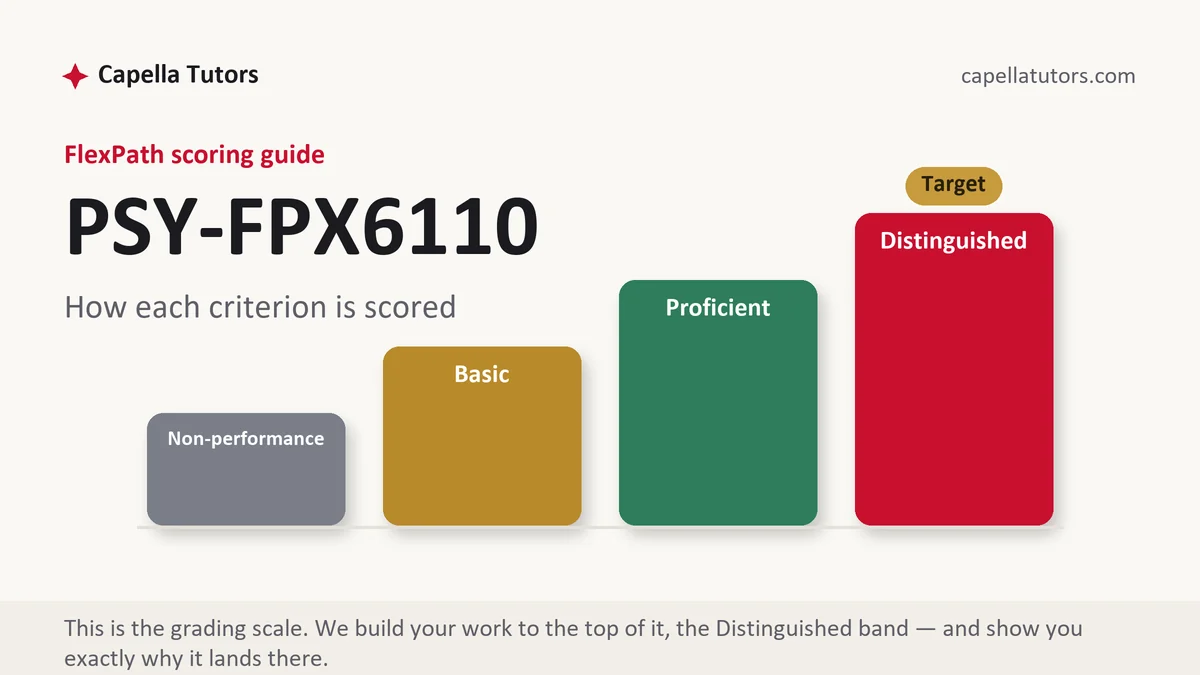
What PSY FPX 6110 actually grades
This is a precision course disguised as a survey. The vocabulary is familiar enough that most learners assume they already own it, and the criteria are built to find out whether they do. Reinforcement is not a synonym for reward, punishment is not a synonym for unpleasant, and negative does not mean bad. Each of those terms is defined by what happens to the behavior afterward, which makes them empirical labels rather than descriptive ones. A paper that uses them loosely will not recover the analysis rows, because every later claim inherits the error.
The conditioning strand is graded on mechanics. Learning by association, where a signal comes to elicit a response the outcome already produced, is a different process from learning by consequence, where a behavior changes in frequency because of what follows it, and the criteria expect you to know which one your case involves before you name a theorist. Within the second process, the mechanics have real predictive content: intermittent and unpredictable reinforcement produces behavior far more resistant to extinction than reinforcement on every occasion, removing a reinforcer usually produces a temporary increase before the decline, an extinguished response can reappear after a break without any retraining, and shaping means reinforcing successive approximations rather than waiting for the finished behavior. Those facts let you predict what a case will do next, which is what a graduate criterion means by applying a theory.
The cognitive and social strand is graded on two distinctions students routinely lose. The first is between learning and performance: a capability can be acquired and not displayed, which is why an adolescent who has learned an aggressive routine by watching one may show it only when the situation makes it worth showing, and why a training evaluation that measures behavior during the session has not measured learning. The second is between a specific expectation and a general feeling. Confidence about a named task under stated conditions predicts effort and persistence on that task; a general sense of being capable predicts much less, and the criteria notice which one your paper is claiming. Observational learning has components worth writing separately, since attention, retention, the ability to reproduce the behavior and the motivation to do so can each fail on their own.
The fourth strand is application, and this course has the best-evidenced applied literature in psychology to draw on. Spaced practice beats massing, retrieving material beats rereading it, mixing problem types beats blocking them, and each of those has been tested in enough settings to be worth building a plan on. Assessments here often ask for exactly that kind of plan, and your scoring guide decides the form, whether that is an analysis, an intervention design, a training proposal or an evaluation. The graded difference is whether the plan specifies a measurable target, a schedule with intervals, a delayed measure and a maintenance strategy, or whether it describes an activity and hopes.
How we help in this course
Samples for 6110 are written contingency first. Every behavioral claim is set out as antecedent, behavior and consequence with the direction of change stated, so the labels in the paper are earned rather than assigned. Observational and cognitive accounts arrive with their components separated, self-efficacy claims are written as task-specific expectations, and any instructional recommendation carries the retention evidence behind it with the effect at the size the research reports. Tell us the setting, whether that is a classroom, a clinic, a training function or your own study habits, and the sample is built around behavior that actually occurs there.
Delivery works the way it does across the studio. One premium original sample per deliverable inside 24 to 48 hours, built by eight people from the source pull to the last proofread, with one pass reserved for checking that every behavioral term in the document is used in its technical sense. Revisions are free and uncapped, and faculty feedback re-enters the cycle at no charge. FlexPath bills in flat twelve-week sessions, so the only pacing question that matters is how many deliverables you finish inside one, and a turnaround measured in hours is what keeps that number moving.
The assessments, one by one
Assessment 1: Annotated Bibliography
Research a topic in learning or learning theory and annotate scholarly studies, summarizing and evaluating each. Read the full Assessment 1 manual.
Assessment 2: Learning Theory Comparison
Compare two learning theories, such as behaviorism and cognitive theory, and apply both to a case. Read the full Assessment 2 manual.
Assessment 3: Current Debate in Learning Theory
Examine a current debate such as multiple intelligences theory, advances in learning theory, multiple perspectives and the current state of evidence. Read the full Assessment 3 manual.
How to actually write PSY FPX 6110: where to begin
Read the guide first and mark the verbs, because in this course they map onto different levels of technical precision. Describe wants an accurate account of a process. Analyze wants a case broken into its contingencies. Apply wants a theory doing work on a real behavior. Evaluate wants a judgment against a standard you name. In current courserooms the assessments include "Annotated Bibliography", "Learning Theory Comparison" and "Current Debate in Learning Theory" among others, and your scoring guide decides the exact format of each. Then write the behavior you are analyzing in observable terms at the top of the draft, because a paper about motivation with no behavior in it cannot be scored on mechanism.
Then take one case and label the contingencies correctly, including the ones on the adult's side. A student disrupts a lesson, the teacher sends him to the hallway, and over three weeks the disruptions become more frequent. The weak analysis calls the removal a punishment that failed. The graduate analysis reads the direction of change first: the behavior increased, so whatever the consequence was intended to be, it functioned as reinforcement, and since something was removed rather than added, it was negative reinforcement, with the removed item being the demand of the lesson. Then it does the part almost no student paper does, which is to analyze the teacher's behavior on the same terms. Sending the student out is immediately followed by quiet, so the teacher's behavior is also being negatively reinforced, which explains why an ineffective practice persists without anyone deciding to continue it. Then it proposes the alternative that follows from the analysis rather than from disapproval: identify what the disruption is achieving, teach a behavior that achieves the same thing legitimately, and make the classroom demand something the student can meet, which usually means checking whether the work is at the right level. One case, two contingencies, one function, one replacement behavior.
Then build the instructional or study section on the retention literature and respect the awkward part of it. Practice distributed across days produces better long-term retention than the same total time massed, and retrieval attempts produce better retention than additional reading, with the advantage appearing on delayed tests rather than immediate ones. That timing detail is the whole point. Massed rereading feels more effective while it is happening and often produces better immediate performance, so a learner judging a method by how fluent it feels will choose the worse one, and a training evaluation that tests at the end of the session will reach the same wrong conclusion. Write the delayed measure into the plan and say why. Then specify the intervals, the number of retrieval attempts, the feedback timing and the mix of problem types, since a plan that says review regularly has committed to nothing that could be checked.
Then measure like the applied literature does. Define the behavior so two observers would agree, take a baseline before you change anything, and choose a design that lets a change be attributed to the intervention rather than to time, which in single-case work usually means alternating conditions or staggering the intervention across several people or settings. Then plan for the two things that fail after every successful intervention: generalization, meaning whether the behavior occurs where you did not train it, and maintenance, meaning whether it survives once the reinforcement thins out. Neither happens by default, both have to be programmed, and a paper that stops at acquisition has answered half the design criterion.
| Section | What goes in it | What Distinguished looks like |
|---|---|---|
| The behavior and setting | The target behavior in observable terms, the setting, and the people whose behavior is involved. | A target two observers would score the same way, with the setting's demands described. |
| Contingency analysis | Antecedent, behavior, consequence, the direction of change, and the function the behavior serves. | Labels derived from the direction of change, with the adult's contingency analyzed too. |
| Theory applied | The account being used, its author, and the part of the case it explains better than a rival. | A prediction the theory makes about what happens next, stated before the recommendation. |
| Evidence | The studies supporting each mechanism and each instructional choice, with designs and sizes. | Effects reported at their published magnitude, with immediate and delayed results distinguished. |
| Plan and measurement | Baseline, schedule, intervals, feedback, the measure, and the design that allows attribution. | A delayed measure, a comparison condition or baseline, and a stated criterion for success. |
| Maintenance and references | Generalization and maintenance programming, plus current APA in text and list. | Thinning and setting transfer planned explicitly rather than assumed to follow. |
Developing the synthesis
The synthesis worth writing in this course is about conditions that make learning harder and retention better, because it reverses the intuition most learners and most trainers work from. Spacing practice, testing instead of reviewing, mixing problem types and reducing how often feedback arrives all slow acquisition down and improve what survives to a delayed test, which means performance during learning is an unreliable indicator of learning itself. That is a strong and repeatedly demonstrated finding, and a graduate paper should also state where it stops. Most of the evidence comes from material simpler than a semester of coursework and from intervals shorter than an academic year, the benefit of interleaving depends on the categories being confusable in the first place, and the advantage of leaving a learner to struggle reverses once that learner has enough prior knowledge, since guidance that helps a novice can interfere with an expert. So argue the position with its boundary: build the schedule on distributed, retrieval-based, mixed practice, measure at a delay, and adjust the amount of support to the learner's current knowledge rather than applying one difficulty setting to everyone.
Citations that survive faculty review
Four source types carry a learning deliverable. Primary theoretical statements belong to their authors, so a conditioning claim goes to the experimental literature that established it and a social cognitive claim to the papers that formalized it, cited under their own dates, since a mid-century date is provenance rather than staleness. Primary empirical articles in learning, cognition and educational psychology journals, reached through PsycINFO, ERIC and the Capella library, support every claim about how much a method helps, and each enters your sentence with its design, its material and its retention interval. Systematic reviews and meta-analyses are the right citation for the size of an instructional effect, and they are also where you find the moderators that decide whether the effect applies to your setting. Applied behavior analytic journals supply the single-case evidence for intervention procedures, and they are the correct source for anything you propose to do with contingencies in a real setting. What fails review is the familiar pile: training-industry white papers, motivational blog posts, a textbook standing in for the experiment it describes, and any instructional claim without a retention interval attached. Then check current APA both ways and reread once for technical terms used casually.
The mistakes that land Basic instead of Distinguished
- Reinforcement used to mean reward. The term is defined by an increase in behavior, and a paper that assigns it by pleasantness has abandoned the mechanism.
- Negative read as unpleasant. Positive and negative describe whether something was added or removed, and the confusion misclassifies most classroom cases.
- Learning inferred from performance during training. A method that feels effective and tests well immediately is often the weaker one at a delay.
- Instruction matched to a preferred learning style. The tests of that matching claim have not supported it, and asserting it costs the evidence row.
- A plan with no maintenance. Behavior that was reinforced on a rich schedule and then abandoned reverts, which the design criterion expects you to anticipate.
PSY FPX 6110 questions students actually ask
Reinforcement or punishment: how do I label the contingency correctly?
Label it by what happened to the behavior afterward, never by whether the consequence looked pleasant. Two questions settle every case. Did the behavior become more or less likely? More means reinforcement, less means punishment. Was something added or taken away? Added is positive, removed is negative, and neither word means good or bad. So a reprimand that increases attention-seeking is a reinforcer, and a privilege withdrawn that changes nothing is neither. Write the sequence out as antecedent, behavior, consequence, then state the direction of change you observed, then apply the label. Students who reverse that order and start from the label are the ones who write positive punishment when they mean negative reinforcement.
Do I have to pick one learning theory for the whole paper?
Not usually, but you have to say what each one is doing and refuse to let them blur. A defensible structure assigns each account the part of the phenomenon it explains best: a conditioning analysis for the contingencies maintaining a behavior right now, an observational account for how the behavior was acquired without being trained, a cognitive account for the processing limits that determine what a learner can take in during a session. What loses credit is a paragraph that names three theories on the same claim as though agreement between them were evidence for it. If your guide asks for comparison, keep one case fixed, run each theory across it, and say which one predicted the detail the others missed. Then name the disagreement rather than the overlap, because that is what the comparison criterion is scored on.
The assessment wants a study or training plan built on learning research. What goes in it?
A target, a schedule, a measure and a maintenance plan, in that order, and every element with a citation. The target is a behavior or a performance stated so that two people would agree whether it happened. The schedule specifies distributed sessions rather than one long block, retrieval attempts before rereading, and mixed rather than blocked practice once the basics are in place. The measure is a delayed test, because an immediate one will flatter the wrong method. The maintenance plan says what keeps the behavior going once the training stops, which usually means thinning the reinforcement schedule and moving practice into the setting where the skill has to be used. Then add the honest sentence: name what your plan would look like if it failed, and say when you would check.
Learning theory paper due?
Send the prompt, the guide and the case. First premium sample free, with the contingencies labeled correctly and the schedule specified.