Forward the prompt with the scoring guide attached and a premium original sample reaches you inside 24 to 48 hours, aimed at the Distinguished descriptors in that guide, with revisions included at no cost until it gets there. On your record the course is PSY FPX 6025, Child Psychology, worth 2.5 program points, one of the courses in the Child and Adolescent Development specialization of Capella's FlexPath MS in Psychology, a graduate degree without a licensure track. In Capella's catalog the course code is written PSY-FPX6025.
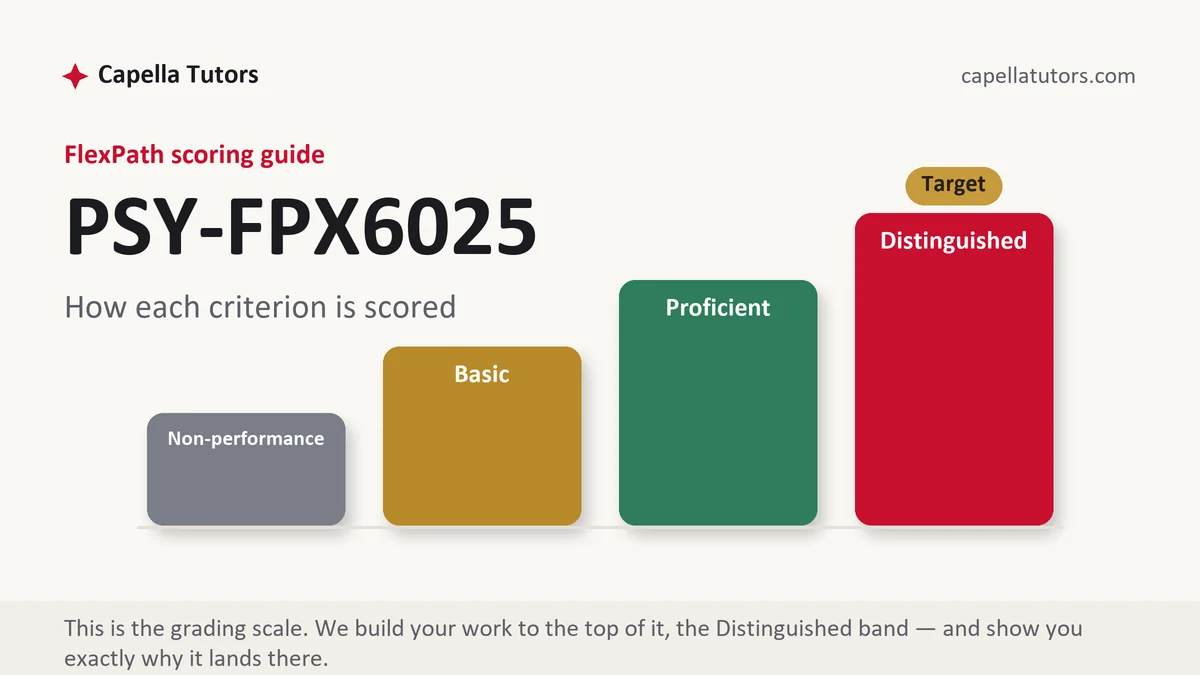
What PSY FPX 6025 actually grades
The graduate version of this subject is about mechanism and measurement rather than about milestones. Three questions run through the criteria. What is a given capacity actually made of? How did anyone establish that a child of this age has it? And what makes it develop faster, slower or differently? A draft that lists what children do at three and at five has answered a question from an earlier degree. A draft that says what a capacity requires, which task was used to detect it, and what the task itself demands of a child is writing in the columns this course pays for.
Measurement carries more weight here than in almost any other developmental course, because the participants cannot be interviewed. Almost everything known about the first two years was inferred from where infants look, how long they look, what they reach for, what they imitate and what surprises them, and every one of those inferences is arguable. That is why the same capacity gets dated years apart in different papers. Understanding that other people can hold a false belief is the standard illustration: verbal tasks that ask a child to predict where a mistaken character will search are passed reliably somewhere around the fourth and fifth years, while measures based on where toddlers look in anticipation have been read as showing a precursor much earlier, and the argument between those literatures is about what the tasks demand rather than about what children are. The criteria reward a writer who reports the task alongside the age and treats an age of onset as a property of the pair.
The content strands are graded on the same discipline. Attachment is a pattern in a relationship with a particular caregiver, measured by a particular procedure, rather than a trait a child owns. Language is graded on the difference between comprehension and production and on the enormous variation in early vocabulary that is normal. Executive function is graded on its components, which are usually described as holding information in mind, inhibiting a first response and shifting between rules, and which are less separable in early childhood than in adults. Temperament is graded on fit, meaning the interaction between what a child brings and what an environment demands, rather than as a set of labels. Middle childhood adds peer status, achievement motivation and the school as a developmental setting.
The fourth strand is ethical, and in a child psychology course it is not a formality. Children cannot consent, so lawful participation requires permission from a parent or guardian plus the child's own assent, sought in language matched to the child's age and freely refusable. Observation in a school or childcare setting needs the setting's agreement as well. Confidentiality has an announced limit, because a disclosure suggesting harm carries reporting obligations that are not suspended by a course assignment. And interpretation carries its own ethical demand: a parenting practice that differs from the norms of the sample your instrument was built on is a difference before it is a deficiency, and the criteria notice which of those two words your paper uses.
How we help in this course
Samples for 6025 are written so the evidence and the instrument stay visible. Capacities arrive with the task that measured them, ages arrive as ranges rather than as dates, and any classification is named with the procedure and the age band it belongs to. Where the deliverable involves an observation, the sample supplies operational definitions a second person could apply, a recording method, and a limitations paragraph that says plainly what one observer cannot establish. Tell us the child's age, the setting and whether you have access to a real observation, and the sample is built around what you can actually collect rather than around what would be convenient.
Delivery is the studio standard. One premium original sample per deliverable inside 24 to 48 hours, produced by eight people from the literature pull to the final proofread, with one pass reserved for checking that every age claim in the document matches the age range of the study behind it. Revisions are free and unlimited. FlexPath grades each criterion at one of four levels and lets you submit the moment the work is ready, so the practical goal is a first attempt with no Basic rows in it, and that is what the second read exists to protect.
The assessments, one by one
Assessment 1: Prenatal and Neonatal Quick Reference
A concise, evidence-based reference on prenatal and newborn development topics for parents or practitioners. Read the full Assessment 1 manual.
Assessment 2: Applications of Development Theories
Explain child psychology and apply theories such as Piaget's and Vygotsky's to understanding and supporting children's development. Read the full Assessment 2 manual.
Assessment 3: Examining Early and Middle Childhood Development
Analyze a child's case from an ecological perspective, set expectations for healthy development, and recommend support. Read the full Assessment 3 manual.
How to actually write PSY FPX 6025: where to begin
Start with the guide, turn the criteria into headings, and then write the child's age in months at the top of the document if the child is under three and in years if older, because precision about age is what makes everything else in the paper checkable. Mark which criteria want a construct explained, which want evidence appraised, which want an observation analyzed and which want a recommendation for an adult. In current courserooms the assessments include "Prenatal and Neonatal Quick Reference", "Applications of Development Theories" and "Examining Early and Middle Childhood Development" among others, and your scoring guide decides the exact format of each. Anything you write that would be equally true of a two-year-old and a nine-year-old is not answering a developmental criterion.
Then build the observation properly, because it is where the largest number of easy points are lost. Say the criterion asks you to analyze an observed behavior using developmental research. The Basic version narrates: the child played with blocks, then took a toy from another child, then looked at the teacher. The graduate version defines before it counts. Choose the behavior and write an operational definition with an inclusion rule and an exclusion, for instance sustained joint engagement, counted when the child and an adult attend to the same object and the child makes at least one bid for the adult's attention, not counted when the child is merely in proximity. Then choose a recording method rather than describing continuously: ten-second interval sampling across a twenty-minute period gives you 120 intervals and a denominator, so a result reads as joint engagement occurred in 34 of 120 intervals across twenty minutes of free play rather than as the child seemed to engage well. Then interpret with the literature, and state what the design cannot support, which for a single session with one observer includes reliability, stability and anything about the child in general.
Then handle theory as machinery rather than as citation. If you are applying a constructivist account, the graded work is showing which task feature produced the error you observed, not naming the stage the child is in. If you are applying a sociocultural account, the graded work is identifying what the child could do with a specific kind of adult support and what that tells you about the support to recommend, which is a testable claim about the next session rather than a general endorsement of help. If you are applying a learning account, the graded work is specifying the contingency you observed and what would change if it changed. In every case, attribute the framework to the writer who proposed it, and where the current literature has revised the original claim, say what the revision was rather than presenting a seventy-year-old proposal as the field's present position.
Then write the family and the recommendation with the care the professional communication rows are grading. Use a role or initials for everyone involved, remove the name of a school, a clinic or an employer, and leave out material you learned in confidence that the criteria do not require. Where the paper recommends something to an adult, write it as a behavior with a setting and a frequency, since a recommendation to be more responsive cannot be carried out while a recommendation to narrate what the child is looking at during the ten minutes before bed can. And describe variation as variation: a two-year-old with fifty words and a two-year-old with three hundred are both inside the ordinary range, and a paper that treats the lower figure as a delay has made a clinical claim it has no instrument to support.
| Section | What goes in it | What Distinguished looks like |
|---|---|---|
| The child, setting and question | Age in months or years, the setting, the relevant history, and the developmental question being asked. | A question the observation or the literature could actually answer, with the age held throughout. |
| The construct defined | The capacity under discussion, its components, and how the field operationalizes it. | Construct and instrument kept apart, with the task named whenever an age is claimed. |
| Observation or evidence | Behavioral definitions, recording method, duration, counts with denominators, or the studies used instead. | Definitions a second coder could apply, and figures reported against the time observed. |
| Theory applied | The framework, its author, the mechanism, and the specific feature of this case it explains. | A mechanism doing work on the observed detail, with the framework's later revisions acknowledged. |
| Ethics and consent | Site agreement, guardian permission, child assent, confidentiality limits, de-identification. | Assent worded for the child's age, with reporting obligations disclosed rather than assumed. |
| Recommendation and references | What an adult should do, when and how often, plus current APA in text and list. | An action an adult could perform tomorrow, with variation described as variation. |
Developing the synthesis
The synthesis this course rewards is the competence and performance problem, which is the deepest methodological issue in the study of young children. A child can fail a task for reasons that have nothing to do with the capacity the task was built to detect: the instructions were long, the wording was ambiguous, the materials were unfamiliar, the adult was a stranger, or the child answered the question a cooperative person would assume was being asked rather than the one that was asked. Decades of work simplifying classic procedures has repeatedly found competence earlier than the original boundaries allowed, which is a real contribution and also a trap, since a simplified task can be passed by a strategy that falls short of the capacity in question. Infancy research carries its own version of the problem, because samples are small, exclusion rules are generous, and effects measured in fractions of a second are fragile enough that several well-known findings have been difficult to reproduce. The position worth arguing is procedural rather than triumphant: report the task with every age claim, prefer converging evidence from procedures with different demands, and treat a single striking result from one paradigm as a hypothesis about children rather than a fact about them.
Citations that survive faculty review
Four source types do the work and the criteria can tell them apart. Primary empirical articles in developmental journals, reached through PsycINFO and the Capella library, support every claim about what children of an age do, and each one enters your sentence with its task, its sample size and its age range. Theoretical statements belong to the people who made them, so a constructivist claim is cited to its own literature and a sociocultural claim to its own, and where you have read a chapter rather than the original, say so honestly. Instrument and coding documentation supplies definitions, procedures and psychometric properties, and it is the correct citation whenever you borrow a behavioral definition or report a classification. Public health and professional guidance from pediatric and early childhood bodies is the right source for what practice currently recommends about screening, sleep, screen use or referral, cited with the issuing body and the year. What fails review is the parenting internet: milestone graphics, developmental checklists reproduced without a source, blog summaries of studies, and any age claim that arrives without a task attached. Then run current APA both ways and reread the draft once for the word children where your evidence was about infants or about preschoolers.
The mistakes that land Basic instead of Distinguished
- Milestones narrated instead of a mechanism explained. A list of what children do by an age answers a survey question rather than a graduate criterion.
- An age claimed without its task. Capacities appear at different ages under different procedures, so an unqualified age of onset is not a finding.
- Behavior counted without a denominator. Four instances of anything means nothing until a reader knows over how long and out of how many opportunities.
- Reliability reported by a single observer. Agreement requires two coders, and an invented coefficient is a fabrication rather than a shortcut.
- Difference written as deficiency. A practice outside the norms of one sample is a variation, and the language rows are scored on which word you chose.
PSY FPX 6025 questions students actually ask
The assessment wants an observation of a child. How do I arrange one ethically?
Get three agreements before you get a notebook. The setting has to agree, because a classroom, a childcare room or a playground is somebody's responsibility and an unannounced observer is a problem for them. The parent or guardian has to agree, and they should be told what you will record, what happens to it, and that no names or identifying details will appear. The child has to agree in words they can follow, which for a school-age child means a sentence like I am watching how children play today, you can tell me to stop any time, and it is fine to say no. Then keep the record itself de-identified from the first line, describe behavior rather than motives, and write down the date, the setting and the duration, since a graded observation without those three cannot be interpreted by anyone including you.
How do I code what I observed without inventing a scoring system?
Borrow a definition and be transparent that you borrowed it. Published coding schemes for play, joint attention, aggression, self-regulation and language exist, and citing one for your behavioral definitions is the professional move, since it lets a reader compare your observation with the literature. If your guide expects you to build your own definitions, write them so a second person could apply them without asking you a question, which means a definition with an inclusion rule and at least one exclusion. Then choose a recording method rather than describing continuously: fixed intervals with a mark for whether the behavior occurred, or counts of onsets, or duration in seconds. And do not report agreement figures if you were the only coder. Say instead that reliability could not be established with a single observer, which is a limitation a criterion will accept and a fabricated coefficient is not.
How much can an early attachment measure carry in my analysis?
It can carry a description of a relationship at a point in time, and it cannot carry a verdict about a child. The laboratory separation and reunion procedure was designed for a narrow age band around the end of the first year and the start of the second, it runs about twenty minutes, and the classification comes almost entirely from what the child does when the caregiver returns rather than from how much the child cried while she was gone. That single fact corrects most student misreadings, since distress is not the variable. It also means the result is specific to that caregiver and that instrument: observer Q-sorts, narrative and picture measures for preschoolers, and questionnaires for older children measure related but non-interchangeable things, so a classification obtained with one cannot be reported as though it came from another. Name the instrument, the age it was designed for, and the caregiver it involved.
Child psychology paper due?
Send the prompt, the guide and the child's age. First premium sample free, with the tasks named, the counts denominated and the consent handled.