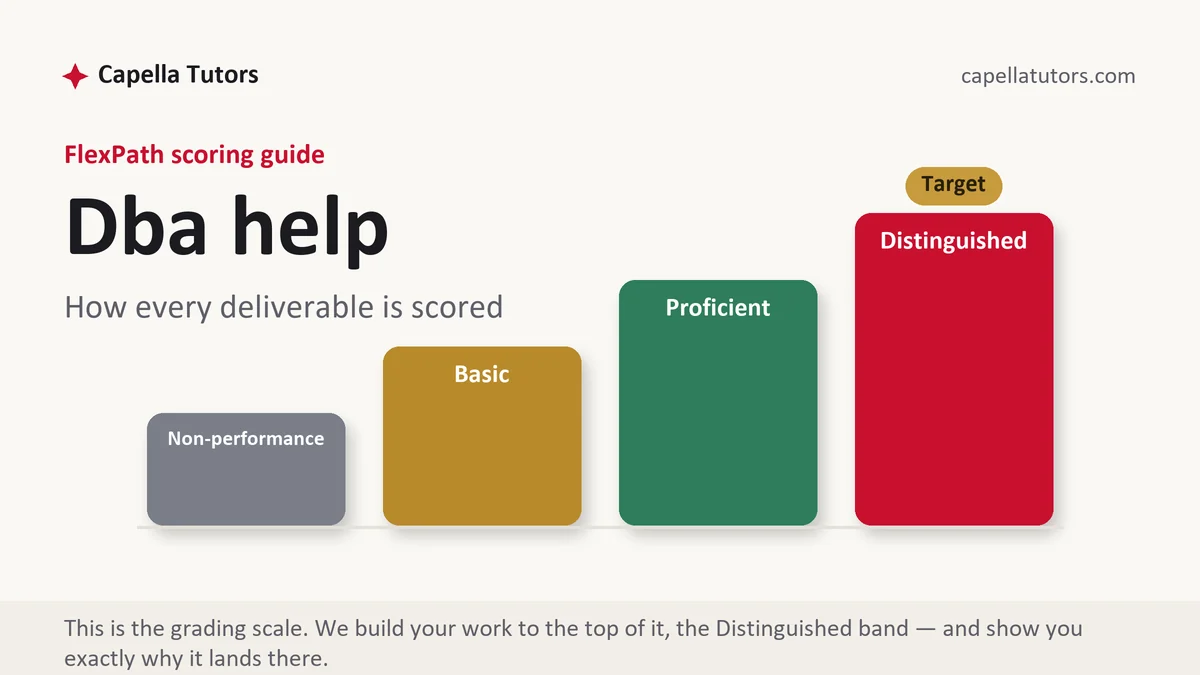
Capella's DBA is the FlexPath doctorate for people who intend to keep their jobs while they earn it. Three specializations, General Management, Organizational Leadership and Development, and Strategy and Innovation, sit on one shared doctoral core and end in the same four-course project sequence, DB FPX 9801 through DB FPX 9804. What separates it from the MBA is not length: a DBA wants a contribution to practice, a defensible method, and a project that clears a committee and an IRB. We draft to the Distinguished column inside 24 to 48 hours, in the register a doctoral committee reads, and keep revising until the criteria clear.
What a DBA demands that an MBA does not
Most requests for Capella DBA class help come from someone who already finished an MBA and expects the doctorate to be the same work at greater length. That is the most expensive assumption in the program. An MBA deliverable applies a framework to a firm and commits to a recommendation. A DBA deliverable has to produce something the reader did not already have, then account for how it was produced. Those are different jobs, and the second one carries procedural machinery the first never touches.
| Dimension | At the MBA level | At the DBA level |
|---|---|---|
| Unit of work | One assessment, finished when it is graded | One project carried across four courses and several approvals |
| What counts as a claim | A recommendation the analysis supports | A finding a stated method produced, with its limits named |
| Method | Chosen implicitly, rarely discussed | Named, justified, and defended against the alternatives you rejected |
| Who has to agree | The faculty evaluator | A committee, and a review board before any data is collected |
| Usual failure mode | A framework recited rather than applied | A topic that cannot be researched with the access you actually have |
Choosing between the three specializations
The choice looks like a career decision and is really a literature decision. The overlap in the course list is obvious: the three leadership courses and the three strategy courses are each listed as General Management choices too. What is not shared is the seminar pair, and the seminars are where your topic gets narrowed and your literature review gets built.
| Specialization | Its seminars | Choose it when | The tradeoff |
|---|---|---|---|
| Organizational Leadership and Development | DB FPX 8640 and DB FPX 8650 | Your problem is people, culture, capability, or change | The leadership literature is vast, so narrowing is the hard part and the seminar is where it happens |
| Strategy and Innovation | DB FPX 8740 and DB FPX 8750 | Your problem is positioning, digital transformation, or new offerings | Strategy questions resist measurement, and a project needs something you can actually measure |
| General Management | DB FPX 8840 and DB FPX 8850 | Your problem crosses both bands, or your employer's problem ignores the categories | The widest reading and the least pre-narrowed body of work to stand on |
The point values say where the program thinks the risk sits. Content courses in the leadership and strategy bands carry 2 points each; both seminars in every track carry 3. The catalog spends more on narrowing a topic than on any subject course in the band. Pick the track whose literature you can live inside for two years, not the one whose name reads best on a signature block.
The point map, and the part that is not on this page
Every specialization is built from the same three blocks plus a methods block. Five DB-FPX core courses at 3 points each is 15. The project sequence, four courses at 3 points, is another 12. A full specialization band, three content courses at 2 points plus two seminars at 3, is 12 more. That is 39 points we publish pages for.
| Block | Points | What sits in it |
|---|---|---|
| Five DB-FPX core courses | 15 | Your DBA Journey, organizational leadership, HR and compliance, strategic decision making, teaching business |
| Specialization band | 12 | Three content courses at 2 points, two seminars at 3 |
| Doctoral project, 9801 to 9804 | 12 | Proposal, data and IRB, results, final reviews and presentation |
| Research methods, the RSCH courses | Confirm in your catalog year | The methods training a DBA has and an MBA does not |
| DB FPX 9980 | 2 | Doctoral Project Development, a continuation course outside the standard 45-point sequence |
The gap between 39 and your degree total is research methods, the RSCH courses, and they are the reason a DBA can defend a method rather than assert one. We do not publish pages for them, which is worth saying plainly. Capella revises requirements between catalog years, so confirm your totals and your methods requirement in your own catalog year.
The doctoral project arc, and where it waits
Four courses, 3 points each, running in order because each depends on an approval the last one produced. DB FPX 9801 is proposal writing, DB FPX 9802 pairs data analysis practice with IRB approval, DB FPX 9803 is project results, DB FPX 9804 is final reviews and presentation. You cannot write results before you have data, you cannot collect data before the review board clears you, and you cannot reach the board without a proposal a committee accepted.
One planning fact separates this sequence from everything before it. In ordinary FlexPath coursework, faculty have two business days to evaluate a submitted attempt, and under submit-on-grade the next assessment waits on that grade. Two days is a wait you can plan around. Committee and IRB review do not run on that clock, and nothing in FlexPath makes them faster. Your flat 12-week session keeps billing while a document sits with someone else, which is why this block punishes an empty queue harder than any earlier one. Confirm review timelines with your chair and Capella's review board rather than assuming them.
DB FPX 9980, Doctoral Project Development, is the continuation course that keeps you enrolled if the project outlasts the sequence. It sits outside the standard 45-point path. Read it as the catalog's admission that doctoral projects overrun, and plan so that you never need it.
Send the DBA course you are in
The code and the scoring guide are enough to start. First premium original sample free, back inside 24 to 48 hours.
Every DBA course we cover
Twenty-two pages, because the three specializations share a core and a project sequence and diverge only in the middle. Each one takes a course apart: what its criteria reward, how its guide is worded, and the mistakes that drop a level.
The doctoral core, five courses at 3 points
DB FPX 8400, DB FPX 8405, DB FPX 8410, DB FPX 8415, DB FPX 8420
Organizational Leadership and Development
DB FPX 8610, DB FPX 8620, DB FPX 8630, DB FPX 8640, DB FPX 8650
Strategy and Innovation
DB FPX 8710, DB FPX 8720, DB FPX 8730, DB FPX 8740, DB FPX 8750
General Management seminars
The doctoral project, all three specializations
DB FPX 9801, DB FPX 9802, DB FPX 9803, DB FPX 9804, DB FPX 9980
Browse the full course catalog
The register a doctoral committee reads
Doctoral business criteria are written for three readers who want different things from one document. A methodologist wants to know why this method and not the obvious alternative. A practitioner wants to know what changes on Monday and who has to sign off. An executive reader wants the claim first and the confidence attached to it. A draft that satisfies one and ignores the other two is the Proficient ceiling in this program.
The Basic to Distinguished gap is easy to state and hard to execute. Basic work reports what the literature says, source by source. Distinguished work says where it converges, where it conflicts, and what it cannot answer for the setting you are studying, then names which of those gaps your project addresses. Limitations follow the same rule: at the master's level a limitation reads like a confession, here it is a criterion. Contribution to practice is the last test. If a reader finishes your finding and cannot name a decision it would change, it has not landed. The scoring guide guide and the FlexPath writing manual cover how criterion language is built.
Where DBA students stall
Rarely in the core. The stall lands the first time a seminar occupies one of the two available slots. A student pairs DB FPX 8415, strategic decision making, with DB FPX 8640, the leadership topic development seminar. The 8415 assessments have shape: a prompt, a guide, a submission that ends them. The seminar has none of that. Six weeks in, the student has four candidate topics, no narrowing, and a growing pile of reading, because topic work expands to fill whatever time it is given while graded assessments self-limit. Pair a seminar with a course that finishes.
- A topic chosen for how it sounds. The early question is whether you can get the data, not whether the title impresses a committee.
- Access assumed rather than secured. A verbal yes from a manager is not organizational approval, and it is worth nothing at the IRB gate.
- The literature review treated as a chapter to write once. It is the thing your committee argues with, and it is revised more than anything else you produce.
- Methods postponed to the proposal. The RSCH courses are where a method gets chosen. Arriving at DB FPX 9801 without one costs a session, not a weekend.
The working-executive time problem
Almost everyone here is employed, most at a level where the job does not shrink to accommodate a degree. The FlexPath mechanics are unchanged: two courses at a time, flat 12-week billing sessions, submit-on-grade. The lever is what goes in each slot, and doctoral units are longer, so a week lost to a quarter close is not one you recover in a late night when the deliverable is a literature review.
Sequence with that in mind. Start with DB FPX 8400, which installs the doctoral apparatus every later criterion assumes. Run the argument-shaped core courses alongside your methods work rather than after it, since a method understood early changes which topics you will consider at all. Enter the topic development seminar only once you have an organization and a realistic read on access, because the seminar is where the topic gets fixed. The project courses go last and in order.
The pairing rule holds throughout: one course whose labor is producing something next to one whose labor is thinking about something. Two thinking courses in the same session stall together, and a seminar plus a project course is the worst pair in the program. What your enrollment agreement permits is a question for your enrollment counselor, the rotation mechanics are in the two-course rotation playbook, and the pacing math sits on the expedite page.
DBA questions students actually ask
Which Capella DBA specialization should I choose?
The coursework overlaps more than the three names suggest. DB FPX 8610, DB FPX 8620 and DB FPX 8630 in the leadership band, and DB FPX 8710, DB FPX 8720 and DB FPX 8730 in the strategy band, are also listed as General Management choices, so what separates the tracks is the seminar pair where you narrow a topic and build a literature review. Choose leadership and development for people, culture or capability, strategy and innovation for positioning, digital transformation or new offerings, and general management when the problem crosses both.
Is a DBA the same as a PhD in business?
No. Both are doctorates and both demand a method you can defend, but the standard differs. A PhD is judged on contribution to theory, a DBA on contribution to practice, so the test of a finding is whether a practitioner could act on it. The teaching route stays open, since DB FPX 8420 Teaching Business in Higher Education sits in the core, but the project is built around a problem inside an organization rather than a gap in a theory.
Do I need my employer's data to finish the doctoral project?
Not your employer's specifically, but you do need an organization that will grant access in writing before you reach DB FPX 9802, the course that pairs data analysis practice with IRB approval. Using your own employer is the fastest route and the one most working students take, with the usual cautions: use only what you are permitted to use, and anonymize where your employer would expect it. Settle access during topic development, not after a committee approves a proposal built on data you cannot reach.