Send the prompt with your scoring guide and a premium original sample returns inside 24 to 48 hours, written to the Distinguished descriptors and revised free until the criteria are satisfied. The course records as DB FPX 8420, Teaching Business in Higher Education, worth 3 program points, part of the doctoral core in Capella's FlexPath Doctor of Business Administration, a 45-point path whose graduates frequently teach as well as practice. In Capella's catalog the course code is written DB-FPX8420.
What DB FPX 8420 actually grades
DB FPX 8420 is a design course wearing a teaching title. The criteria are not assessing whether you would be a warm presence in a classroom, they are assessing whether you can specify what a learner will be able to do, build the evidence that would show it, and construct the activities that make it likely, in that order. Practitioners entering this course usually arrive with the content and without the specification, and the gap shows immediately in a plan listing the topics a course will cover rather than the performances a student will be able to produce.
Alignment is the spine of every criterion here. An outcome states an observable performance at a stated level of cognitive demand. An assessment produces evidence of that performance. An activity gives the learner practice at the thing the assessment will require. When those three agree the course teaches itself, and when they do not, students work hard at the wrong thing and blame themselves for the result. The classic misalignment in business teaching is an outcome promising that students will evaluate an investment decision, an assessment made of multiple choice questions on terminology, and a lecture demonstrating the calculation once. Three defensible components, no alignment, and the criteria will find it.
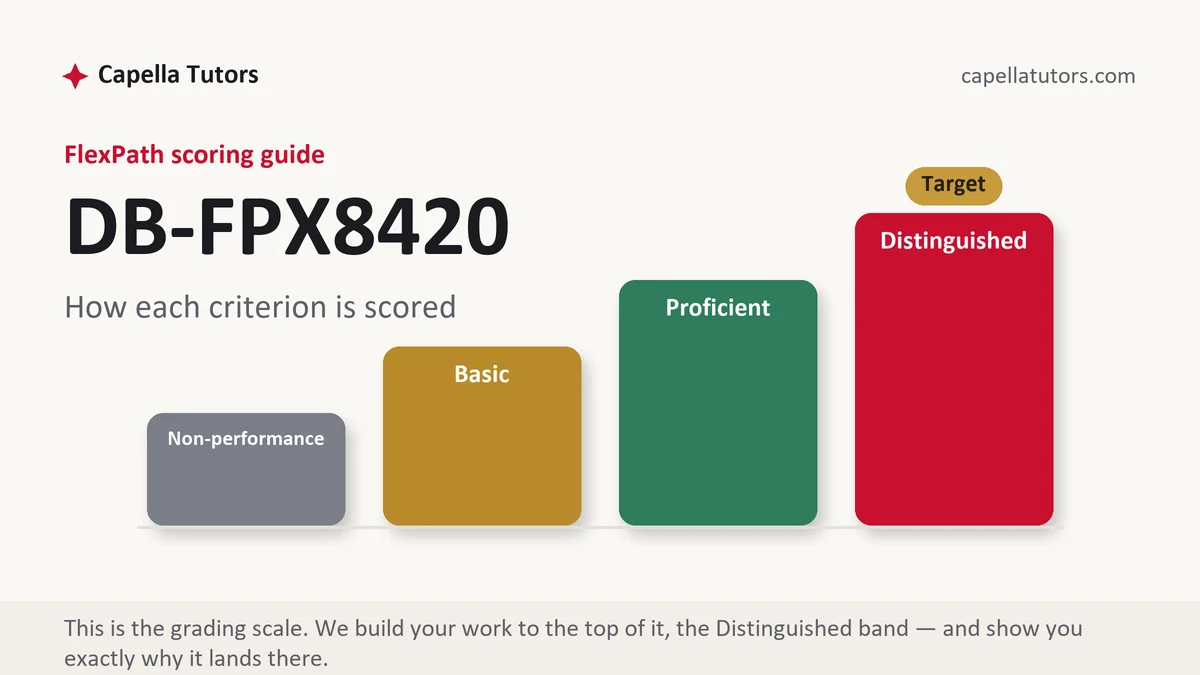
The assessment strand is marked on whether two graders would agree. That means criteria describing observable qualities of the work rather than adjectives about the student, levels differing in what is present rather than in how well it was done, and the removal of the word appropriately, which is where agreement between markers goes to die. Capella hands you a live example of criterion-referenced grading to study: four levels running from Non-performance through Basic and Proficient to Distinguished, where each level describes a different artifact rather than a different quantity of merit. Reading your own scoring guide as an instrument, and asking why its top descriptor is worded the way it is, is the fastest preparation available for writing one.
The fourth strand is the environment the teaching happens inside, and it carries more weight in a doctoral business course than candidates expect. Adult learners holding jobs, online or competency-based delivery, accessibility obligations that shape documents and media before any student requests an accommodation, academic integrity where work is submitted from a laptop at midnight, and the accreditation context in which a business school must show its faculty are sufficient, current and qualified for what they teach. A teaching plan ignoring these describes a classroom that does not exist.
How we help in this course
Our 8420 work starts at the outcome statement and builds outward, because everything else is derived from it. We write outcomes with an observable verb and a criterion of success, map each one to the assessment producing evidence of it and to the activity that rehearses it, then draft the rubric so the levels differ in substance rather than in adverbs. Where you name a course you teach or intend to teach, the sample uses its real content, its credit load and the delivery mode it runs in. Where you have a grade distribution or a set of student comments, the evaluation section works from those instead of from a hypothetical.
Terms are the studio's, applied to a course design rather than to an essay. One premium original deliverable inside 24 to 48 hours, eight readers between the source pull and delivery, a pass reserved for checking that each criterion is answered where the grader looks for it, a separate pass for current APA and originality, and free revision until the criteria are met. Faculty feedback comes back at no charge. Evaluators hold a submitted attempt for up to two business days, so a design deliverable returned over one unaligned outcome costs most of a week, which is the argument for having it read before it goes.
The assessments, one by one
Assessment 1: Course Welcome Message
Write the welcome message you would send students as the instructor of a business course, setting expectations and tone grounded in adult learning principles. Read the full Assessment 1 manual.
Assessment 2: Supply Chain Learning Resources List
Curate resources for students in a business course, explain each resource and its takeaways, and reflect on how the list supports learning. Read the full Assessment 2 manual.
Assessment 3: Creating Supply Chain Management Instructional Plans and Assessments
Design an assignment for a business course, with an overview, instructions, requirements and a scoring guide aligned to measurable learning outcomes. Read the full Assessment 3 manual.
How to actually write DB FPX 8420: where to begin
Read the guide, then start at the end, because backward design is both the content of this course and the fastest way to write for it. Decide what a graduate of the unit must be able to do, write the evidence that would convince a skeptical colleague they can do it, and only then plan the teaching. In current courserooms the assessments include "Course Welcome Message", "Supply Chain Learning Resources List" and "Creating Supply Chain Management Instructional Plans and Assessments" among others, and your scoring guide decides the exact format of each. Keep a two-column map open from the first paragraph, outcomes on the left and evidence on the right, and refuse to write an activity until both columns are full.
Then rewrite one outcome in front of the reader, since the criteria reward demonstrated craft over described craft. A weak outcome reads: students will demonstrate an understanding of financial statements. It cannot be observed, it sets no level, and almost any assessment can be argued to match it. A usable version reads: given a filed annual report, the student calculates liquidity, leverage and profitability ratios, compares them against two industry peers, and states what the comparison implies for a lending decision, with the arithmetic correct and the interpretation defended. Now write the rubric levels so they differ in what the artifact contains. At the top the ratios are correct, the peer comparison suits the industry, and the lending implication is argued with the limits of ratio analysis acknowledged. A level down, the ratios are correct and the interpretation is generic. Below that, calculations are present with errors and no interpretation follows. None of those descriptors uses the word thoroughly, and a second grader could apply all three.
Then design the activities that make the performance likely, and justify them with evidence rather than preference. Meta-analytic comparisons of active instruction against continuous lecture in undergraduate courses have generally favored the active conditions, most of the strongest studies come from science and mathematics teaching, and carrying that finding into a case-based business course is an inference you should make openly rather than silently. The safer claim, and the one the criteria will accept, is that students improve at the performance they practice under conditions resembling the assessment, which in business teaching means the case discussion rehearses the memo, the spreadsheet exercise rehearses the model, and the graded presentation is preceded by an ungraded one carrying feedback. Sequence matters as much as choice: practice has to precede the graded event by enough time for the feedback to be used, which is a scheduling decision rather than a pedagogical opinion.
Then write the evaluation section, where most drafts substitute popularity for learning. Student ratings measure satisfaction and are influenced by grading leniency, class size, discipline and characteristics of the instructor having nothing to do with instruction, so they belong in the paper as one weak indicator among several rather than as the verdict. Better evidence is sitting in the work itself. If 34 students in a section of 92 miss the same outcome on the same assessment, that is a design finding rather than a cohort finding, and the doctoral response is to establish whether the outcome was unclear, the practice absent or the assessment misaligned, change one of them, and compare the next section. Add peer observation against a stated protocol, and one short, specific claim about your own teaching that a reader could check, because a teaching philosophy asserting a commitment to engagement with no evidence behind it is this genre's most familiar failure.
| Section | What goes in it | What Distinguished looks like |
|---|---|---|
| Learners and context | Who the students are, what they bring, the delivery mode, the credit load and the constraints. | A context described from evidence about these learners rather than assumptions about students. |
| Outcomes | Observable performances at a stated level of demand, each with its criterion of success. | Outcomes an external reader could assess without asking the author what was meant. |
| Assessment design | The tasks producing evidence of each outcome, with the rubric that will judge them. | Levels differing in the content of the work, applied the same way by a second grader. |
| Instructional activities | The practice, the sequencing and the feedback that make the assessed performance likely. | Activities matched to the assessed task, with feedback scheduled early enough to be used. |
| Integrity and access | Academic integrity in the task design, accessible materials, and accommodation by default. | Integrity built into the task rather than added as surveillance, with materials usable as issued. |
| Evaluation and references | How the design will be judged to have worked, and current APA in text and list. | Learning evidence weighted above satisfaction data, with the next change already specified. |
Developing the analysis
The scholarly position this course wants you to reach is that teaching claims are empirical claims and deserve the treatment you would give a claim about a market. That has an uncomfortable consequence, which is that much of what circulates confidently about business education is weaker than it sounds. Matching instruction to learning styles has not survived testing and still appears in teaching philosophies. Generational characterizations of students are marketing categories rather than findings. Satisfaction ratings are widely used as a proxy for teaching quality and align poorly with what students actually learned. Meanwhile the findings that do replicate are unglamorous: spacing practice over time beats massing it, attempting retrieval beats rereading, feedback works when it arrives soon enough to be applied to the next attempt, and prior knowledge predicts more than nearly anything an instructor controls. A doctoral paper building on the second list and explicitly declining the first is making the argument the criteria are looking for. Then hold your own design to the same standard and say how you would know it had failed, because the difference between the scholarship of teaching and an opinion about teaching is a claim somebody else could test.
Citations that survive faculty review
Four groups of source carry a teaching deliverable in a business doctorate. Peer-reviewed management education research from Academy of Management Learning and Education, Journal of Management Education, Journal of Education for Business and Decision Sciences Journal of Innovative Education sits closest to your context and should carry most of the weight, reached through Business Source Complete and ERIC. Learning science and higher education research supplies the mechanisms and is cited to primary work rather than to a training deck, which means Anderson and Krathwohl for the revised taxonomy rather than a pyramid graphic, Wiggins and McTighe for backward design, Knowles for the adult learning assumptions with the critiques of them acknowledged, and the retrieval and spacing findings cited to the experiments rather than to a summary article. Institutional and accreditation documents establish the rules you are designing inside, including your institution's own policies on grading, integrity and accommodation, and business accreditation standards on faculty qualification and assurance of learning, cited by body, document and year because they are revised. Public data from the Integrated Postsecondary Education Data System supports claims about who your students are and how the institution compares. Run current APA in both directions, and be particularly careful with the frameworks, since these are the sources most often credited to the wrong originator.
The mistakes that land Basic instead of Distinguished
- Outcomes that cannot be observed. Understand, appreciate and be familiar with describe internal states, and no assessment can produce evidence of one.
- An assessment measuring something else. Terminology questions cannot produce evidence that a student can evaluate an investment.
- Rubric levels separated by adverbs. Thoroughly, adequately and somewhat describe the grader's mood rather than the work in front of them.
- Learning styles used as a design principle. The matching claim has been tested repeatedly and has not held, and a doctoral reader knows it.
- Teaching judged by how much students liked it. Satisfaction is one weak signal, and the learning evidence is already sitting in the graded work.
DB FPX 8420 questions students actually ask
I have never taught. Can I write this credibly?
Yes, because the course assesses design rather than experience, and design is examinable on paper. Choose a course you could plausibly teach out of your own practice, name the institution type and the delivery mode, and be concrete about the students, since a first-year community college section and a part-time executive cohort require different decisions and the criteria reward decisions rather than generalities. Where you would otherwise draw on classroom experience you do not have, draw on adjacent experience you do have, because you have almost certainly trained staff, briefed a board, run an onboarding program or explained a model to somebody who had to use it, and the design questions are identical. Then be explicit about the assumptions your inexperience forces you to make and say how you would test them in the first term, which is a stronger paper than a confident account of a classroom you have never stood in.
How do I write rubric levels that two graders apply the same way?
Describe the artifact, not the achievement. Each level should name what is present, absent, correct or incorrect in the work, so a grader is checking rather than judging. Take one criterion, write the top level first as a full description of the best realistic submission, write the bottom level as the submission that fails, then fill the middle by removing one substantive element at a time rather than by weakening an adverb. Test it the way an instrument is tested: grade three real or constructed samples, hand the rubric and the samples to a colleague without your grades, and compare. Where you disagree, the rubric is at fault, and the sentence you disagreed over is the one to rewrite. Then confirm every criterion maps to an outcome, because a criterion grading something the course never promised to teach is unfair whether or not two graders agree about it.
Does finishing this course qualify me to teach business at a university?
The course teaches the craft, and the qualification is decided elsewhere. Hiring institutions set their own requirements, and business schools are also answerable to their accreditor for whether faculty are sufficient in number, appropriately credentialed and current in the field they teach, which is why a practitioner holding a doctorate and recent industry work is treated differently from one whose practice ended fifteen years ago. Treat this course as the part you control: a defensible course design, a teaching philosophy with evidence inside it, a rubric you can put in front of a search committee, and a documented instance of using assessment data to change a course. Those artifacts travel, and they are what a committee can evaluate in an applicant who has not yet held a faculty appointment. What a given department requires is a question for that department and for your program's own guidance.
Course design deliverable due?
Send the prompt, the guide and the course you want to build. The first premium sample is free, and it comes back with outcomes, evidence and activities already mapped to each other.