Send the prompt and the scoring guide and a premium original sample returns inside 24 to 48 hours, written to the Distinguished descriptors your faculty are reading from, revised free until the criteria are met. The course records as DB FPX 8400, Your DBA Journey, worth 3 program points, the opening course of the doctoral core in Capella's FlexPath Doctor of Business Administration, a 45-point sequence that continues through General Management, Organizational Leadership and Development, or Strategy and Innovation. In Capella's catalog the course code is written DB-FPX8400.
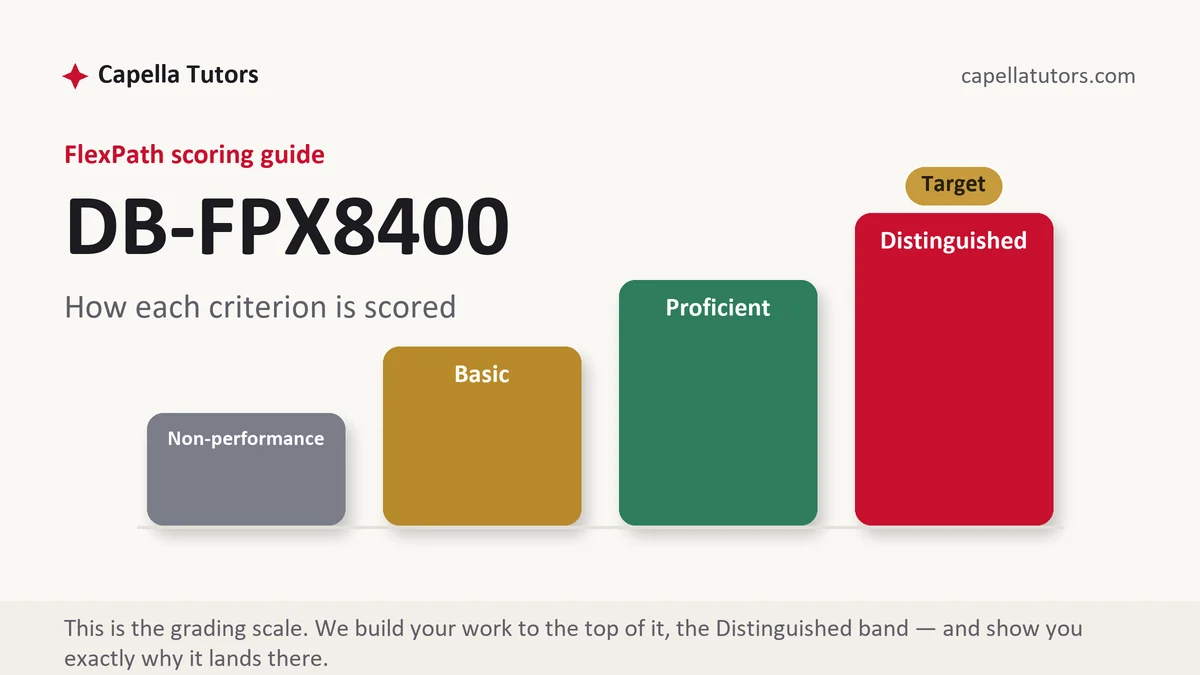
What DB FPX 8400 actually grades
Capella opens the doctorate with a course that reads like orientation and functions as a filter. DB FPX 8400 exists to find out whether an accomplished manager can build an argument that survives a reader paid to doubt it, and the criteria are written to expose the two habits experienced business people arrive with. One is the consulting voice: assured, unsourced, three bullets and a call to action. The other is the overcorrected student voice, which summarizes eleven articles faithfully and asks nobody to do anything. Doctoral business writing sits between them, as a claim, the evidence behind it, the limit of that evidence, and a consequence an executive could sign.
The first thing graded is the distance between a topic and a problem. Engagement is a topic. Succession risk is a topic. A problem is a gap at a named organization, carrying a size, a period and a source, that somebody inside that organization would spend money to close. The criteria test three properties of the candidate you bring: whether it can be observed rather than asserted, whether it is bounded to a population and a site rather than to an industry, and whether an answer would change a decision someone actually makes. A committee will forgive an unfashionable problem. It will not forgive one that cannot be measured, or one whose answer nobody needs.
The second strand is what qualifies as evidence at this level, and business students lose points here more often than they expect, because the business press is unusually good at sounding authoritative. A magazine feature on a turnaround, a consultancy report on hybrid work, a vendor white paper on retention software and a peer-reviewed field study are four objects with four different warrants. Practitioner material is legitimate evidence of what firms are doing and how practitioners talk. It is not evidence that an intervention works, because it carries no sample, no comparison and no disclosure of who paid for it. The habit the rest of the program depends on starts here: read the method section first, find the design and the sample, and decide what a study can support before deciding whether you like its conclusion.
The third strand is the machinery of the doctorate itself, graded more literally than students anticipate. Integrity at this level is not the undergraduate plagiarism lecture. It covers reusing your own submitted work across courses, attributing a framework to its originator rather than to the textbook that paraphrased it, and representing an organization you work inside without flattering it. Alongside that sits the plan. FlexPath bills in flat twelve-week sessions and permits up to two courses at once, an attempt moves you forward the moment it is graded rather than on a date, and a candidate who reads that structure as permission to sprint through the literature usually pays for it in the seminar courses later.
How we help in this course
Work on 8400 starts with whatever is irritating you at your job and ends with a sentence a committee could accept. We take the situation you describe, locate the figure that proves it exists, and write the problem so it names a population, a site, a measure, a magnitude and a window without naming a cause or a cure. Then we run the search you will have to defend later and hand back the reproducible version of it: databases used, terms and Boolean combinations, year limits, the inclusion rule and the record count at each stage. Empirical studies come back marked with their design and sample, so you can see at a glance which of your sources can carry a causal claim and which cannot.
Terms are the studio's, adjusted for doctoral work. Each deliverable returns as one premium original sample inside 24 to 48 hours, eight people touch it between the database search and the final read, and one of those passes exists only to test the draft against the guide criterion by criterion. Revision stays free until the criteria are satisfied and faculty comments re-enter the cycle at no cost. Because an evaluator has two business days with a submitted attempt, we plan backward from the date you intend to submit rather than forward from the day you ask.
The assessments, one by one
Assessment 1: Ontological Humility
Examine how assumptions and cognitive differentiation shape how leaders frame business problems, apply the ideas to a business scenario. Read the full Assessment 1 manual.
Assessment 2: Professional Development Framework
Reflect on the competencies expected of DBA graduates, set goals in each subdomain, connect them to your specialization, and plan how you will stay motivated. Read the full Assessment 2 manual.
Assessment 3: Library and Annotated Bibliography
Identify the library databases most useful for your field, search them, and write an annotated bibliography of scholarly sources on a business problem. Read the full Assessment 3 manual.
How to actually write DB FPX 8400: where to begin
Start with the guide and treat it as the specification it is. Number the criteria, give each one its own page, and accept that a doctoral paper is marked criterion by criterion, so a paragraph attached to none of them is writing you did for yourself. Here the criteria usually gather around four things: the practice problem you propose to pursue, the evidence that it is real, the scholarly conversation it belongs to, and your own readiness to work at this level. In current courserooms the assessments include "Ontological Humility", "Professional Development Framework" and "Library and Annotated Bibliography" among others, and your scoring guide decides the exact format of each.
Then write the problem statement, and expect the tenth version to be the first usable one. A version that holds reads roughly like this: at a regional distributor employing 480 people, 14 of the 41 warehouse supervisors resigned in the twelve months ending in March, a rate of 34 percent against 6 resignations, or 15 percent, in the preceding twelve months, and at a replacement cost the firm puts at three quarters of a $68,000 salary the eight additional departures represent about $408,000. Notice what the sentence declines to do. It does not say why they left, it proposes no retention program, and it does not use the word crisis. Every criterion in every later course then has something to fasten onto, because the sentence contains a denominator, a comparison period and a figure a chief financial officer would recognize.
Then locate the conversation, and log the search while you run it rather than reconstructing it afterward. Business Source Complete and ABI/INFORM Global through the Capella library are the two databases faculty expect to see named, chaining citations forward and backward from three good studies finds more than another hour of keyword variations, and the log needs the date, the string, the filters and the number of records surviving each stage. As you read, keep the alignment chain in view: the problem says what is wrong and how much, the purpose says what you will do about knowing it, the questions say what you will ask, and the design says how answers get produced. Most doctoral work that stalls in year two stalls because those four drifted apart in year one, commonly when a student who framed a measurement problem wrote questions only a set of interviews could answer.
Then write the self-assessment without flattering yourself, since the criteria reward an accurate account of a weakness with a plan attached over a confident account of neither. If your APA is unreliable, say which parts of it are, and name the pass you will add to your process. If you have not read a quantitative results section since a statistics course a decade ago, say so and describe how you will read one this term. Then set the pacing honestly by counting the reading hours this work actually needs against the hours your week contains, and decide whether you are carrying one course this session or two before the session opens rather than in week nine.
| Section | What goes in it | What Distinguished looks like |
|---|---|---|
| The practice problem | The gap stated at a named site, with its population, measure, magnitude and window. | A sentence naming no cause and no remedy, carrying a figure a reader can check. |
| Evidence it exists | Operating reports, organizational documents and public data showing the gap is real rather than felt. | Local figures with source, date and definition, set against an external benchmark. |
| The scholarly conversation | The empirical literature on this class of problem, with designs and samples identified. | Studies weighed rather than listed, with the strongest and weakest evidence labeled. |
| Alignment | Problem, purpose, questions and the design implied by them, written so the four agree. | Questions the named design can actually answer, and a purpose that answers the problem. |
| Doctoral practice | Voice, attribution, reuse of your own work, and the ethics of writing about your employer. | Frameworks credited to their originators, and the writer's position in the firm disclosed. |
| Plan and references | The route through the sequence, the hours available, and current APA in text and list. | A schedule tied to real weeks, and a reference list where every entry appears in the text. |
Developing the analysis
The judgment this course quietly assesses is whether you understand what a professional doctorate is for. A PhD answers to a literature and contributes to theory. A DBA answers to practice and contributes to it, which sounds like the softer standard and is in fact the harder constraint, because a contribution to practice has to name the person who will act differently and say what they can do on Monday that they could not do on Friday. Theory does not disappear under that constraint, it changes jobs: it tells you where to look, what to measure, and which rival explanation has to be ruled out before your recommendation means anything. A defensible 8400 problem therefore carries both halves. The site-level number establishes that something is wrong here. The literature establishes that this class of problem behaves in known ways and that the mechanisms worth testing are these three rather than any of thirty. A justification resting only on a gap in the literature fails the practice test, a justification resting only on a manager's frustration fails the scholarship test, and the criteria are built to catch both.
Citations that survive faculty review
A doctoral business paper draws on four source types that are not substitutes for one another. Peer-reviewed empirical research, reached through Business Source Complete, ABI/INFORM Global and the Capella library, is the only support for a claim that one thing causes another, and each study should enter your text carrying its design, its sample and its setting, because a field experiment across 24 call centers and a survey of 190 graduate students do not license the same sentence. Framework sources are cited to their origin: Porter's 1980 account of industry structure, Barney's 1991 statement of the resource-based view, Simon on bounded rationality, taken from the work itself rather than from a chapter that summarized it, because faculty who know the primary text can tell within a paragraph which one you read. Organizational and public data supply the numbers, whether an annual report, a filed 10-K, an internal report you name and date, or a federal series from the Bureau of Labor Statistics or the Census Bureau quoted with its series and collection year. Practitioner sources, meaning the business press, consultancy publications and trade associations, are cited as evidence of practice and framed that way in the sentence that uses them. Then run current APA in both directions and confirm every in-text citation appears in the list and every entry in the list appears in the text.
The mistakes that land Basic instead of Distinguished
- A subject area standing in for a problem. Engagement, innovation and culture are fields of interest, and not one of them can be sited, measured or closed.
- Consultancy material doing empirical work. A white paper with no sample and an undisclosed sponsor cannot support a claim that an intervention works.
- Frameworks cited to the textbook. The paraphrase you read is a secondary source, and the criterion is checking whether you went to the original.
- A scope no doctorate could finish. Studying leadership across an industry is not ambition, it is the absence of a site.
- A reflection with no evidence in it. A self-assessment reporting confidence rather than a named weakness and a plan reads as unfinished.
DB FPX 8400 questions students actually ask
Is the DBA project the same thing as a dissertation?
Treat your own program documentation as the authority, because requirements are set there and they change. What is safe to say is that the capstone sequence in this program is a doctoral project rather than a traditional theoretical dissertation, and the difference shows up in what counts as a contribution. A theoretical dissertation earns its place by moving a literature. A doctoral project earns its place by resolving something at a real organization with a defensible method, and it is judged on whether the design supports the conclusion and whether the conclusion is usable by somebody with authority to act. For 8400 the practical consequence is blunt: your candidate problem needs a site, and a problem you cannot site is a problem you cannot carry into the project courses.
What if my employer will not let me use company data?
Pick that constraint up now rather than in the project courses, because it decides which problems are available to you. Three routes usually work. Choose a site you can actually reach, which is often a smaller organization, a professional association, a franchise operation or a department other than your own, where permission is a conversation rather than a legal review. Build the case from public material, since filed statements, regulatory disclosures, association reports and federal statistical series will support a great many business problems without touching anything confidential. Or work with figures your employer will release in aggregate, which is frequently more than people assume once the request is specific and the reporting is at group level. Whichever route you take, label constructed figures as constructed and give their basis, and remember that site permission and any human subjects review sit later in the sequence and are governed by your program's own process.
How quickly can I move through DB FPX 8400?
The billing structure is generous and the reading is not. A FlexPath session runs a flat twelve weeks, you may carry up to two courses inside it, and completing an attempt to a passing standard moves you to the next deliverable immediately rather than on a calendar date. Against that, faculty have two business days to evaluate a submitted attempt and doctoral evaluators tend to use the window, so a plan assuming same-day turnaround is a plan built on nothing. The real limit is that this course asks you to read empirical articles properly, possibly for the first time in years, and working through a results section carefully takes an evening rather than a coffee break. The students who finish early are usually the ones who ran the search in week one and let the reading run while the writing caught up.
Starting the doctorate this session?
Send the prompt, the guide and the problem you keep running into at work. The first premium sample is free, and it arrives with the search log attached.