Send the full manuscript and the guide and a premium original sample returns inside 24 to 48 hours: the backwards alignment audit written up, every figure reconciled across chapters, a slide set with speaker notes, and revisions free until the criteria clear. The identity: DB FPX 9804, Final Reviews and Presentation, 3 program points, the closing course of the doctoral project sequence, identical for every specialization in Capella's FlexPath DBA, whose standard sequence totals 45 points. In Capella's catalog the course code is written DB-FPX9804.
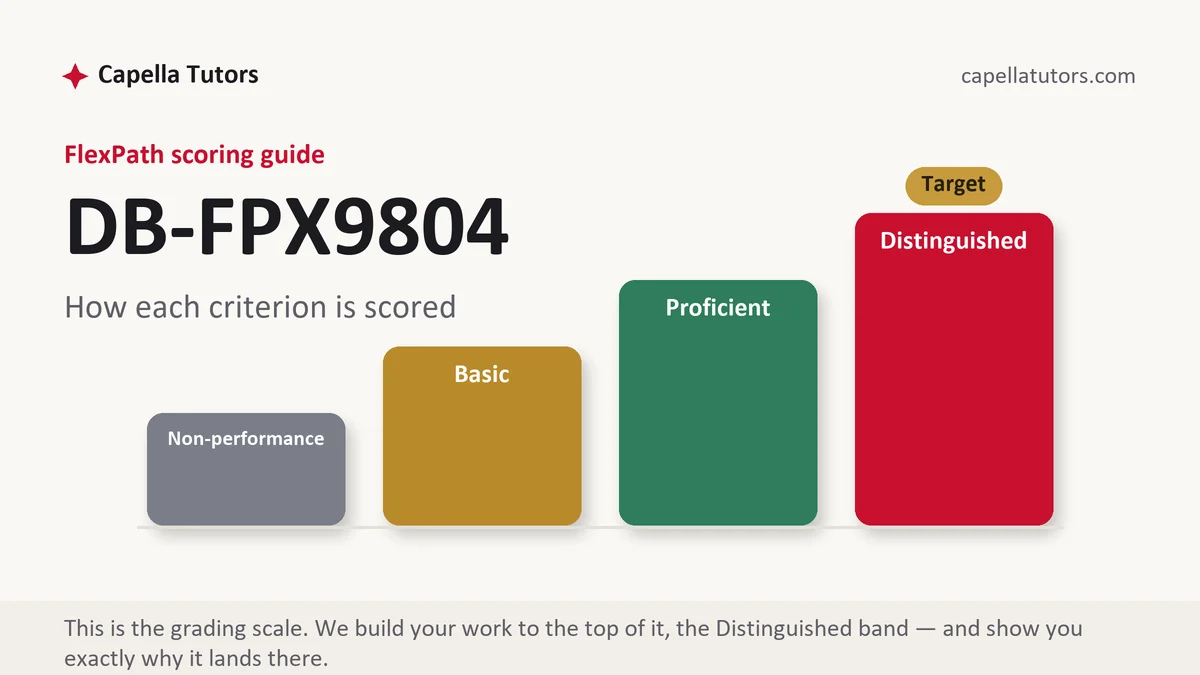
What DB FPX 9804 actually grades
By this point nobody is grading your idea. They are grading whether one document holds together when read end to end for the first time, and that is a different test from the one each chapter passed on its own. Reviewers look for the seams: an abstract describing the study you planned rather than the one you ran, a problem statement still promising something the data never addressed, a purpose sentence in future tense three chapters after the work finished, a discussion claiming a relationship no table in the manuscript contains. Consistency is the criterion, and it is checked mechanically.
Presentation of the artifact is graded too, which offends people who think format is trivial and costs them a submission anyway. Heading levels, table titles and notes, figure numbering, the abstract's length ceiling, page order, appendix labels and one consistent APA reference list are inspectable in minutes, and a reader who finds four of them wrong starts hunting rather than reading. Fix formatting as a discrete task with the template open beside you, and do it before the intellectual pass rather than after.
Then there is the talk. The criteria treat it as executive communication rather than as a lecture: decision first, method compressed to what the audience needs to trust the numbers, findings delivered with magnitude, and a recommendation somebody could fund. You are also being graded on how you answer questions, which means separating what the data shows from what you believe, and saying the words that a doctoral audience respects most, which are that the study cannot answer that and here is what would.
How we help in this course
Send the manuscript and we run the audit in reverse: discussion first, then results, then method, then the problem statement, marking every claim that no table supports and every number that changes between chapters. What comes back is a corrected document plus a short reconciliation log listing what moved and why, which is the artifact your chair can check quickly rather than a silent rewrite nobody can verify.
The presentation is built from the same source: a slide set at the length your guide asks for, speaker notes timed to a spoken minute per slide, and a list of the questions your own findings invite, each with an answer that concedes what needs conceding. Studio terms hold. One premium original deliverable inside 24 to 48 hours, an eight person pipeline including a reader assigned only to the number census, and revisions at no charge until the criteria clear.
The assessments, one by one
Assessment 1
Assessment 1 of DB FPX 9804, Final Reviews and Presentation, usually asks for the pass nobody enjoys and every manuscript needs: the whole document read backwards, every claim checked against the table that supports it, every repeated figure traced across chapters, and a reconciliation log recording what moved and why. Read the full Assessment 1 manual.
Assessment 2
Assessment 2 of DB FPX 9804, Final Reviews and Presentation, usually asks for the artifact itself: an abstract describing the completed study inside its length limit, front matter in the required order, headings, tables, figures and appendices conforming to the template, and a reference list. Read the full Assessment 2 manual.
Assessment 3
Assessment 3 of DB FPX 9804, Final Reviews and Presentation, usually asks for the talk: a deck at the length your guide specifies, speaker notes timed by rehearsal, a recommendation somebody could fund, and answers prepared for the questions your own findings invite. Read the full Assessment 3 manual.
How to actually write DB FPX 9804: where to begin
Read the document backwards before you touch a word of it. Start at the last paragraph of the discussion and work toward chapter one, asking one question at every claim: which table in this manuscript proves that. Claims with no table behind them either get evidence or get deleted, and there is no third option that survives a careful reader. Then check the tense and the promise. If collection changed, and it usually does, the early chapters have to describe the study that actually happened, in past tense, with the purpose sentence rewritten to match the population you reached rather than the one you hoped for.
Then run the number census, which is the least intellectual and most decisive task in the course. List every figure that appears more than once and trace each one across the manuscript: the usable sample, the response rate, the effect size, the interval, the percentage in the abstract, the count in the discussion. A results chapter reporting 128 usable cases beside an abstract saying 130 and a discussion rounding to about 130 is three errors from one drift, and reviewers who find it assume the analysis drifted too. Fix rounding conventions in the same pass, two decimals for effect sizes and coefficients, one for percentages, whole dollars for money, and apply them everywhere including the appendices.
Then build the talk to arithmetic rather than to taste. Take the length your guide specifies, budget roughly a spoken minute per slide, and hold back a fifth of the time for questions, so an eighteen minute slot becomes about fourteen slides with four minutes in reserve. Spend two slides on the problem and why an executive should care, two on method, five on findings, three on recommendations and one on limitations. Rehearse twice out loud against a timer, standing, without reading the slides, because the version you have only read silently always runs long and always sounds like a document.
Then cost the recommendation, since a practice doctorate is judged on what somebody could do on Monday. Say the finding supports redesigning supervisor onboarding: facilitation at $9,500, forty-six supervisors away from the floor for four hours each at a loaded $52 an hour for $9,568, materials and tracking at $12,000, so roughly $31,000 in the first year. Set that against nine separations avoided at a replacement cost near $23,200, which is about $208,800, then name the assumption the whole case rests on and say what happens if it moves. Attach an owner, a measure the organization already reports, and a review date, and prepare the three questions you least want to be asked, because they will be the first three.
| Section | What goes in it | What Distinguished looks like |
|---|---|---|
| Abstract and front matter | The study as completed, inside the length limit, with the required pages in order. | An abstract naming design, sample, principal finding and practice implication in past tense. |
| Alignment across chapters | Problem, purpose, questions and method rewritten to describe what happened. | No promise in chapter one that the later chapters fail to keep, and no tense left in the future. |
| Findings and discussion | Each interpretation tied to the table that supports it, with prior work compared. | Every claim traceable to a result, and each divergence from published estimates explained. |
| Limitations and recommendations | Design boundaries, and actions with cost, owner, measure and review point. | Limitations stated as design facts, and recommendations a committee could fund unchanged. |
| Formatting and references | Template compliance, headings, tables, appendices, current APA both directions. | Nothing for a reviewer to correct, so the reading attention goes to the argument. |
| Presentation and notes | Slides at the length required, speaker notes, and the anticipated question list. | A deck built for a decision maker, timed by rehearsal, with sources shown on borrowed figures. |
Developing the analysis
The contribution argument is what most final drafts underwrite. A doctoral project in business is expected to change what a practitioner does, so the discussion has to name the practice that changes, the setting where the change applies, and the boundary past which your evidence stops covering it. Contribution to practice is not the same as contribution to theory, and claiming both from one study inside one organization is the fastest way to look inexperienced. Say which one you are claiming, then defend the scale of it honestly.
Limitations belong in the same argument rather than in a corner. A single site, a cross sectional window, self reported measures and a response rate under a third are facts about the design, and stating them as facts costs nothing while apologizing for them costs credibility. The useful version explains what each limitation does to the reading of a specific finding, then names the study that would settle the question. A reviewer who sees a limitation described precisely usually stops looking for the ones you missed.
Citations that survive faculty review
Late stage citation work is a repair job rather than a research job. Anything cited in the discussion should already have appeared in the literature review, and the exception is a source brought in to explain a surprise the data produced, which is legitimate and belongs in both chapters. Every citation added during revision has to be checked twice, because sources inserted late are where mismatched years, missing entries and half remembered attributions accumulate.
Then reconcile the list mechanically in both directions, confirm the template's reference rules rather than the ones you learned elsewhere, and check that DOIs, retrieval statements and organizational authors follow one convention throughout. Slides need citations too: any borrowed figure, benchmark or framework diagram carries its source on the slide, and the deck's final page lists the works a listener might want. A presentation that shows an industry statistic with no attribution invites the one question you cannot answer.
The mistakes that land Basic instead of Distinguished
- An abstract describing the proposal. Future tense in the abstract tells a reviewer the document was never read as a whole.
- Figures that disagree between chapters. One drifted sample size undermines every table that follows it.
- Limitations written as apologies. Regret is not analysis, and it invites the reader to discount the findings.
- Recommendations with no cost and no owner. An action nobody owns and nobody funds is a wish in a doctoral binding.
- A talk that spends half its minutes on literature. The audience came for your findings, not for chapter two.
DB FPX 9804 questions students actually ask
What do final reviewers actually check?
Consistency, completeness and compliance, in that order, and almost never originality. Consistency means the same study is described in the abstract, the problem statement, the method and the discussion, with the same numbers throughout. Completeness means every required element exists, the appendices contain what the method promised, and each research question has a visible answer. Compliance means the template, the reference style and the reporting conventions were followed without the reviewer having to correct them. Substance is judged too, but a reviewer who spends the first hour on formatting reads the argument with less patience.
How long should the presentation be and what goes on the slides?
Follow the length your guide states, and treat it as a hard ceiling rather than a target. Slides carry the skeleton and your voice carries the content, which means a headline that states a finding, one exhibit that proves it, and nothing else on the surface, with the detail living in the notes. Put the answer early: an executive audience wants the finding and the recommendation in the first three minutes and the method only far enough to trust the numbers. Show effect sizes and dollars rather than screenshots of output, keep one idea per slide, and end on the recommendation with its owner and its cost visible so the last thing on screen is the thing you want funded.
What if a reviewer asks for a change I disagree with?
Separate taste from requirement before replying. Where the note reflects a rule, a template, a reporting convention or an ethical standard, make the change and move on, because that argument has no upside. Where it is an interpretive judgment, answer in writing with evidence: cite the table, quote the guide, and offer the alternative wording you think is defensible. Ask one clarifying question rather than several, and never send a reply that reads as a defense of your feelings about the work. When the note is simply a preference and the cost of complying is a paragraph, comply, because the calendar you spend arguing is longer than the calendar you spend rewriting.
Final review or presentation coming up?
Send the manuscript and the guide. The first premium sample is free, and the reconciliation log comes with it.