Send the seminar prompt and the scoring guide and a premium original doctoral sample returns inside 24 to 48 hours, built to the Distinguished descriptors with a reproducible search strategy and a synthesis matrix behind every claim. The course reads DB FPX 8650, Seminar: Leadership Literature Review, on a transcript, worth 3 program points, a seminar in the Organizational Leadership and Development specialization, taught in FlexPath within the 45-point Doctor of Business Administration. In Capella's catalog the course code is written DB-FPX8650.
What DB FPX 8650 actually grades
A literature review at doctoral level is an argument assembled from other people's evidence, and this seminar grades the assembly. The criteria are looking for a search that somebody else could repeat, a screening process with numbers attached, an appraisal that distinguishes strong studies from weak ones, and a synthesis organized around what the literature disagrees about. The deliverables in this seminar usually ask for the review itself plus an account of how it was produced, and your scoring guide decides how formal that account has to be. What consistently fails is the annotated bibliography written in paragraphs, where each source gets its turn and no claim is ever built from more than one of them.
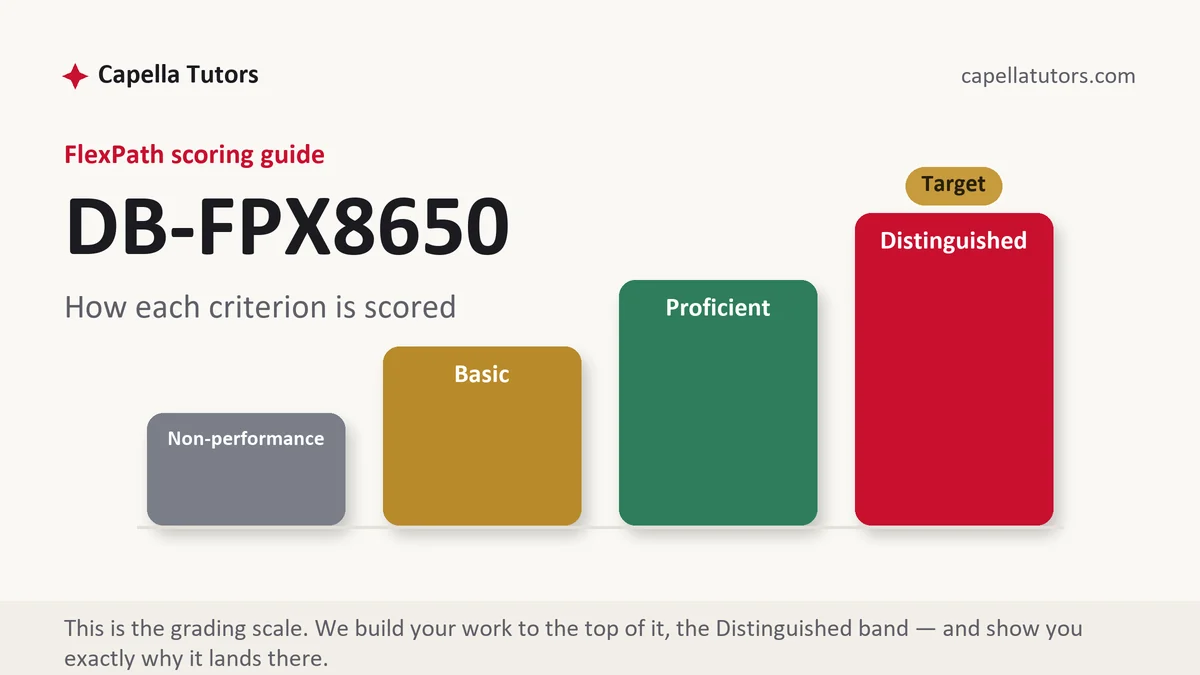
Organization is the visible difference between the columns. A review structured author by author tells the reader what you read. A review structured by theme tells the reader what the field currently holds, and a review structured by point of contention tells the reader what remains open, which is the structure that sets up a doctoral project. Inside each theme the paragraph shape matters as much as the sequence: state the claim, cite the studies that support it with their designs indicated, cite the studies that complicate it, then say what you conclude and how confidently. Any paragraph in a review that ends without a judgment is a paragraph that has stopped short of the criterion.
The third thing this seminar grades is your handling of construct trouble, which is severe in leadership research and largely invisible to newcomers. Two studies measuring authentic leadership may share a label and not a scale, engagement is operationalized several incompatible ways across the outlets you will search, and a review that pools them silently has produced an average of different things. Doctoral treatment names the instrument alongside the finding, groups studies by what was actually measured rather than by what it was called, and says so in the synthesis when an apparent disagreement turns out to be about definition rather than about the world.
How we help in this course
In 8650 we hand over the apparatus as well as the prose. You get the search log with databases, strings, limiters, and dates, the screening counts at each stage, the inclusion and exclusion rules stated as rules rather than as preferences, and the synthesis matrix that shows which source supports which claim. The narrative is written from the matrix, which is why the paragraphs carry judgments rather than summaries. Tell us the review question, the criteria, and any sources your faculty has already asked you to include, and everything is built around that spine.
Turnaround and terms match the rest of the studio, with one difference worth knowing about for review work. Documents are returned within 24 to 48 hours, argued at the level the top column describes, and the citation and originality pass on this course is heavier than usual because a review lives or dies on reference integrity, so every in-text citation is checked against the reference list and every reference against the retrieved record. You are not billed for further passes while a criterion is unmet, and anything your faculty sends back is worked in at no cost. If your faculty adds sources after the first read, sending them straight back is the fastest route, since the matrix already exists and only the affected claims need rewriting.
The assessments, one by one
Assessment 1
Assessment 1 of Seminar: Leadership Literature Review usually asks for the review question and the method behind it: a bounded question, inclusion and exclusion rules fixed in advance, and a search another researcher could rerun and land near your set. Read the full Assessment 1 manual.
Assessment 2
Assessment 2 of Seminar: Leadership Literature Review usually asks for the funnel and the appraisal: counts at every screening stage with grouped reasons for exclusion, and a matrix that records what each retained study actually did rather than what it concluded. Read the full Assessment 2 manual.
Assessment 3
Assessment 3 of Seminar: Leadership Literature Review usually asks for the synthesis itself and the gap that follows from it: themes built from several studies at once, disagreements explained rather than smoothed, and a gap a reader can see arriving out of the reading rather than out of your preference. Read the full Assessment 3 manual.
How to actually write DB FPX 8650: where to begin
Write the review question before you search, in a form that names the population, the phenomenon, the outcome, and the boundary. Then build the strategy from the question rather than from the topic, because a question about first-line supervisors in distribution operations produces very different search terms than a topic labelled leadership and retention. Each criterion becomes a heading, and the criteria in a review seminar usually cover the question and rationale, the method of the search, the appraisal, the synthesis, and the statement of what remains unresolved. Draft the method section as you work rather than reconstructing it afterwards, because reconstruction is where accuracy dies.
Then put numbers on the funnel, since a reviewer trusts a review with an audit trail and questions one without. A search of Business Source Complete and PsycINFO combining leader or supervisor terms with turnover and retention terms, limited to peer-reviewed English-language work from 2016 forward, might return 1,240 records. Deduplication removes 210 and leaves 1,030. Title and abstract screening against your written inclusion rules removes 940 and leaves 90 for full-text reading. Of those, 52 fail on setting, level of leader, or outcome measured, leaving 38 studies in the synthesis. Report those five numbers and the reasons at each stage, and note the workload honestly, because 90 full-text appraisals at 25 minutes each is 37 and a half hours before any writing begins. Candidates who plan for that finish the seminar on time.
Then appraise rather than describe. For each included study, record the design, the sample and its setting, the measure of leadership, the measure of the outcome, whether both came from the same respondent, the effect reported, and the limitation the authors themselves named. Those seven fields turn into a matrix that does the synthesis for you, because sorting by measure reveals which disagreements are definitional, sorting by design reveals which claims rest only on cross-sectional survey work, and sorting by setting reveals the boundary of what the field has actually tested. Say the strength of each conclusion out loud, using the language of weight of evidence, and reserve the confident verbs for claims supported by more than one design. That calibration is the single most visible marker of doctoral reading.
| Section | What goes in it | What Distinguished looks like |
|---|---|---|
| Review question and rationale | Population, phenomenon, outcome, and boundary, with the reason the review is needed now. | A question specific enough that its search terms are obvious from reading it. |
| Search method | Databases, search strings, limiters, date range, and the dates the searches were run. | A strategy another researcher could rerun and roughly reproduce, documented as it happened. |
| Screening and selection | Inclusion and exclusion rules, counts at each stage, and the reason records were dropped. | Numbers reported at every stage, with exclusion reasons grouped rather than left implicit. |
| Appraisal | Design, sample, setting, measures, source of ratings, effect, and author-stated limitations per study. | Study quality discriminated in the text, so weak and strong evidence are not cited in the same breath. |
| Synthesis | Themes or points of contention, each built from multiple studies, with a stated conclusion. | Definitional disagreements separated from empirical ones, and confidence expressed proportionally. |
| Gap and implications | What remains unresolved, for whom it matters, and what a study could usefully do next. Current APA both ways. | A bounded gap that follows visibly from the synthesis rather than from the candidate's preference. |
Developing the analysis
The synthesis is where a review becomes doctoral, and the move is to write about the literature rather than through it. Leadership research offers several disagreements substantial enough to organize a review around. Whether transformational leadership adds explanatory power beyond transactional practice is contested and the answer depends on whose ratings supply the outcome. Whether leadership development programs change behavior or only change self-perception depends on whether the evaluation used multi-source ratings or a post-course survey. Whether span of control harms supervisory quality has support and a boundary condition, since the effect looks different where the work is standardized. Pick the disagreement your project will sit inside, then write the paragraph that a committee remembers: here is the claim, here are the studies that support it and the designs they used, here are the studies that do not and the reason the results differ, and here is what I conclude while acknowledging what would change my mind. A review that names three open questions and settles one is stronger than one that appears to settle all three.
Citations that survive faculty review
Balance is what a faculty reader checks first, and it has two dimensions. Currency means the bulk of your empirical evidence should be recent, conventionally the last five years unless your question is historical, because a review of 2009 studies describes a field that has moved. Provenance means the founding claims still go to their original publications, so a review touching leader-member exchange cites the work that introduced it as well as the recent tests of it. Draw the empirical body from peer-reviewed outlets a business faculty recognizes, with The Leadership Quarterly, the Journal of Applied Psychology, Personnel Psychology, Human Resource Development Quarterly, and the Academy of Management journals available through the Capella library and Business Source Complete. Include any systematic review or meta-analysis in your area and treat it as a map rather than as an answer. Then run reference integrity as a separate task: every citation matched to a reference, every reference matched to a record you actually retrieved, every author-year pair verified against the article rather than against a database summary, and every quotation checked against the source page. Reviews fail on that last item more often than on argument.
The mistakes that land Basic instead of Distinguished
- Writing an annotated bibliography in paragraph form. One source per paragraph proves reading and never produces synthesis, which is where the criterion sits.
- A search that cannot be reproduced. Missing databases, strings, or date limits makes the method section unverifiable and the review unauditable.
- Pooling studies that measured different constructs. A shared label is not a shared scale, and averaging across instruments manufactures a finding.
- Citing weak and strong designs in one undifferentiated list. A cross-sectional survey and a longitudinal multi-source study do not carry the same weight and the text should show it.
- A gap statement that does not follow from the synthesis. If the gap was decided before the reading, the review reads as decoration for a conclusion already reached.
DB FPX 8650 questions students actually ask
How many sources does a doctoral literature review need?
Enough to support the claims you make, which in practice means the count follows from the question rather than from a target. A tightly bounded review question with a defensible search will often yield between thirty and sixty included studies, and the number that matters is not the total but the number supporting each claim in your synthesis, because a theme resting on two papers is a theme you should mark as thinly evidenced. If your search returns very few records, widen the boundary deliberately and say what you widened and why. If it returns thousands, tighten the population or the outcome rather than screening arbitrarily. Report your counts either way, since a reviewer reading a documented funnel judges the process, and a reviewer reading a bare bibliography can only judge the length.
Can I use sources older than five years?
Yes, for the right jobs. Founding theoretical statements should be cited to their original publication regardless of date, because the point of citing them is provenance. Landmark empirical studies that shaped how a construct is measured belong in the review with their dates visible. What weakens a review is using an older study as current evidence for a claim about the present, particularly in areas that have changed materially, and remote and hybrid leadership is the obvious example where a 2014 finding may describe a different world. The workable rule is that recent peer-reviewed work carries your empirical claims while older work carries theory, definition, and history, and you make the distinction visible in the sentence rather than leaving the reader to infer it.
How do I handle two studies that flatly contradict each other?
Treat the contradiction as your material rather than as a problem to smooth over. Put the two studies side by side and compare them on the fields that usually explain a divergence: who was sampled and in what sector, how leadership was measured and by whom, how the outcome was measured and by whom, the time lag between measurements, and the analytic model used. In leadership research most apparent contradictions dissolve into one of those differences, and naming which one is doing the work is a genuine contribution in a review. Where the difference does not explain the divergence, say that plainly, note which study has the stronger design, and record the question as open. A candidate who can hold a real disagreement open without either dodging it or pretending to settle it is demonstrating exactly the judgment the criteria describe.
Literature review draft due?
Send the review question, the criteria, and any sources your faculty has flagged. You get the search log, the appraisal matrix, and the synthesis written from it. Your first sample is free of charge.