Tell us which piece of the project is actually outstanding and a premium original sample of exactly that piece returns inside 24 to 48 hours, written to the guide you send, with free revisions until it clears. The identity: DB FPX 9980, Doctoral Project Development, 2 program points, the continuation course attached to Capella's FlexPath DBA doctoral project, sitting outside the standard 45 point sequence rather than inside it, and taken while the project is finished with your chair. In Capella's catalog the course code is written DB-FPX9980.
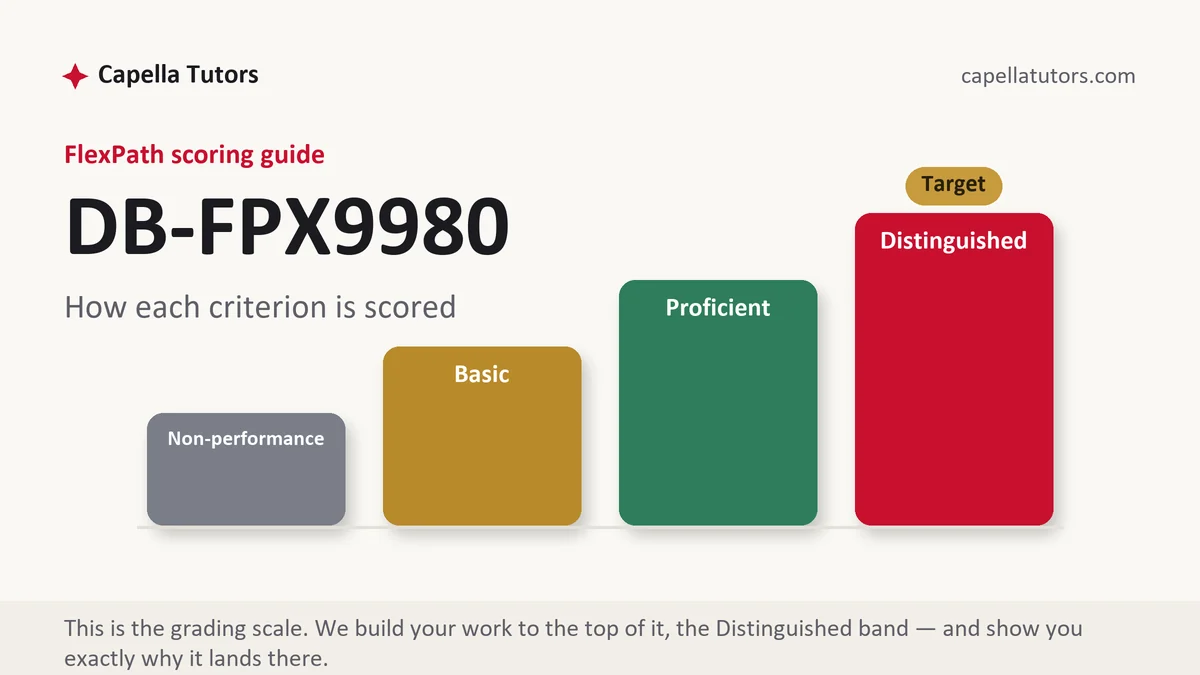
What DB FPX 9980 actually grades
This is the course you register for when the project is not done and the sequence has run out. That is common enough to be unremarkable, and treating it as a verdict on your ability wastes the one resource the course exists to give you, which is time attached to supervision. What gets graded is documented movement: a plan agreed with your chair, work produced against that plan, and evidence at the end of the term that a named deliverable is closer to finished than it was at the start.
Because the outstanding piece differs for every learner, there is no fixed artifact to write and no standard shape to copy. One person is still hunting for a site, another has an approved protocol and 41 responses where 84 were needed, a third has a complete results chapter that contradicts the purpose statement written eighteen months earlier. The criteria are built to accommodate all three, which sounds generous and is actually demanding, because you have to define the deliverable yourself and then be measured against your own definition.
The economics deserve a sentence. The course carries 2 program points and sits outside the standard sequence, so it adds cost and calendar rather than credit toward the required total, and how many terms you need is a conversation between you, your chair and the university. That is the argument for ruthless prioritization: a week spent polishing something already acceptable is bought at the price of a continuation term.
How we help in this course
The first thing we do is scope, not write. Send the current manuscript, the last set of chair comments and the guide, and you get back an inventory of what is approved, what is drafted, what is missing and what is blocked by somebody other than you, with the next deliverable named in one sentence. Most learners in a continuation term are working on the wrong thing, usually the chapter they find easiest rather than the one holding the project.
After that the studio terms apply to whatever the outstanding piece turns out to be: a premium original sample inside 24 to 48 hours, drafted to the Distinguished descriptors of your guide, run through an eight person pipeline, and revised at no charge until the criteria clear. Chair comments re-enter the same cycle free. FlexPath gives faculty two business days to evaluate a submitted attempt, and doctoral supervision does not run on that clock, so the pipeline is built to keep you producing while a longer review is out.
The assessments, one by one
Assessment 1
Assessment 1 of DB FPX 9980, Doctoral Project Development, usually asks you to define the work of the term before starting it: an inventory of what is approved, drafted, blocked and untouched, the single stage that is actually holding the project, and a deliverable named with dates a chair has agreed to. Read the full Assessment 1 manual.
Assessment 2
Assessment 2 of DB FPX 9980, Doctoral Project Development, usually asks for the work itself rather than the plan for it: the blocked deliverable produced, the writing turned into a session count somebody can audit, and the access problem either solved or converted into a design that no longer needs solving. Read the full Assessment 2 manual.
Assessment 3
Assessment 3 of DB FPX 9980, Doctoral Project Development, usually asks you to close the term on evidence: one running register of what went out, came back, changed and remains open, a literature and data refresh with the date it was run, and a statement of where the named deliverable now stands. Read the full Assessment 3 manual.
How to actually write DB FPX 9980: where to begin
Diagnose before you write, on one page. List the stages of the project down the left and mark each one approved, drafted, blocked or untouched, then write the single sentence naming what has to exist next and who has to see it. Stalls cluster into a small number of shapes: a problem never narrowed enough to be studied, a site that never confirmed, a protocol circling in revision, a collection window that closed with too few responses, a results chapter that no longer matches the purpose it was built for, and the revision loop where every pass repairs something different. Name yours out loud, because the wrong diagnosis produces months of honest work on the wrong document.
Then do the calendar arithmetic, which is the number that governs a continuation term. If your chair takes ten to fourteen days on a section and the piece needs three passes before it is accepted, that is roughly five to six weeks of elapsed time in which you are writing nothing new unless you plan for it. Twelve week billing sessions do not stretch to accommodate a sequential habit. So send work earlier and rougher than instinct allows, keep a second section moving while the first is out, and never let a review return to an empty desk. A section that comes back marked up on day twelve should meet a writer who spent those twelve days on the next one.
Then make production mechanical. A results chapter of about 6,000 words, written at 500 usable words a session, four sessions a week, is three weeks of work and not the three months it feels like from the outside; the difference between those two numbers is almost entirely decision fatigue rather than typing speed. Fix the session length, fix the time of day, and start each session by rereading only the last paragraph rather than the whole chapter.
Then be honest about waiting. If access has been two weeks away for the last eight weeks, it is not two weeks away, and the project needs a different plan rather than more patience. The usual conversions are archival: records the organization already holds, a second site in the same sector, or filings that answer a narrower version of your question. Take that to your chair with the alternative already drafted. Whatever you do, do not restart chapter one, which is the classic displacement activity of a stalled project and produces a beautifully polished introduction to a study that still has no data.
| Section | What goes in it | What Distinguished looks like |
|---|---|---|
| Progress plan | The deliverable for this term, its milestones, and the dates each one is sent. | A plan agreed with the chair in writing, with dates that account for review time rather than ignoring it. |
| Diagnosis of the stall | Which stage is blocked, by what, and who can unblock it. | The real obstacle named, including the ones that are your own habits rather than external delays. |
| Access and data | Current status of the site, the sample, the collection window and any fallback. | A fallback already drafted, with the decision point and the date it triggers stated in advance. |
| Writing production | Word targets, session pattern, and the order sections are written in. | Output logged against a schedule, with the hardest section scheduled first rather than last. |
| Revision loop | What went out, when it returned, what changed and what is still open. | A single running list of open items, so no comment is answered twice and none is quietly dropped. |
| Communication record | Dates of contact with chair, committee and site, and decisions taken. | A record complete enough that a new reader could pick up the project without a meeting. |
Developing the analysis
Long projects age, and the analytic argument ages fastest. A literature search run two years ago is no longer current, and a reader will notice that the newest source in a chapter predates the pandemic era of workplace research or the arrival of whatever technology now sits in the middle of your topic. Re-run the search with the same terms and an extended window, record the date you ran it, and read what appeared since. Occasionally somebody has published something close to your study, which feels like a disaster and is usually a gift, because it hands your discussion a comparison.
Check that the gap still exists in the form you claimed. If new work has closed part of it, narrow the claim rather than ignoring the paper, and say in the text what the recent evidence settles and what it leaves open. Data ages as well: figures describing your organization in a year that ended long ago need the year attached and, where the business has changed shape since, a sentence acknowledging it. The point is to head off the one question you cannot answer, which is why anyone should still trust a study framed three years ago.
Citations that survive faculty review
Reference lists decay quietly over a long project. Links rot, preprints turn into published articles with different pagination, a source cited from a working paper now exists in a journal, and occasionally a paper you relied on has been corrected or withdrawn. Re-verify every reference before the next submission, confirm each DOI resolves, and update anything that moved from preprint to print so the citation points at the version of record.
Then check that the balance still reads as doctoral. Recent peer reviewed empirical work should dominate, seminal theory stays cited to the original whatever its age, and public data carries its vintage. Where a continuation term has added sources, run the two way check from scratch rather than trusting the earlier pass. A reference manager helps only if you reconcile it against the document itself, since the errors that get noticed are the ones software cannot see.
The mistakes that land Basic instead of Distinguished
- Treating the term as a pause. Registration without a written plan produces twelve weeks and no deliverable.
- Polishing before sending. A rough section reviewed this week beats a perfect one reviewed next month.
- Working on the comfortable chapter. Progress on anything except the blocked stage is motion rather than movement.
- Waiting on a silent site. No fallback named means the delay becomes another term.
- Changing topic late. A new question at the results stage restarts a project that was three months from finished.
DB FPX 9980 questions students actually ask
What is the continuation course actually for?
It buys supervised time when the project outlasts the sequence, for reasons that are usually structural rather than personal. Approval cycles run long, organizations reorganize halfway through a collection window, response rates arrive at half the modeled figure, and any one of those pushes a project past the courses built to carry it. Use the term as a project term with a defined deliverable rather than as breathing space, and agree that deliverable with your chair in writing early, because the terms that produce nothing are the ones that started without a target.
How do I get unstuck when every review takes weeks?
Stop treating the project as one queue. Break the outstanding work into pieces that can be reviewed independently, send the first, and begin the second the same afternoon rather than waiting to hear back. Ask your chair which single change matters most when a set of comments is long, because a list of fifteen edits usually contains two that decide acceptance. Send a short status note on a predictable day each week whether or not there is news, since the supervision relationship works better with a rhythm than with silence broken by requests. If a review has been out significantly longer than usual, a polite factual follow up naming the date you sent it is entirely appropriate.
Can I change the design or the topic at this stage?
Design, sometimes and with your chair's agreement; topic, almost never without paying for it in terms. Swapping a survey for interviews or an original collection for archival records is a real option when access has failed, and it is usually cheaper than waiting, but it means revising the method chapter, submitting an amendment to the review board and re-justifying the sample. Changing the question itself sends you back to the literature, the alignment and the approvals, which is why it is worth doing only when the original question has become unanswerable rather than merely inconvenient. Write the comparison down, weeks against weeks, and make the decision on the arithmetic rather than on how tired the current plan makes you feel.
Project stalled and the term running?
Send the manuscript and the last chair comments. The first premium sample is free, and the scope inventory comes first.