Send us the prompt and the scoring guide and a premium original sample comes back inside 24 to 48 hours, written toward the Distinguished descriptors and revised free until the criteria are met. The transcript entry reads DB FPX 8410, Addressing Problems in Human Resources and Compliance, worth 3 program points, a doctoral core course in Capella's FlexPath DBA, which runs 45 points across its three specializations. In Capella's catalog the course code is written DB-FPX8410.
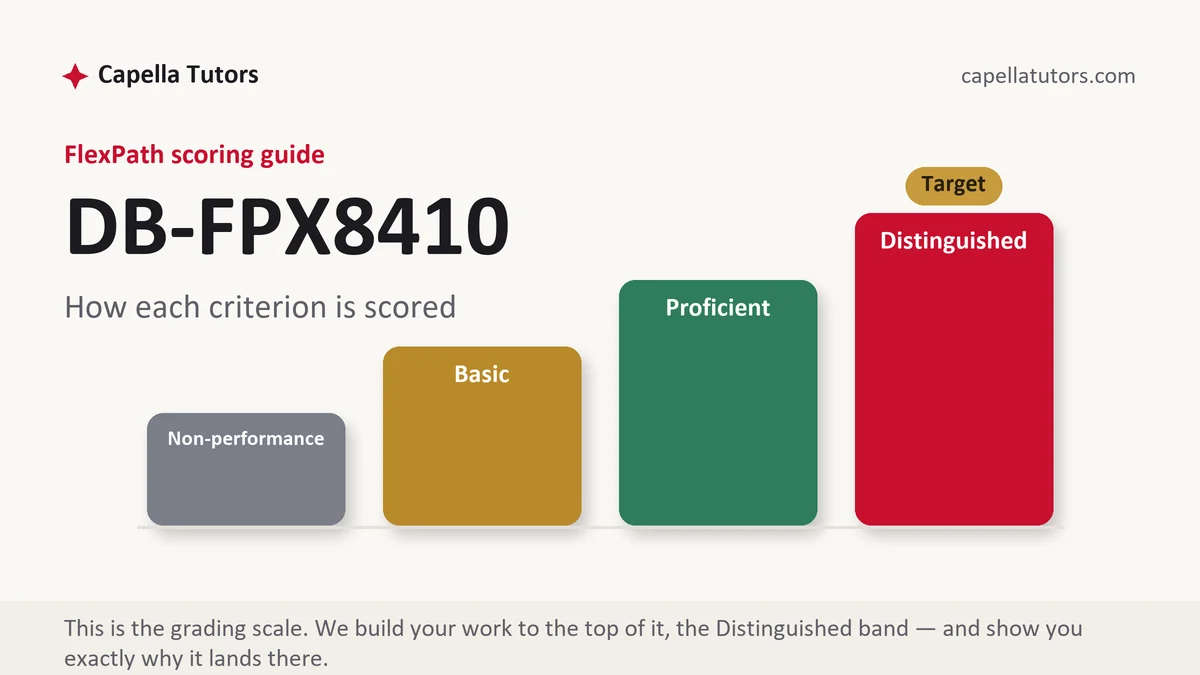
What DB FPX 8410 actually grades
DB FPX 8410 marks one specific competence: whether you can look at a workforce problem and see the legal exposure, the operating cost and the root cause at the same time, then design something that reduces all three. It is not an employment law course and it does not want a law review paper. It wants the analysis a senior officer produces in the week before a board committee asks how much this could cost us and what we are doing about it.
The first thing the criteria check is whether you can name the obligation correctly. There is a wide gap between a paper saying the company may have discriminated and one identifying whether the theory is disparate treatment or disparate impact, which statute supplies it, which agency enforces it and what the employer would have to show. Title VII of the Civil Rights Act of 1964, the Americans with Disabilities Act, the Age Discrimination in Employment Act, the Fair Labor Standards Act, the Family and Medical Leave Act, the National Labor Relations Act and the Occupational Safety and Health Act cover different conduct and different employers, and a doctoral paper cites the provision rather than a description of it. State law frequently imposes more, which is why a compliance analysis stopping at the federal floor is incomplete for any employer with a location inside one.
The second thing graded is arithmetic, because compliance problems are priced. Adverse impact is a ratio. Wage exposure is hours times a rate times a population times a period. Attrition after a policy change is a count over a denominator inside a window. The criteria reward a candidate who turns an abstract risk into a range with its assumptions declared, and they punish the phrase significant legal risk, which tells a reader nothing and conceals the fact that the writer never did the calculation.
The third is the design of the response, and this is where most drafts thin out. A policy is not a program. A compliance program a doctoral reader will accept has an owner by role, a documented procedure, training aimed at the people whose behavior has to change, a monitoring measure that would detect recurrence, a defined consequence when it recurs, and a review date. The criteria also watch for root cause. A supervisor who misclassified an employee because the job description had not been touched since 2014 is a documentation failure, and retraining that supervisor fixes nothing.
How we help in this course
Our 8410 drafts arrive with the numbers already run. Selection rates are calculated by group with the counts shown, pay exposure is modeled with the rate, the hours and the period visible, and every legal reference points at the provision rather than at a secondary account of it. The program you propose comes with an owner, a monitoring measure and a review date, so a reader can see how the organization would learn that the problem had returned. Hand us the job descriptions, the applicant counts or the policy text you are working from and the analysis runs on those rather than on a constructed scenario.
The commercial terms do not move. One premium original deliverable inside 24 to 48 hours, an eight-person pipeline, a dedicated scoring-guide pass, a separate current APA and originality pass, and revision at no charge until the criteria are satisfied. Comments from your faculty re-enter that same pipeline without a charge. Since an evaluator holds a submitted attempt for up to two business days, tell us the date you plan to submit and the schedule gets built from there.
The assessments, one by one
Assessment 1: Analyze a Set of Worker Complaints
A consultant-style report for senior management that analyzes employee complaints, assesses their legal and organizational risk, and recommends responses. Read the full Assessment 1 manual.
Assessment 2: Employee Complaint Analysis
A deeper risk assessment of the higher-risk complaints, the legal liability involved, and recommended policies and training to reduce it. Read the full Assessment 2 manual.
Assessment 3: Critical Incident Analysis
Analyze a serious workplace incident, the actions, errors and omissions involved, the potential legal liabilities and their severity. Read the full Assessment 3 manual.
How to actually write DB FPX 8410: where to begin
Take the guide apart and sort the criteria into the two questions they are really asking, which are what is the exposure and what will you do about it. Everything in the deliverable serves one or the other. In current courserooms the assessments include "Analyze a Set of Worker Complaints", "Employee Complaint Analysis" and "Critical Incident Analysis" among others, and your scoring guide decides the exact format of each. Put the exposure figure on the first page, because a reader who reaches page four without a number has already decided how this is going.
Then run the selection arithmetic if the problem touches hiring, promotion or a reduction in force, since the criteria expect the calculation rather than the impression. Suppose a warehouse operation fills 66 openings from 240 applicants. Of 90 applicants in one group, 36 are hired, a selection rate of 40 percent. Of 150 in the other, 30 are hired, a rate of 20 percent. The impact ratio is 20 divided by 40, or 0.5, well under the four fifths threshold that enforcement guidance uses as a screen. Two things then belong in your paper. The first is what the ratio means procedurally: it is a flag that turns attention to whether the selection procedure is job related and consistent with business necessity, and it is a rule of thumb in guidance rather than a legal test standing alone, which matters because at small counts one hire moves the ratio dramatically. The second is where the disparity is produced, since a ratio computed at the offer stage often hides a screen applied three steps earlier, and the fix belongs at the screen.
Then price the wage and hour exposure if the problem touches classification, because it is the arithmetic executives follow fastest. Twenty two client service coordinators are paid a $54,000 salary, treated as exempt, and the duties in their job descriptions are largely routine work performed under close supervision. If the classification is wrong, the regular rate is roughly $25.96 an hour across a 2,080 hour year, overtime runs at one and a half times that, about $38.94, and six hours a week beyond forty across 46 worked weeks is 276 hours each. Over 22 people that is 6,072 hours, or near $236,000 for a single year, before liquidated damages, interest, the cost of the audit that finds it, and the fact that a lookback period is longer than one year. Write the figure, then name the assumption that would change it most, which here is the estimate of weekly hours, and show the result at four hours and at eight.
Then design the response as a program rather than a memo. Name the owner by role, state the change to the document or system that produced the problem, specify who is trained and on what, and choose a monitoring measure the organization can produce from data it already keeps. For a classification problem that might be the proportion of exempt job descriptions reviewed against current duties inside 24 months. For a selection problem it might be the impact ratio recomputed each quarter at every stage of the funnel rather than at the offer. Then add the two sentences most drafts omit: what happens when the monitor trips, and when the whole program is reviewed. Close by stating that this is a management analysis and that the organization should take advice from counsel before acting, which is not a hedge but an accurate description of what a doctoral candidate is qualified to produce.
| Section | What goes in it | What Distinguished looks like |
|---|---|---|
| The situation | What happened, to whom, over what period, taken from documents rather than recollection. | A factual account with dates, counts and sources, kept apart from the writer's interpretation. |
| Obligations engaged | The statutes, regulations and agency guidance in play, with the provision identified. | Federal and state obligations both addressed, cited to authority rather than to a summary. |
| Exposure priced | The financial and operational cost modeled, with rates, hours, population and period shown. | A range with declared assumptions, and a sensitivity on the input most likely to be wrong. |
| Root cause | The system, document or incentive that produced the behavior, evidenced rather than assumed. | A cause located in a process or record, with the evidence ruling out the individual explanation. |
| Program design | Owner, procedure change, training population, monitoring measure, consequence and review date. | A monitor built from data the organization already produces, with a defined trip point. |
| Limits and references | The scope of the analysis, the counsel disclaimer, and current APA in text and list. | Limits stated in the writer's own terms, and every legal source cited with section and year. |
Developing the analysis
The analytical position this course wants is that compliance and performance are one problem examined from two directions, and the way to demonstrate it is to hold two accounts of the same facts side by side. The legal account asks whether the employer met an obligation. The operating account asks what the practice cost in turnover, rework, supervisory time and reserve. A candidate who writes only the first produces a paper that reads as risk aversion, and executives discount it. A candidate who writes only the second produces a paper that will be overtaken by the first the moment a charge is filed. The synthesis is the sentence pricing the compliance failure as an operating loss, then showing that the control removing the legal exposure also removes the loss, and it usually turns out to be true, because misclassification, inconsistent discipline and unstructured selection are expensive before anyone sues. Be careful with the evidence on the human resources practices themselves. Estimates of how well common selection methods predict performance have been revised as researchers re-examined the corrections applied to older meta-analytic work, and structured procedures continue to outperform unstructured ones while the specific magnitudes are contested. Report that state of affairs honestly, use it to argue for structure and documentation, and do not stake a recommendation on a single validity coefficient quoted from a textbook.
Citations that survive faculty review
Legal and empirical sources are cited differently, and mixing the conventions loses a criterion quickly. Statutes and regulations are cited to the provision with the section and the current year, because a doctoral reader assumes you checked what the rule says now rather than what a textbook said it said. Agency material carries a different weight: enforcement guidance, the Uniform Guidelines on Employee Selection Procedures, Department of Labor wage and hour interpretations and Occupational Safety and Health Administration standards tell you how the enforcer reads an obligation, which is not identical to how a court reads it, and that difference is worth one sentence when it matters. Case law enters with a full citation and a narrowly stated holding, since a decision on one circuit's facts is not a national rule. Empirical human resources research from Personnel Psychology, Journal of Applied Psychology, Human Resource Management and Industrial and Organizational Psychology supports every behavioral claim about why the failure happened or why the remedy will work. Practitioner sources such as the Society for Human Resource Management, benefits consultancies and industry surveys are cited for benchmarks and prevailing practice, labeled as such. Finally, cite your organization's own documents by name, date and version, because an undated policy is not evidence that a policy existed on the day in question.
The mistakes that land Basic instead of Distinguished
- Significant legal risk with no number attached. Exposure is a calculation, and the criterion is checking whether you can perform one.
- The four fifths ratio treated as the legal standard. It is a screening rule in enforcement guidance, and it behaves badly at small applicant counts.
- Statutes cited from a summary. A secondary description of a rule is not authority, and provisions change between editions.
- A policy issued instead of a program built. With no owner, no monitor and no review date, the recommendation is an announcement.
- An individual blamed for a system defect. Retraining one supervisor does not repair a job description that has been wrong since 2014.
DB FPX 8410 questions students actually ask
Do I need legal training to write this well?
No, and pretending to it is the more common failure. The criteria expect a manager's competence with legal material: identify which obligation is engaged, cite the provision, describe the test the employer would have to satisfy, and stop short of predicting how a dispute would end. Say plainly that the analysis is a management analysis and that the organization should obtain advice from counsel before acting on it. That sentence costs nothing and demonstrates exactly the judgment being assessed. Where a question is genuinely unsettled, and several classification and accommodation questions are, the doctoral move is to lay out the range of interpretations, note the factors deciding which applies, and design a response defensible under either reading rather than one betting on the favorable one.
The facts I want to use come from an investigation I actually ran. Can I use them?
Only with identifying detail removed, only if your obligations to the parties allow it, and often better as a composite. Investigation records carry confidentiality commitments made to complainants and witnesses, and those are not suspended because you enrolled in a doctorate. Strip names, roles only one person holds, dates that pin the matter down, locations, and any detail that would let a colleague recognize the file. Consider shifting the industry and the size of the organization, and note that identifying features have been changed. If the matter is live, subject to a settlement term, or in front of a regulator, build a constructed scenario instead and say it is constructed, because a fabricated case handled openly is entirely acceptable while a real one handled carelessly becomes a problem for you rather than for your grade.
Where do I get exposure figures if human resources will not release the data?
Build them from public inputs and show the construction. Wage rates come from Bureau of Labor Statistics occupational series for your metropolitan area, headcount by role can often be estimated from public job postings or an organization chart, benefit loads are commonly modeled at a stated percentage of base pay, and charge and settlement patterns can be described in general terms from published enforcement statistics rather than from anything internal. Then put every input in a small table with its source and its date, so the reader is checking your arithmetic instead of trusting your access. A model built this way is frequently more useful in a course paper than the real figures would be, because the assumptions are visible and a faculty reader can follow the reasoning a confidential spreadsheet would have hidden.
Compliance deliverable due?
Send the prompt, the guide and the policy or the applicant data. The first premium sample is free, with the exposure calculated and every legal source cited to the provision.