Send the prompt with your scoring guide and a premium original sample comes back inside 24 to 48 hours, aimed at the Distinguished descriptors and revised free until the criteria are satisfied. On your record the course posts as DB FPX 8405, Effective Organizational Leadership, worth 3 program points, one of the doctoral core courses every Capella DBA candidate takes in FlexPath, inside the 45-point sequence that ends in the doctoral project. In Capella's catalog the course code is written DB-FPX8405.
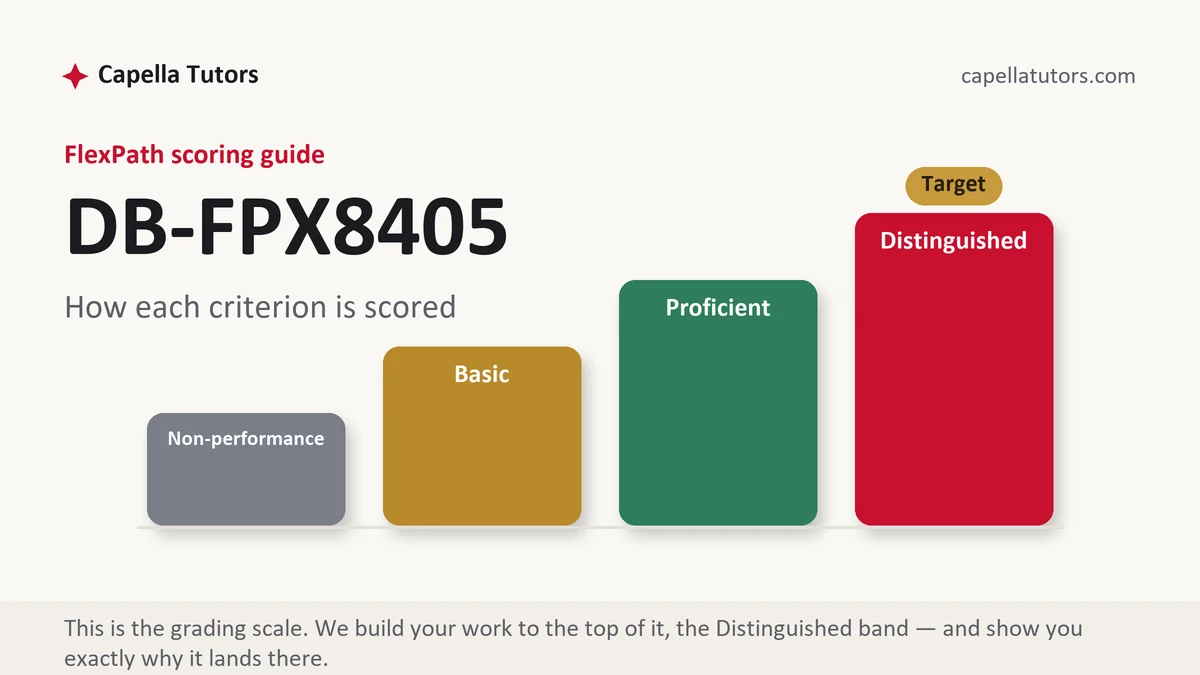
What DB FPX 8405 actually grades
The trap in DB FPX 8405 is that everyone has a leadership opinion and the criteria are not marking opinions. A doctoral course on organizational leadership wants a diagnosis: what leadership behavior is being produced at a specified level of a specified organization, how you know, what it appears to be costing, and what would have to change for the effect to move. The submission that fails is rarely wrong. It is usually a fluent account of what the author believes about leadership, decorated with three models, closing on a recommendation nobody could implement or measure.
The first technical demand is that you fix the level of analysis and stay on it. Leadership of an individual by a supervisor, leadership of a team by its manager, and leadership of a firm by an executive group are three different phenomena with different evidence behind them, and sliding between them is the most common structural fault in these papers. A dyadic finding about exchange quality between a supervisor and a direct report does not transfer to a chief executive's effect on firm performance, and the evidence on the second is thinner than candidates assume, because the number of firms is small, the confounds are large and the outcome responds to a hundred things besides the person at the top.
The second demand is that leadership become measurable. Transformational leadership, leader member exchange, servant leadership, authentic leadership and empowering leadership are constructs with instruments attached, overlapping content, and a long-running argument about whether some of them are distinct at all. Naming a style is not measurement. The criteria want the construct defined, the instrument or observable proxy named, and the properties of that measure acknowledged, including the awkward fact that much leadership research captures the leader and the outcome in one survey, filled in by the same person, in the same sitting.
The third demand is the intervention and its evaluation, written for readers who allocate budget. An executive audience will accept uncertainty and will not accept vagueness. That means a development or structural change with a named population, a cost, a start date, a mechanism the literature supports, and a measurement plan capable of showing that it failed. Criteria at this level reward the sentence that says what result would cause you to stop, and they penalize a proposal that could only ever be reported as a success.
How we help in this course
Drafts for 8405 are built as diagnoses rather than as essays. We fix the level of analysis in the opening paragraph and hold it, attach a construct and a measure to every claim made about your leaders, and separate what your data can show from what it cannot. Where you have survey results, exit interviews, span of control figures or safety and quality reports, the analysis runs on those and states their limits. Where you have none, the sample builds an estimate and labels it as one, because a doctoral reader tolerates an estimate whose basis is visible and does not tolerate a number that appeared from nowhere.
Everything ships on the studio's terms with the adjustments doctoral work needs. One premium original deliverable inside 24 to 48 hours, eight people between the first source pull and the last read, one pass spent purely on whether each criterion is answered where a grader will look for it, and free revision until the score lands. Faculty feedback returns to the same pipeline at no charge. Because a submitted attempt can sit with an evaluator for two business days, we set the delivery date against your submission plan instead of against the calendar.
The assessments, one by one
Assessment 1
The opening deliverable in a doctoral leadership course is normally a diagnosis rather than an argument about leadership: name the level you are studying, name the construct, attach a measure or an observable trace to it, and report what the pattern appears to be producing at one organization. Read the full Assessment 1 manual.
Assessment 2
The middle deliverable of a doctoral leadership course usually asks you to establish how much the leadership evidence can actually bear, then apply that judgment to one organization: which claims the literature supports at what magnitude, which of them your own data reaches, and which one nothing. Read the full Assessment 2 manual.
Assessment 3
The closing deliverable of a doctoral leadership course usually asks for the change itself, written for people who allocate budget: a development or structural intervention with a named population, a cost, a mechanism the evidence supports, and an evaluation capable of showing that it failed. Read the full Assessment 3 manual.
How to actually write DB FPX 8405: where to begin
Begin by turning the guide into a diagnostic outline. Under each criterion write the question that criterion is really asking, then the evidence needed to answer it, then whether you hold that evidence. The assessments in this course usually ask you to evaluate leadership effectiveness in an organization you can observe and to argue for a change, with your scoring guide deciding the form, the sections and the weighting. Two cells in that outline will be empty on the first pass, and those two are the week's work.
Then build the diagnosis on figures rather than impressions. Take a 62-store retail chain running an annual engagement survey. Across the 16 stores in the bottom quartile of engagement, 23 of 48 assistant managers resigned in the following year, a rate of 48 percent, against 9 of 46, or 20 percent, in the top quartile. Had the bottom quartile turned over at the top quartile rate it would have lost about 10 people rather than 23, so 13 separations are the excess, and at a replacement cost near $9,400 per assistant manager the gap runs to roughly $122,000 a year in one quartile of one chain. That is the paragraph an executive reads. The next one earns the doctorate.
Say plainly what the comparison cannot establish. Engagement and turnover were captured in the same population by self-report, the design is cross-sectional, and the causal arrow runs comfortably in both directions, since a store that has lost three managers in a year will report low engagement for that reason alone. Those stores also differ in market, wage competition, volume and the tenure of their district manager, and any of those could produce both results. The doctoral answer to that is not a disclaimer in the limitations paragraph, it is a design: match stores on volume and market, test the prior year engagement score against turnover in the following year, and if you are proposing a supervisor development program, stage the rollout so that the stores receiving it later serve as the comparison for the stores receiving it first. A staged rollout costs nothing extra and converts an opinion into evidence.
Then write the recommendation the way a board paper is written. One paragraph on what you propose and for whom, then a line each on the annual cost, the mechanism you expect it to work through, the measure that should move, the movement that would justify continuing, and the result that would end it. Attach the assumption you are least sure of and show whether the recommendation survives it moving. Executives read that structure every week, and a doctoral paper that adopts it is treated as competent before its argument has even been weighed.
| Section | What goes in it | What Distinguished looks like |
|---|---|---|
| Situation and level | The organization, the level of leadership under study, and the unit the data describes. | The level fixed and defended, with every later claim made at that same level. |
| Construct and measure | The leadership construct, its definition, the instrument or observable proxy, and its known limits. | An instrument named with its source, and method concerns raised before a reader raises them. |
| Evidence base | The empirical work on this construct and this outcome, with designs, samples and effect sizes. | Meta-analytic findings used at their reported size, with the weakest link in the chain identified. |
| Diagnosis | The local pattern quantified, with the rival explanations the data cannot rule out. | Confounds named specifically, and the inference held to what the design supports. |
| Intervention and evaluation | The change proposed, its population, cost, mechanism, and how movement will be detected. | A comparison built into the rollout and a stated result that would end the program. |
| Ethics and references | Permission for internal data, the writer's role in the organization, and current APA. | Access and position disclosed, and internal sources described without identifying individuals. |
Developing the analysis
The synthesis this course rewards is a position on how much the leadership evidence can actually bear. The honest summary of the field is that leader behavior is reliably associated with attitudes, effort and intention to leave, that its association with hard performance outcomes is smaller and noisier, and that a large share of published correlations come from designs in which one respondent rated both the leader and the outcome on one instrument, which inflates them. None of that makes the evidence useless. It makes it evidence of a particular size. A doctoral argument built on it separates three claims and supports each at its own strength: that a behavioral pattern exists in this organization, which your local data can carry; that the pattern is associated with the outcome you care about, which the literature can carry at a modest magnitude; and that changing the behavior will change the outcome here, which nothing you currently hold can carry, which is exactly why the recommendation includes a way to find out. Writing those as three claims is the move that separates the top column from a competent essay, because the alternative, borrowing the strength of the first claim for the third, is precisely what an experienced faculty reader is scanning for.
Citations that survive faculty review
Sources that hold up in this course fall into four groups. Peer-reviewed leadership and organizational behavior research is the core, and The Leadership Quarterly, Journal of Applied Psychology, Academy of Management Journal, Journal of Organizational Behavior and Personnel Psychology are the outlets faculty expect, reached through Business Source Complete and ABI/INFORM Global. Prefer meta-analyses and longitudinal or experimental designs when the claim concerns effect, and say which you are leaning on. Framework sources belong to their originators: Burns and Bass on transformational leadership, Graen and Uhl-Bien on leader member exchange, Greenleaf on servant leadership, each cited from the work rather than a summary, and each dated, because a 1978 argument and its later critique are two citations. Instrument sources form their own category and get skipped constantly: if you name a published measure, cite the validation study and acknowledge that several established leadership instruments are licensed and cannot simply be reproduced in an appendix. Practitioner and benchmarking material from consultancies, professional bodies or industry surveys is useful for what firms report doing and for wage and turnover benchmarks, cited with its year and framed as practice rather than as finding. Then check current APA both ways and verify every figure in the narrative matches the figure in the exhibit.
The mistakes that land Basic instead of Distinguished
- A leadership autobiography. The criteria are assessing an organization's leadership system, not the writer's philosophy of leadership.
- A style named with nothing measuring it. Calling a manager transformational without an instrument or an observable behavior is a label, not a diagnosis.
- An association reported as a cause. Cross-sectional survey data support a claim about pattern, and the recommendation has to say so.
- A development program with no comparison. If everyone receives it at once, no result it produces can be attributed to it.
- A proposal that cannot fail. An intervention with no stopping condition tells a reader the evaluation plan is decorative.
DB FPX 8405 questions students actually ask
Can I write about the organization I work for?
Usually yes, and it is generally the stronger choice, provided three things are handled in the paper rather than in your head. Say what your role is and what access it gives you, because a reader weighs a diagnosis differently when the diagnostician reports to the person being diagnosed. Describe individuals by role and never in a way that identifies them, since a chain of small details pins a person down as effectively as a name. And separate what you observed from what you were told and from what a document shows, because those carry different weight and a paper that blends them cannot be evaluated. Where you plan to collect new data from colleagues rather than use records that already exist, the requirements for permission and review are set by your program and your employer, and that conversation is one to start early.
Do I have to administer a validated leadership instrument?
Not usually at this stage, and the criteria rarely require it. What they require is that whatever stands in for measurement is defensible. If you use an instrument, name it, cite the validation study, and check its licensing before you build a plan around it, because several of the best known leadership measures are commercial products. If you use your employer's existing engagement or culture survey, treat it as the imperfect proxy it is: report the items you are leaning on, the response rate, and the fact that it was not designed to measure the construct you are discussing. If you have no survey at all, behavioral traces will often do more work than a questionnaire would, since span of control, promotion rates, internal transfer requests, overtime distribution, grievance counts and meeting frequency are all recorded somewhere, and none of them depend on a leader rating himself.
How do I write about a leader who is failing without it reading as a complaint?
Convert every judgment into an observation with a consequence attached. Instead of writing that a director communicates poorly, write that three of the four teams reporting to that director learned of the reorganization from a peer rather than from the director, that two of them were still working to the previous plan five weeks later, and that the rework consumed an estimated 90 hours. The tone problem disappears once the sentences carry evidence, and so does the credibility problem, because a reader who can check your claims stops evaluating your motives. Keep the analysis at the level of role and system as well: one director who withholds information is a personnel matter, while a structure in which information reaches teams laterally in four cases out of four is a finding, and a doctorate is interested in the second.
Leadership deliverable due?
Send the prompt, the guide and whatever survey or turnover data you can share. The first premium sample is free, and it will state what your data can and cannot prove.