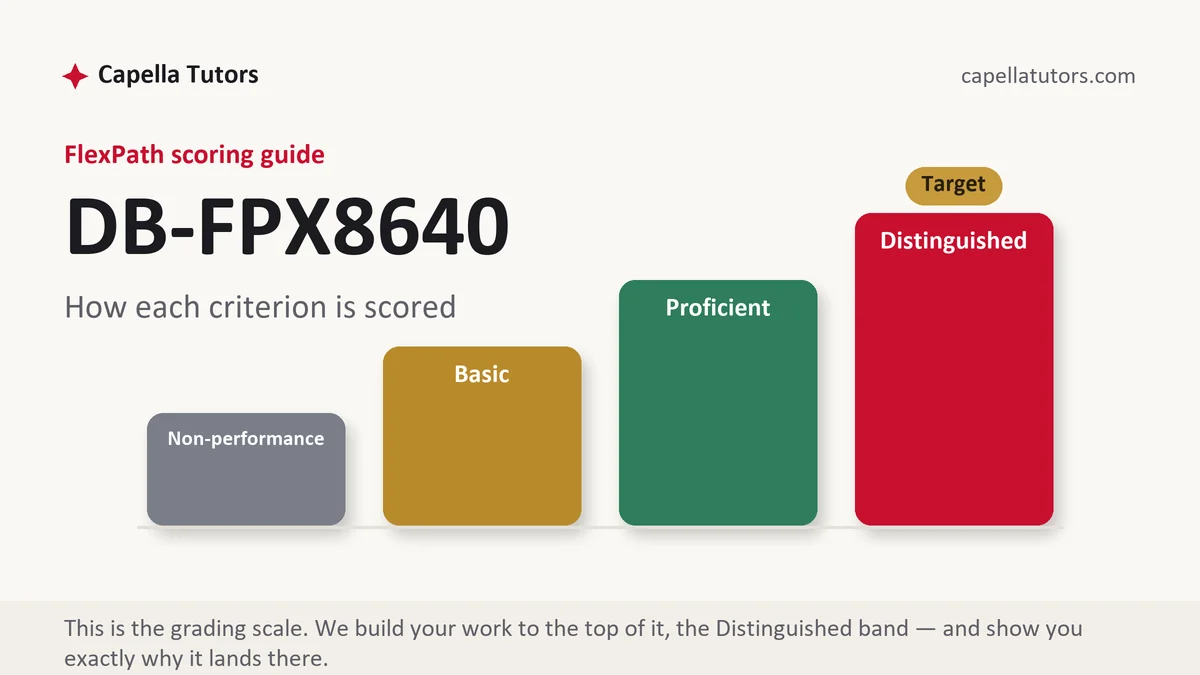
Send the seminar prompt and the criteria and a premium original doctoral sample comes back inside 24 to 48 hours, written to the Distinguished descriptors with the problem, purpose, and questions aligned line by line before anything else is drafted. On a transcript the course reads DB FPX 8640, Seminar: Leadership Topic Development, worth 3 program points, a seminar in the Organizational Leadership and Development specialization, delivered in FlexPath inside the 45-point Doctor of Business Administration. In Capella's catalog the course code is written DB-FPX8640.
What DB FPX 8640 actually grades
The seminar is grading the distance between a topic and a problem, and most submissions arrive with a topic. Leadership development, employee retention, and remote team effectiveness are subjects, not problems, and a criterion asking for a problem of practice wants something narrower: a specific gap between what an organization is getting and what it needs, located in a setting, sized with evidence, and owned by someone. The assessments in this seminar usually ask you to take a broad interest and drive it down to a statement a committee could evaluate, and your scoring guide decides how much supporting evidence has to be assembled at this stage.
Alignment is the criterion that fails most often, and it fails quietly. The problem statement, the purpose statement, and the research questions have to describe the same study, and a doctoral reader tests that by reading them out of order. If the problem is that first-line supervisors in a distribution network are promoted without preparation and turn over quickly, then a purpose statement about exploring leadership styles has drifted, and questions about organizational culture have drifted further. Every noun in the questions should already have appeared in the purpose, and every construct in the purpose should already be present in the problem. Reading those three sentences aloud in sequence catches more alignment failures than any amount of revision to the literature section.
The third thing this seminar grades is whether the study could actually be done by you, at your site, in the time a doctoral project takes. Leadership research runs on access, and access is the constraint students discover last: matched leader and follower pairs need both parties to participate, evaluative data about supervisors is often confidential, and an organization that employs you has its own view about being studied by you. The criteria reward a candidate who names the access requirement, states who controls it, and describes the evidence that it is obtainable, and they penalize a proposal whose feasibility rests on an assumption nobody has tested.
How we help in this course
Our work in this seminar starts with the alignment table rather than the prose. We set the problem, the purpose, the questions, and the intended data source in adjacent columns, force every construct to repeat across the row, and only then draft the narrative that carries them. The evidence supporting the problem is assembled first as well, since a problem statement without a sized gap is the single most common reason a topic gets sent back. Give us the setting you have access to, the leadership issue you care about, and the criteria, and the sample will be built around a study you could plausibly run.
Delivery follows the studio's normal pattern with one addition for seminar work. Each deliverable returns inside 24 to 48 hours and is set against the Distinguished descriptors, a research analyst pulls the empirical base before drafting begins, and the scoring-guide reviewer runs an extra pass that reads the problem, purpose, and questions in isolation to check they still describe one study. Redrafting carries no fee while the guide is unsatisfied and faculty notes are folded into the next pass free, which matters in a topic seminar because feedback here is usually directional rather than corrective and often needs a second conversation.
The assessments, one by one
Assessment 1
Assessment 1 of Seminar: Leadership Topic Development usually asks you to convert a leadership interest into a problem of practice: a specific, evidenced, located gap between what an organization is getting and what it needs. Read the full Assessment 1 manual.
Assessment 2
Assessment 2 of Seminar: Leadership Topic Development usually asks for the purpose statement and the research questions, aligned to the problem you already established and to each other. Read the full Assessment 2 manual.
Assessment 3
Assessment 3 of Seminar: Leadership Topic Development usually asks whether the study you have designed can actually be run: the sampling arithmetic, the access you would need, the person who controls it, and where the work sits in an existing scholarly conversation. Read the full Assessment 3 manual.
How to actually write DB FPX 8640: where to begin
Work backwards from the criteria and forwards from the setting at the same time. Turn each criterion into a heading, then write the problem statement last rather than first, because a problem statement is a conclusion drawn from evidence and drafting it early guarantees you will spend the rest of the seminar defending a sentence you wrote before you read anything. Assemble the evidence first: what the organization is experiencing, how big it is, what it costs, who has noticed, and what the literature already says about that pattern elsewhere. The statement then writes itself in three moves, which are the general situation, the specific gap with numbers attached, and the consequence of leaving it unaddressed.
Feasibility is arithmetic, and doing it in the seminar rather than at proposal saves a term. Suppose you want 120 usable survey responses from first-line leaders. At a 22 percent response rate on an internal emailed instrument you need a sampling frame of about 545 people, and if your sponsoring organization employs 380 first-line leaders the design does not fit the site, which is a discovery you want now rather than after approval. Qualitative designs have their own arithmetic: 15 interviews at an hour each, with five to six hours of transcription, coding, and memoing per interview, is roughly 90 hours of analysis before a single theme is written, and spread across a 12-week billing session that is about seven and a half hours a week on analysis alone, on top of everything else you are carrying. Put those figures in the paper. A committee reads a candidate who has counted the hours very differently from one who has not.
Then handle the gap claim carefully, because it is where topic seminars are won and lost. A gap in the literature and a gap in practice are different justifications and a doctoral project usually needs both, but they are not interchangeable. Asserting that no one has studied a topic is a claim you cannot verify and a reviewer can refute with one search, so the defensible version specifies the boundary: the phenomenon has been examined in large healthcare systems and not in mid-sized distribution operations, or it has been studied through survey measures and not through the accounts of the supervisors themselves. Pair that with the practice gap you evidenced in your own setting, and the justification stands on two legs rather than one.
| Section | What goes in it | What Distinguished looks like |
|---|---|---|
| Topic to problem | The general interest, then the specific underperformance or risk it points to in a named type of setting. | A gap sized with evidence and located in a setting, rather than a subject area with an adjective attached. |
| Evidence for the problem | Organizational indicators plus published work showing the pattern is real beyond one site. | Practice evidence and scholarly evidence used for different jobs, with each source doing only what it can. |
| Purpose statement | What the study will do, with whom, by what broad approach, to address the stated problem. | Every construct traceable back into the problem sentence, with no new concept introduced. |
| Research questions | Questions answerable with obtainable data, matched to the purpose and to one another. | Questions whose wording already implies the design, with nothing asked that the data could not answer. |
| Feasibility and access | The site, the population, the gatekeeper, the data required, and the time the analysis will take. | Response rate or interview count worked through numerically, with the access assumption named and tested. |
| Scholarly positioning | The literatures the study joins, the boundary of the existing work, and current APA both ways. | A bounded gap statement that a reviewer could check, rather than a claim that nothing exists. |
Developing the analysis
Reading for a topic seminar is different from reading for a literature review, and the difference is worth understanding early. Here you are reading to find the shape of the conversation rather than to summarize it, which means paying most attention to the limitations paragraphs and the future research suggestions at the end of strong empirical papers, since that is where authors say out loud what their design could not reach. In leadership research those admissions cluster in predictable places: samples drawn from a single organization, outcomes rated by the same people who rated the leader, cross-sectional timing that cannot establish order, and populations skewed toward large firms and toward managers senior enough to be surveyed. Each of those is a legitimate opening for a practitioner study, and the strongest topics in this specialization tend to sit exactly where an established finding has never been tested in the kind of setting the candidate works in. Also read three or four recent doctoral projects in the leadership space, not for their findings but for their scope, because scope is the thing candidates misjudge and a completed project is the most reliable calibration available.
Citations that survive faculty review
At this stage the sourcing job is to demonstrate command of a conversation, so the mix matters more than the count. Anchor the theoretical territory in primary work, cited to the original, so a study of supervisor development sits explicitly on the leadership development literature it extends rather than on general management writing. Bring current peer-reviewed empirical studies, preferably from the last five years and preferably from The Leadership Quarterly, the Journal of Applied Psychology, Human Resource Development Quarterly, and comparable outlets reached through the Capella library and Business Source Complete, because recency is what shows the gap is still open. Add any systematic review or meta-analysis that covers your area, since one good review establishes the state of the field faster than a dozen individual studies and gives you a defensible boundary for the gap claim. Sector reports and labor statistics can size the practice problem where they are labelled as practice evidence. Record your searches as you run them, including databases, terms, and date limits, because the literature review seminar that follows will ask for that log and reconstructing it later is miserable work.
The mistakes that land Basic instead of Distinguished
- Submitting a subject instead of a problem. A topic area with no sized gap and no setting gives a committee nothing to evaluate.
- Purpose and questions that quietly change the study. New constructs appearing after the problem statement is the alignment failure reviewers look for first.
- Claiming nothing has been written on the topic. An unbounded gap claim can be refuted by a single search, and a bounded one cannot.
- Assuming access you have not confirmed. The person who controls the data has not agreed to anything until somebody has asked them.
- A design whose arithmetic does not fit the site. A target sample larger than the available population is a fatal flaw that costs nothing to catch now.
DB FPX 8640 questions students actually ask
How narrow does a doctoral topic have to be?
Narrow enough that you can state the population, the setting, and the outcome in one sentence without using the word various. A useful test is whether you can name the people who would be your participants, say roughly how many of them exist at your site, and describe what you would ask them or measure about them. If any of those three answers is vague, the topic is still a subject. Candidates resist narrowing because a small question feels unambitious, and the opposite is true in practice: a tightly bounded study produces a defensible contribution and finishes, while a broad one produces two years of scope negotiation. You can always discuss wider implications in the final chapter, and that is the correct place for the ambition.
Should my topic come from my workplace?
It usually should, since a professional doctorate is built around contribution to practice and your access is a genuine asset, but there are two conditions. The first is permission, which means understanding early who authorizes research in your organization and what their process looks like, because that conversation takes longer than candidates expect and cannot be compressed. The second is role conflict, since studying people who report to you, or who could be affected by what you write, raises consent and confidentiality issues that a review board will examine closely. Neither condition is disqualifying and both are manageable with a design that separates your managerial role from your researcher role, but they belong in the seminar paper rather than in a later surprise.
What if my problem has already been studied?
Almost every worthwhile problem has been studied somewhere, and the question is where it has not. Take the existing findings seriously, then specify the boundary conditions of that work: the sector, the organizational size, the country, the level of leader, the outcome measured, and the method used. A study of leader development in large hospital systems does not settle the question for a mid-sized logistics operation with a hybrid workforce, and a survey-based finding does not close off a study of how the supervisors themselves account for what happened. Replication in a genuinely different context is a legitimate doctoral contribution when you say why the context should matter, and that argument, made explicitly, tends to read stronger than a claim of novelty.
Topic paper or problem statement due?
Send the seminar prompt, the criteria, and the setting you have access to. We will align the problem, purpose, and questions and check the feasibility arithmetic. First premium sample, no fee.