Send the seminar prompt and the scoring guide and a premium original doctoral sample returns inside 24 to 48 hours, built to the Distinguished descriptors with the separate literatures integrated into one argument instead of reviewed in sequence. The course appears on a transcript as DB FPX 8850, Seminar: General Management Literature Review, worth 3 program points, a seminar in the General Management specialization, taught in FlexPath within the 45-point Doctor of Business Administration. In Capella's catalog the course code is written DB-FPX8850.
What DB FPX 8850 actually grades
The integrative review is the hardest kind to write and this specialization requires one, so the criteria are calibrated accordingly. A general management question usually draws on two or three bodies of work that developed independently, and the submission that fails treats them as three chapters: here is what the operations literature says, here is what the human resources literature says, here is what the strategy literature says, followed by a paragraph asserting that they are connected. The criteria want the connection made structurally, which means the review is organized around the problem's own logic and each literature is brought in where it answers a question the problem raises. Your scoring guide decides how much of the search process must be documented alongside the synthesis.
Depth is graded against breadth in a way that catches candidates out. Covering three literatures at the same depth produces a review that is shallow in all of them, and a reviewer who works in any one of those fields will notice immediately. The stronger design budgets depth according to how much argumentative weight each literature carries, so a review might be built substantially on one body of work with a second used to specify a boundary condition and a third supplying a single well-evidenced mechanism. Saying that out loud in the method section, and explaining the reasoning behind the allocation, converts what looks like uneven coverage into a defended editorial decision.
The third thing this seminar grades is whether your themes can carry their own weight. Integrative reviews generate themes easily and evidence them unevenly, so a review with nine themes often has four resting on a couple of studies each. Doctoral treatment counts the independent studies behind each claim, marks the thin ones explicitly, and either merges them into better-supported themes or drops them. That discipline is uncomfortable because cutting a theme feels like losing work, and it is the difference between a synthesis a reviewer trusts and one they start auditing.
How we help in this course
In 8850 the integration is built before the prose. The problem's logic becomes the structure, each literature is assigned the specific question it answers, and depth is allocated deliberately with the allocation written into the method. The appraisal matrix records which literature each study belongs to alongside its design and finding, which makes thin themes visible before the draft is written rather than after your faculty finds them. Give us the review question, the criteria, and your project's likely direction, and the review is written to set that project up.
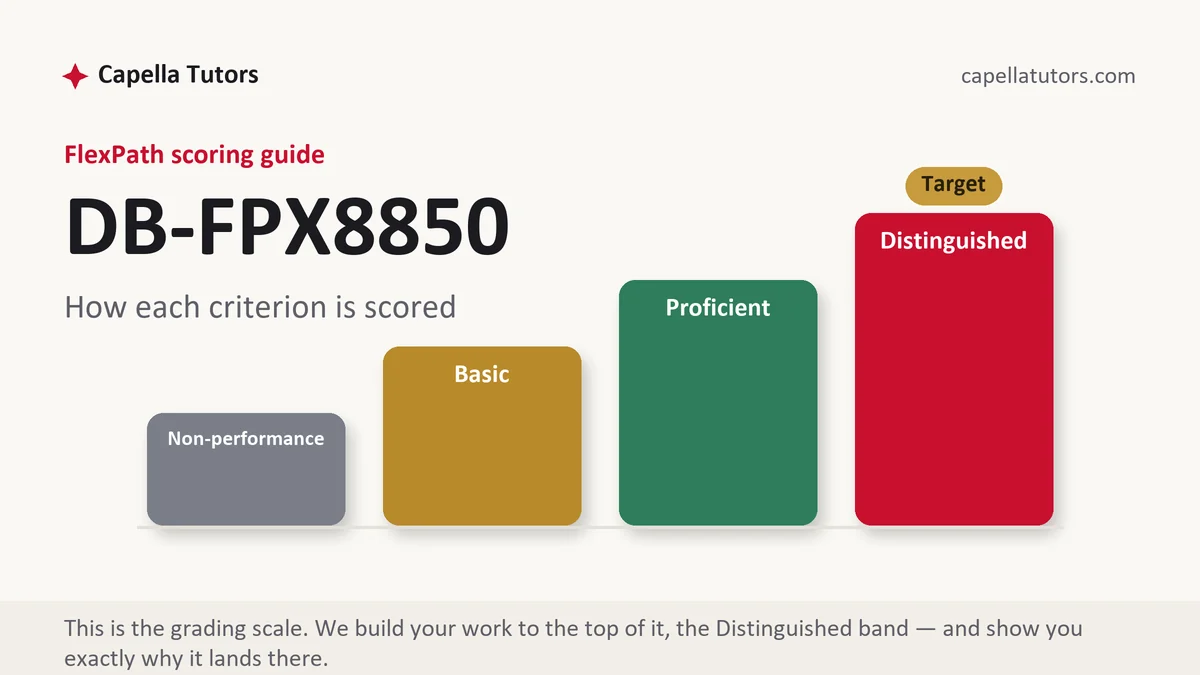
The commercial terms are the studio's standard set, with one habit specific to integrative work. Work returns within 24 to 48 hours written against the top column, and every theme in the synthesis is annotated with the number of independent studies supporting it, so you can see the shape of your own evidence before a reviewer does. Rework carries no charge until the criteria are met, and whatever your faculty returns is folded into the next version free. Because FlexPath lets you carry two courses at once, we will pace a long review across the billing session in sections rather than delivering it as one block, which makes the faculty conversation easier to manage.
The assessments, one by one
Assessment 1
The opening deliverable of a literature review seminar usually asks for the machinery rather than the prose: a review question, the fields you will search, the strings and limiters used in each of them, and an appraisal record that can be sorted. Read the full Assessment 1 manual.
Assessment 2
The middle deliverable of a literature review seminar usually asks for synthesis: themes built across the fields you searched, each one carrying the weight of the evidence behind it and none of them a tour of a single literature. Read the full Assessment 2 manual.
Assessment 3
The final deliverable of a literature review seminar usually asks for the whole review as one document: the question, the method behind the corpus, the synthesis, and a gap sitting at the intersection of the fields rather than inside any one of them. Read the full Assessment 3 manual.
How to actually write DB FPX 8850: where to begin
Begin by writing the problem's logic as a chain of questions, because that chain is the review's structure. If the problem is that a service organization cannot raise responsiveness without raising cost, the questions are what determines responsiveness, what determines cost in this setting, what is known about the relationship between them, and what has been tried. Each question gets a section, and each literature enters the section where it has something to say. Turn the criteria into headings alongside that chain, and check that every section serves both, since a structure that satisfies the problem and ignores the guide will lose marks it did not need to lose.
Then budget depth with numbers rather than by feel. If the body of the review runs to roughly forty pages and you are drawing on three literatures, splitting evenly gives thirteen pages each, which is exactly the outcome to avoid. Decide instead what each literature is for, and allocate accordingly, so a sixty, twenty-five, fifteen split puts the weight on the body of work that carries the argument, gives the second enough space to establish a boundary condition properly, and lets the third do one job well. Write the allocation into the method section with the reasoning attached. A reviewer who can see that the imbalance was chosen reads it as judgment, and a reviewer who cannot read it as neglect of two thirds of the field.
Then audit your own themes before anyone else does. Count the independent studies behind each claim in the synthesis and write the count in the margin of your draft. If nine themes emerge and four of them rest on fewer than three studies each, the review is broader than its evidence supports, and the fix is to merge the thin themes into stronger ones or cut them and say in the text that the area is underexamined, which is itself a finding. Do the same check across literatures, since a theme supported entirely from one field is a claim about that field rather than an integrative conclusion. What survives this audit is a smaller set of well-evidenced claims, and a smaller set of well-evidenced claims is what a doctoral reviewer is reading for.
| Section | What goes in it | What Distinguished looks like |
|---|---|---|
| Problem logic and structure | The chain of questions the problem raises, used as the organizing frame for the review. | A structure a reader can predict from the problem statement, rather than one literature per section. |
| Literatures and their jobs | Each body of work named, with the specific question it is being brought in to answer. | An explicit statement of which literature carries the argument and what the others are for. |
| Search method | Databases, strings, limiters, and dates, recorded separately for each literature searched. | Parallel searches documented individually, so the coverage of each field can be judged on its own. |
| Appraisal | Design, setting, measure, finding, and source literature recorded for every included study. | Study quality discriminated within each field, using the standards that field applies to itself. |
| Integrated synthesis | Claims built across literatures, with the number of independent studies behind each one. | Thin themes merged or cut, and any single-literature theme labelled as such rather than presented as integrative. |
| Gap and implications | What the combination reveals that no single literature shows, and what follows. Current APA both ways. | A gap that exists specifically at the intersection, which is what justifies an integrative review at all. |
Developing the analysis
The payoff of an integrative review is a claim that no single literature could produce, and it is worth writing toward that deliberately. Two fields examining the same phenomenon with different measures will often appear to disagree until you notice that one measures a rate and the other a count, or one observes at the individual level and the other at the unit level, and reconciling them is a genuine contribution that costs nothing but attention. Also watch for the boundary condition one literature has established and the other has not encountered, because carrying it across is a straightforward and defensible integrative move. What to avoid is the synthesis that concludes both literatures are important and further research is needed, which is where integrative reviews go when the author has not decided what they think. Commit to a position, state the evidence behind it, name the strongest objection, and answer it. Doctoral criteria describe that pattern in the top column of nearly every review rubric.
Citations that survive faculty review
Managing sources across several fields is the practical skill this seminar teaches, and the discipline is to keep them separated in your records even while integrating them in the prose. Tag every reference with the literature it belongs to from the moment you save it, because a matrix that cannot be sorted by field cannot tell you whether your coverage of any one field is adequate. Cite founding work to its original publication in each literature, since a review that anchors one field properly and takes the others from textbooks reveals which one the candidate actually knows. Draw current empirical evidence from each field's own leading outlets rather than from general management journals alone, which means the operations work comes from operations journals and the human resources work from human resources journals, all sourced through the Capella library and Business Source Complete. Where fields use the same word differently, and general management topics run into this constantly with terms such as performance, quality, and capability, define the term as each literature uses it the first time you cross between them. Then run reference integrity as a separate pass, checking every citation against a reference, every reference against a retrieved record, and every cross-field definition against the source that supplied it.
The mistakes that land Basic instead of Distinguished
- One section per literature with a paragraph of connection at the end. Sequential coverage is not integration, and the criteria are grading the integration.
- Equal depth across every field. Uniform coverage guarantees shallowness in all of them, and a specialist reader will spot it in their own.
- Themes resting on two studies each. Counting the independent evidence behind every claim before submission is the cheapest quality check available.
- Presenting a single-field theme as integrative. A claim supported entirely from one literature is a claim about that literature and should be labelled that way.
- The same word used differently across fields. Performance, quality, and capability mean different things in different literatures, and unmarked shifts confuse the argument.
DB FPX 8850 questions students actually ask
How do I stop an integrative review from becoming three separate reviews?
Let the problem supply the structure and refuse to let the fields supply it. Write the chain of questions your problem raises, make those the section headings, and then bring each literature into the section where it has an answer, which means a single field may appear in four sections and another in one. The test is whether a reader could predict your section order from your problem statement, and if they could only predict it from your reference list you have written three reviews. This is uncomfortable at first because it breaks the reading order you assembled the material in, and it is the specific skill the seminar is assessing. One practical aid is to draft the synthesis claims before the sections, since a claim built from two fields cannot be written inside a single-field chapter and will force the structure open.
What do I do about a literature I am not trained in?
Read it properly at a bounded depth and be transparent about the boundary. Start with two or three recent systematic reviews in that field, which will give you its structure, its main disputes, and its methodological conventions faster than any number of individual papers. Then read the primary studies you actually need for the specific question that field is answering in your review, rather than trying to acquire general competence in it. Say in the method section what you searched in that field and what you did not, because a declared limit is a strength and an undeclared gap is a weakness a reviewer will find. What causes trouble is applying your home field's quality standards to an unfamiliar one, since what counts as strong evidence differs across management disciplines, so borrow each field's own appraisal conventions when you judge its studies.
How current does an integrative review need to be across every field?
Current where the field is moving and historical where the field is settled, and you say which is which. Some literatures relevant to a general management problem have changed substantially in five years, particularly anything touching work arrangements, technology adoption, or labor markets, and those need recent empirical evidence. Others rest on findings that have been stable for decades, where the recent work is refinement rather than revision, and citing the established studies is correct. Handle it explicitly with a sentence in the method noting where you applied a date limit and where you did not, and the imbalance stops looking like inconsistency and starts looking like knowledge of the fields.
Integrative review due?
Send the review question, the criteria, and the literatures you are drawing on. We will structure it around the problem, budget the depth, and count the evidence behind every theme. The first sample costs nothing.