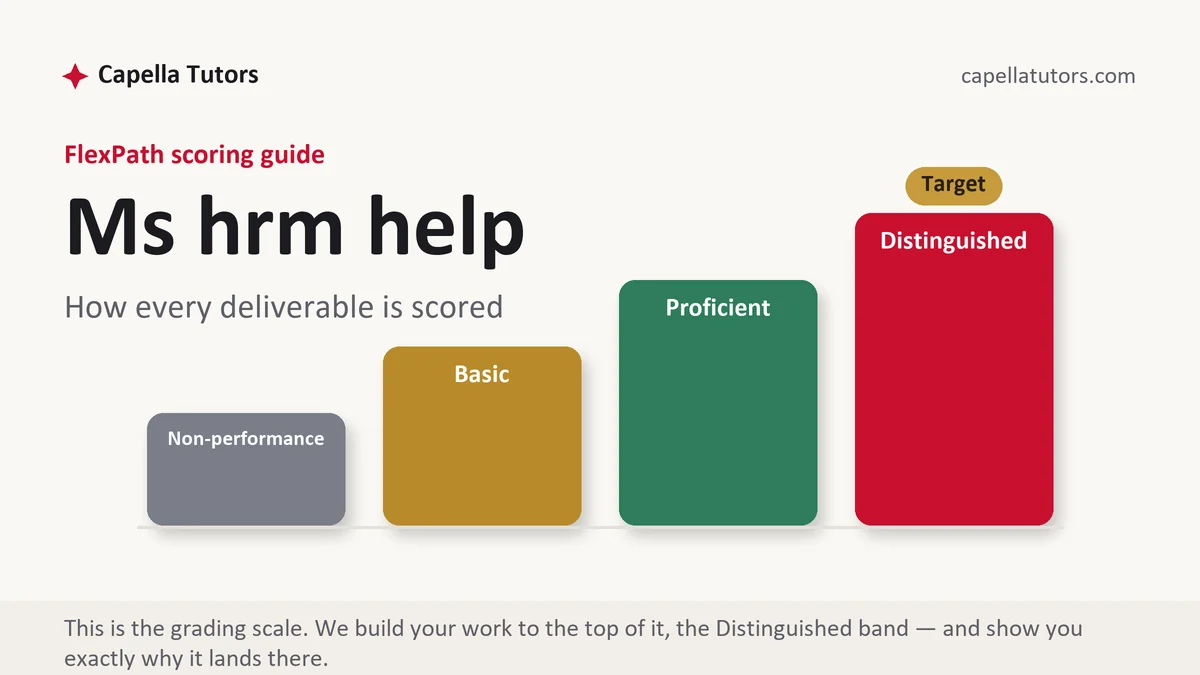
Capella's MS in Human Resource Management grades HR the way an operating department gets audited. Seven core HRM-FPX courses, the 2.5-point HRM FPX 5960 capstone taken in your final quarter, and one specialization, General Human Resource Management or Health Care. The register is applied measurement: a selection ratio, a pay range, a turnover figure, a statute named with its threshold. We draft to the Distinguished column in that register, back inside 24 to 48 hours, revised free until the criteria clear.
What the Capella MS in HRM actually demands
Most requests for Capella MS in HRM class help arrive as one prompt and one deadline, and it gets easier once you see what the program trains. This is not a degree about being good with people. Its subject is the workforce as a system to be measured, priced and defended: who gets hired and on what evidence, what the pay structure costs, which law constrains the decision, and whether your intervention moved a number somebody else can check.
Two groups arrive from opposite directions and fail in opposite ways. Generalists know the practice and lose points on evidence, because a method you have used for a decade is not a source. Career changers from finance bring the measurement habit and lose points on the law, since a business case that runs past a coverage threshold is not one. The core sits where those two failures meet.
The shape: seven core courses, a 2.5-point capstone, one specialization
The fixed part is easy to state. Seven HRM-FPX core courses at 2 points each is 14, and HRM FPX 5960 carries 2.5, the only course above 2 points and the only one restricted to your final quarter. That is 16.5 points on either route. The specialization is the variable.
| Bucket | Points | What sits in it |
|---|---|---|
| Seven HRM-FPX core courses | 14 | Survey of the field, reward systems, sourcing talent, employment law, workplace learning, evidence-based decision making, retention and engagement |
| HRM FPX 5960 capstone | 2.5 | The integration course, taken during your final quarter |
| Health Care specialization | 6 | Three named courses at 2 points each, with no choice inside them |
| General HRM specialization | Varies | A set number of courses drawn from a pool of seven |
Add the Health Care route and the degree accounts for 22.5 points. The General route depends on how many courses your catalog year draws from the pool, and if that number is three, both routes land in the same place. Confirm it in your own catalog year, since pool size and membership get revised between years.
General HR or the Health Care specialization
The two specializations overlap more than their names suggest. The Health Care route names three courses: HRM FPX 5401 on the legal, ethical and regulatory environment of health care, HRM FPX 5402 on planning, sourcing and developing talent in healthcare organizations, and HRM FPX 5403 on transforming the employee experience in health care. Two of them, 5401 and 5402, also sit in the General pool, so the only course a General student cannot reach is 5403.
Name the tradeoff both ways. The Health Care specialization spends every discretionary point on one sector, which is right if you work inside a health system, because credentialing, licensure verification and clinical scheduling never come up in a general program. It costs the leadership and global options, since HRM FPX 5075, HRM FPX 5120, LEAD FPX 5210 and LEAD FPX 5220 sit only in the General pool. The General route buys flexibility and gives up a signal recruiters read off a transcript.
| Question | Health Care | General Human Resource Management |
|---|---|---|
| What you take | Three named courses, 5401, 5402 and 5403 | A set number chosen from a pool of seven |
| How much choice | None. The three are fixed. | Yours, inside the pool. |
| Sector exposure | All of it, in three courses | Optional, since 5401 and 5402 sit in this pool too |
| Leadership content | Not in the three | 5075, LEAD FPX 5210 and LEAD FPX 5220 |
| Extra legal depth | 5401, aimed at health care regulation | 5118, aimed at general employment challenges |
| Global content | None | 5120 and LEAD FPX 5210 |
Note which choice is cheaper to reverse. Taking a health care course from the General pool is a quarter-level decision. Changing a declared specialization is an advising conversation, so ask what a switch costs before you assume it is free.
Send the HRM course you are in
The code and the scoring guide are enough to start. First premium original sample free, back inside 24 to 48 hours.
Every MS in HRM course we cover
Sixteen pages, because the pool offers more courses than you take. Each page sets out what its criteria grade and the mistakes that cost a level.
Core, the seven required HRM-FPX courses
HRM FPX 5002, HRM FPX 5055, HRM FPX 5060, HRM FPX 5065, HRM FPX 5070, HRM FPX 5080, HRM FPX 5090
Capstone
Health Care specialization, all three required
HRM FPX 5401, HRM FPX 5402, HRM FPX 5403
General HRM pool, choose the number your catalog year states
HRM FPX 5075, HRM FPX 5118, HRM FPX 5120, LEAD FPX 5210, LEAD FPX 5220, plus HRM FPX 5401 and HRM FPX 5402 from the group above
Browse the full course catalog
The applied-measurement register HR faculty grade
HR scoring guides are unusual among the business programs: the subject matter is feeling and the criteria will not accept feeling as a finding. Employees feel undervalued is Basic in any row that mentions evidence. Voluntary turnover ran 34 percent against 19 percent company-wide, and exit interviews name pay compression in 11 of 24 cases, is the same observation at Distinguished, because it can be checked and could be wrong. Give every number a base and a period, name the instrument you measured with, and keep assumptions labeled.
Selection is where measurement gets technical fastest. The Uniform Guidelines on Employee Selection Procedures at 29 CFR Part 1607 describe the four-fifths comparison: a group selected at less than 80 percent of the highest group's rate is evidence of adverse impact, and the employer must then show the procedure is job related. Sixty hires from 200 applicants is a 30 percent rate, 18 from 100 is 18 percent, and 18 divided by 30 is 60 percent. The criterion wants that ratio computed, not the phrase adverse impact used as a mood. The scoring guide guide and the FlexPath writing manual cover the rest.
Employment law, named and applied
HRM FPX 5065 grades statutes by name and threshold, not by theme. Title VII of the Civil Rights Act of 1964 reaches employers at 15 or more employees. The Age Discrimination in Employment Act of 1967 starts at 20 and protects workers aged 40 and over. The Americans with Disabilities Act of 1990, as amended in 2008, follows Title VII's threshold. The Family and Medical Leave Act of 1993 applies at 50 employees within 75 miles, and eligibility needs 12 months of service plus 1,250 hours in the preceding year. A paper naming the right theme and the wrong statute scores below one that names three statutes and rules two out with a reason.
The law will not stay in its own course. A reward recommendation meets the Fair Labor Standards Act the moment it touches overtime eligibility, a sourcing plan meets the Uniform Guidelines, and a retention program that treats one group differently meets Title VII. HRM FPX 5118 sits in the General pool for students who want more of it.
How HR work gets defended to finance
The standing criticism of HR proposals is that they arrive without a number, and these criteria absorbed it. The reward, retention and evidence courses want a recommendation a finance reader could fund: cost, benefit, the assumption under each, and where the two meet.
Work one through. A contact center runs 120 agents at 34 percent voluntary turnover, so roughly 41 separations a year. You build a replacement cost from posting and screening time, recruiter hours and six weeks at reduced productivity per hire, total it at $4,200, and show the build. Annual turnover cost is 41 times $4,200, or $172,200. The retention change you propose costs $46,000 a year, so it breaks even by preventing 11 separations, a drop of about nine points, from 34 percent to 25. A finance reader can attack the $4,200 or the nine points, and either attack is a conversation, not a refusal. Write improved retention and reduced costs instead and there is nothing to fund.
Where MS in HRM students stall
Rarely in the survey course. The stall lands where two quantitative courses share a session. A student runs HRM FPX 5055 beside HRM FPX 5080 because both are core, which is the problem: reward systems wants pay structures built, evidence-based decision making wants data interpreted, and both want the same tired evening at a spreadsheet. Submit an attempt in either and faculty have two business days to evaluate it, and under submit-on-grade the next assessment waits. Pair one with HRM FPX 5065 or HRM FPX 5090 instead, where the labor is argument.
- The capstone left with nothing to integrate. HRM FPX 5960 is restricted to your final quarter and cannot be pulled forward to fill a light session.
- No organization chosen. An employer that will not release headcount, turnover or pay data turns every quantitative criterion into hedging.
- Statutes learned as themes. Discrimination is a theme. Title VII at 15 employees is a fact pattern.
- Benchmarks borrowed without a source. A cost per hire you cannot attribute is worth less than a rougher one you built.
- An empty evaluation queue. The two-business-day window costs nothing only when something else is in flight.
How the courses sequence
FlexPath lets you set the order, and some orders are plainly better. Start with HRM FPX 5002, which installs the vocabulary every later criterion assumes. Take employment law second or third rather than late, because the statutes constrain selection, discipline and pay, and students who meet them after the reward and staffing courses often find they argued for something the law would not permit. Spread the two quantitative courses apart, and let HRM FPX 5070 and HRM FPX 5060 sit wherever they fit. Take a specialization course before your last session so the capstone has sector material. The capstone goes last by rule.
The pairing rule matters more than the ordering. Two courses at a time is the FlexPath ceiling, sessions bill flat across twelve weeks, and the only lever you hold is what goes in each slot. Put one building course beside one arguing course, and stagger submissions so something is always in the queue. The two-course rotation playbook walks the cadence and the expedite page carries the pacing math.
MS in HRM questions students actually ask
I work in a hospital. Should I take the Health Care specialization?
Probably, but check the overlap first. HRM FPX 5401 and HRM FPX 5402 also appear in the General Human Resource Management pool, so a General student in a health system reaches the same material. The declared specialization adds HRM FPX 5403 and a line on the transcript. If you intend to stay in health care, take it for the signal. If you want the leadership and global courses that sit only in the General pool, take those and put the two health care courses beside them.
Does this degree give me SHRM or HRCI certification?
No degree does. Certifications are awarded by the certifying bodies under their own eligibility rules, and those rules change, so confirm current requirements with the body itself. What graduate coursework usually does is count toward an education or experience requirement and cover part of the exam content, with the employment law, reward and staffing courses carrying most of that overlap.
I am not in an HR role yet. Can I still write these assessments?
Yes. The criteria need an organization with workforce figures you can retrieve and cite, not an HR title. Public employers publish salary schedules and headcount, federal labor statistics publish separation rates by industry, and public companies describe workforce composition in their annual filings. Pick one early, reuse it wherever a course permits, and cite the year the data covers rather than the day you downloaded it. Resist inventing a company, since a criterion asking about a specific workforce has nothing to grade in a fictional one.