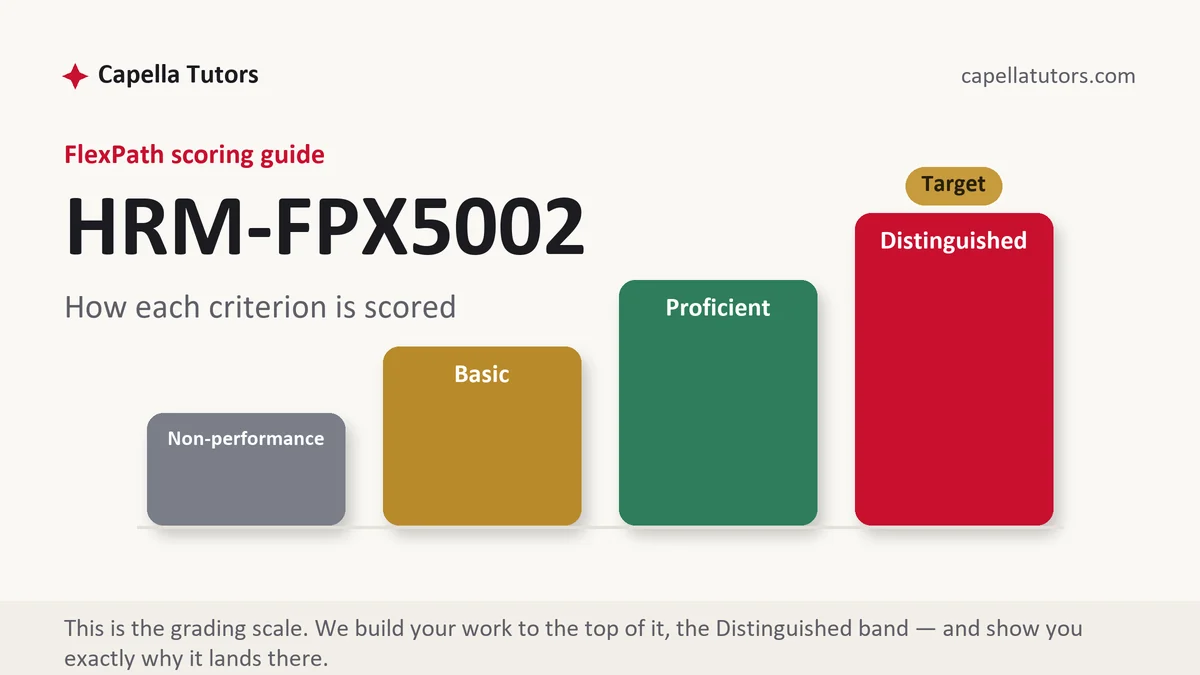
Hand over the assessment prompt and the scoring guide, and one premium original sample comes back within 24 to 48 hours, drafted against the Distinguished column rather than the passing one, with free revision until your faculty agree it is there. On the transcript it reads HRM FPX 5002, Survey of Human Resource Management in Practice, carrying 2 program points, the opening course of the core in Capella's FlexPath MS in Human Resource Management, the degree that later divides into a General Human Resource Management specialization and a Health Care specialization. In Capella's catalog the course code is written HRM-FPX5002.
What HRM FPX 5002 actually grades
A survey course sounds like the gentle one and grades like an audit. HRM FPX 5002 wants human resources described as one connected system rather than six departments sharing a reception desk, so the criteria keep asking you to follow a decision out of the function that made it and into the function that pays for it. Freeze a requisition and the staffing plan shifts, the overtime line rises, the training calendar slips, and employee relations inherits a workload grievance ninety days later. A paper that handles staffing, total rewards, learning, employee relations, compliance and the HR information system as six competent unrelated essays still sits in the Basic column, because the joins are what is being tested.
Next the course separates the administrative half of HR from the strategic half without letting you sneer at the administrative half. Any claim that HR is a strategic partner has to arrive with the sentence underneath it, which is that this practice, changed in this way, moves this operating number by this much, on this evidence. Assessments in this course usually ask you to position an HR function against a recognized competency framework and defend a piece of its practice, and your scoring guide decides whether that lands as a memo, a matrix or an analysis.
Measurement is the third strand. Headcount counts people, full-time equivalents count purchased capacity, and the two answer different questions. Take an employer with 640 names on the payroll, 512 of them full time and 128 part time averaging 22 hours a week: the part-time group converts to 70.4 full-time equivalents, so the company employs 640 people and buys 582.4 FTE of labor. An HR department of 6.5 FTE against that base is 1.12 HR staff per 100 employees, or one HR professional for every 90 employees served, and an HR operating budget of $1,090,000 comes to about $1,872 per employee a year. Those three figures can be compared to something outside the building. A headcount cannot.
How we help in this course
Work on 5002 starts from the organization you already know. Tell us the sector, the approximate size, how HR is arranged and which part of it is currently causing trouble, and the draft comes back with the function mapped, the trouble located inside it, and the downstream effects traced through the functions it touches. Where you have real figures we use yours, and where you do not the sample states the assumption openly and shows the arithmetic.
The terms here are the studio's usual ones. One premium original sample per deliverable inside 24 to 48 hours, eight people between the source search and the final read, and one pass that exists only to test the draft line by line against the guide. Revision stays free until the criteria are satisfied, and faculty feedback re-enters the cycle at no charge. Faculty are allowed two business days to evaluate a submitted attempt, so the calendar we work to counts back from the date you want the grade, not forward from the date you send the prompt.
The assessments, one by one
Assessment 1
Assessment 1 of HRM FPX 5002, Survey of Human Resource Management in Practice, is where the function stops being a list of departments and becomes one system on paper. Read the full Assessment 1 manual.
Assessment 2
Assessment 2 of HRM FPX 5002, Survey of Human Resource Management in Practice, moves from describing the function to judging it. Read the full Assessment 2 manual.
Assessment 3
Assessment 3 of HRM FPX 5002, Survey of Human Resource Management in Practice, is the synthesis deliverable. Read the full Assessment 3 manual.
How to actually write HRM FPX 5002: where to begin
Open the scoring guide and turn it into the outline before you write a sentence. Number the criteria, give each one its own heading, paste the Distinguished wording underneath, and treat any paragraph that cannot be filed under a heading as writing you did for yourself. In 5002 the criteria usually cluster into four jobs: describe the function accurately, connect it to the organization's strategy, judge a practice against a standard, and recommend something with a name attached to it.
Then choose the organization and describe it in figures rather than adjectives. Sector, size, how many locations, whether the workforce is salaried or hourly or both, whether it is unionized, and how HR is arranged, because a centralized service center and a set of embedded generalists fail in different ways. A retail chain with 900 hourly employees across 14 stores and two HR generalists has a span problem.
Then attach one number to the practice you are judging. If the argument is that onboarding is weak, the number is the share of new hires who leave inside ninety days, with the denominator and the window stated. Weak papers assert a problem and then describe it for two pages. Strong ones state the measure, give its source, compare it against something, and only then explain what is causing it.
Then finish with a recommendation someone could be held to. Name what changes, who owns it, what it costs in money or in hours, when it starts, and which existing report will show whether it worked. Say what would make you abandon the recommendation, since a criterion at the top of the column is usually looking for a limit rather than more enthusiasm.
| Section | What goes in it | What Distinguished looks like |
|---|---|---|
| The organization | Sector, size, workforce composition, locations, and how HR is structured. | Structure described precisely enough that the later problem could only occur here. |
| The HR function | The functional areas in scope and how work moves between them. | Handoffs and dependencies named, not just a list of responsibilities. |
| Strategy alignment | The business objective, and the HR practices that support or obstruct it. | A traced line from a practice to an operating result, with the evidence for it. |
| The measure | The metric chosen, its formula, its denominator, its period and its source. | A metric set against a benchmark or a prior period, with its limits admitted. |
| The recommendation | What changes, who owns it, what it costs, and when it takes effect. | A trade-off named and a condition under which the recommendation fails. |
| Standards and references | The competency or ethics framework applied, and current APA both ways. | Frameworks credited to their originators and used, not merely quoted. |
Developing the analysis
The debate underneath this course is worth naming rather than avoiding. One tradition holds that a bundle of practices, selective hiring, real training, employment security, information sharing and pay tied to performance, lifts results in almost any organization, and Jeffrey Pfeffer's statement of it is the version most students meet. The competing tradition says fit decides everything, that a practice which works in a firm competing on service can wreck one competing on cost. The large studies linking high-performance work systems to firm outcomes, Mark Huselid's 1995 analysis among them, are mostly cross-sectional surveys answered by one respondent per firm, which leaves the direction of the arrow open, since profitable firms can afford good HR at least as easily as good HR produces profitable firms. Say that in the paper, then pick a side and justify the choice from the organization in front of you.
Citations that survive faculty review
Three kinds of source do three different jobs in an HR paper. Peer-reviewed empirical research carries any claim that a practice changes an outcome, and Personnel Psychology, the Journal of Applied Psychology and the Human Resource Management Journal are the titles faculty expect, reached through Business Source Complete, ABI/INFORM Global and PsycINFO in the Capella library. Government material settles what the law and the labor market actually are, which means the EEOC and the Department of Labor for obligations and the Bureau of Labor Statistics for wage, turnover and occupational data, quoted with its series and its collection period. Frameworks go to their originators, Ulrich for HR roles and Pfeffer for the practice bundle, taken from the original rather than a textbook paraphrase. Then check current APA in both directions, since a citation missing from the list and an entry missing from the text cost the same point.
The mistakes that land Basic instead of Distinguished
- Six sections that never meet. A paper organized by function with no dependency between the parts answers the syllabus and misses the criterion.
- Strategy asserted, never traced. Calling HR a business partner without a practice, a number and a direction is a claim with nothing under it.
- A rate with no denominator. Turnover, absence and completion figures mean nothing until the population and the period are stated.
- Competency models quoted, not applied. Listing a framework's domains is description, and the criterion asks you to judge something against them.
- A recommendation with no owner and no cost. Proposals nobody has to fund and nobody has to deliver read as opinion.
HRM FPX 5002 questions students actually ask
Do I need an HR job title to write these assessments?
No, and the criteria never ask for one. They ask for an organization you can describe accurately and a practice you can observe. Choose the setting you know best, state plainly what your vantage point is, and use public data where your access runs out. The papers that struggle are not the ones written from outside HR, they are the ones written about an imaginary company with no figures in it.
How do I connect an HR practice to a business result without overclaiming?
State the link as a chain and be honest about its weakest joint. Better onboarding raises ninety-day retention, higher ninety-day retention reduces reopened requisitions, and fewer reopened requisitions cut recruiting cost and lost productivity. Then label which step comes from research, which comes from your organization's own data, and which is an assumption. Claiming that onboarding improves profitability does not, because nobody can trace it and a reader who catches one unsupported leap stops trusting the rest.
Is SHRM a citable source?
SHRM material is authoritative for competency definitions, practice norms, survey benchmarks and the vocabulary the profession uses. It is not a substitute for research when a sentence says one thing causes another, because a member survey reports what organizations say they do, not whether doing it works. Cause and effect needs a study with a design, a sample and a comparison, and the criterion separating Proficient from Distinguished is usually watching for that exact swap.
Survey assessment due this week?
Send the prompt, the scoring guide and the organization you plan to write about. The first premium sample is free and it arrives with its arithmetic shown.