Give us the prompt, the scoring guide and the fact pattern, and a premium original sample returns inside 24 to 48 hours, written to the Distinguished column with each statute named, cited and applied rather than summarized, and revised free until the criteria are satisfied. The course records as HRM FPX 5065, Employment Law in the Successful Workplace, worth 2 program points, a core course in Capella's FlexPath MS in Human Resource Management, which completes through either the General Human Resource Management or the Health Care specialization. In Capella's catalog the course code is written HRM-FPX5065.
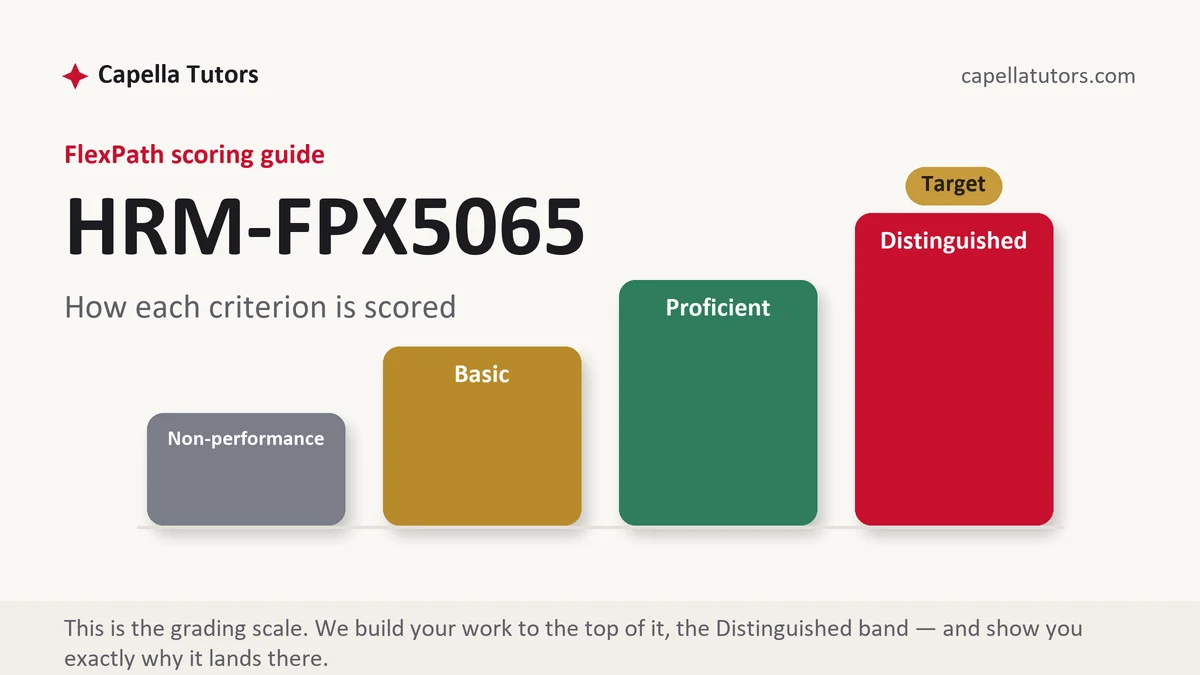
What HRM FPX 5065 actually grades
Employment law assessments are graded on precision, and precision here has a specific shape: name the statute, give its coverage threshold, identify the agency that enforces it, then run the analysis the statute actually requires. Title VII of the Civil Rights Act of 1964 reaches employers with 15 or more employees and is enforced by the EEOC. The Age Discrimination in Employment Act of 1967 requires 20 or more and protects workers aged 40 and over. The Americans with Disabilities Act of 1990, as amended by the ADA Amendments Act of 2008, follows the same 15-employee threshold as Title VII. The Family and Medical Leave Act of 1993 applies to employers with 50 or more employees within 75 miles. Getting those thresholds right is not pedantry, because a good share of the fact patterns in this course are built so that the wrong statute produces the wrong answer.
The second thing graded is whether you can run the correct analysis instead of reaching a conclusion. Disparate treatment cases move through the burden-shifting sequence from McDonnell Douglas Corp. v. Green, where the employee establishes a prima facie case, the employer offers a legitimate nondiscriminatory reason, and the employee then shows that reason to be pretext. Impact claims, following Griggs v. Duke Power Co., begin with a neutral practice producing an unequal effect and turn on job-relatedness and business necessity. Name the framework you are inside, then walk the facts through its steps in order.
Third comes the arithmetic that decides cases, and it is unglamorous. FMLA eligibility requires 12 months of employment and 1,250 hours worked in the preceding 12 months, so an employee averaging 24 hours a week has logged 1,248 hours across 52 weeks and falls two hours short, which is precisely the detail the criteria reward you for checking rather than assuming. Filing deadlines behave the same way: a charge must reach the EEOC within 180 days of the discriminatory act, extended to 300 days where a state or local fair employment practices agency has jurisdiction. Wage arithmetic is where the money sits. A nonexempt employee paid $22.00 an hour who works 46 hours and earns a $120 nondiscretionary production bonus is not owed $1,198. The bonus enters the regular rate, so straight-time pay of $1,132 over 46 hours gives a regular rate of $24.61, the six overtime hours carry an additional half-time premium of $73.83, and the correct total is $1,205.83. The $7.83 gap looks trivial until it is multiplied across 60 employees for two years, at which point it is $48,859 before liquidated damages.
How we help in this course
Send the fact pattern and the scoring guide and the draft comes back as an analysis rather than a summary. Each statute in play is named with its year, its coverage tested against the employer described, and its elements applied to the facts one at a time, with the facts that cut against your conclusion addressed instead of quietly dropped.
The delivery terms are the studio's. Each deliverable is one premium original sample turned around in 24 to 48 hours, passed through eight people, revised free until the criteria are met, with faculty feedback handled at no extra cost. Remember that an attempt sits with faculty for up to two business days, so a submission made on a Thursday is usually a result you see the following week.
The assessments, one by one
Assessment 1
Assessment 1 of HRM FPX 5065, Employment Law in the Successful Workplace, teaches you to analyse rather than to conclude. Read the full Assessment 1 manual.
Assessment 2
Assessment 2 of HRM FPX 5065, Employment Law in the Successful Workplace, is the deliverable where eligibility arithmetic decides the answer. Read the full Assessment 2 manual.
Assessment 3
Assessment 3 of HRM FPX 5065, Employment Law in the Successful Workplace, puts money on the line. Read the full Assessment 3 manual.
How to actually write HRM FPX 5065: where to begin
Turn the guide into headings, then read the fact pattern twice, once for what happened and once for the dates. Build a chronology before you build an argument, because employment law questions are frequently decided by sequence: what the employer knew and when, whether the complaint preceded the discipline, how many days sat between the request and the refusal. Then list every statute the facts could touch and rule out the ones that do not apply, saying why.
Then apply the law element by element, in the structure the criteria are built on. State the rule, paraphrase the standard with a citation, apply it to the specific facts in front of you, and reach a conclusion that admits what remains uncertain. What faculty are grading is whether this employee was a qualified individual, whether this employer had notice, and whether this reason for this termination is supported by anything in the record.
Then write the part most students skip, which is what the employer should do now. An employment law assessment inside an HR program is not a moot court exercise, it is a memo to somebody who has to decide something on Monday. Say whether to settle or defend and why, what the exposure looks like in rough numbers, which documents need preserving, what the policy change is, who gets retrained and by when.
Then handle uncertainty out loud, because this is the discipline where confident overstatement does the most damage. State law sits on top of federal law and is often stricter, several protections carry thresholds that differ by jurisdiction, and figures such as the salary level for the white-collar exemptions have changed and been litigated, so cite the version in force on the date you write and say that is what you have done.
| Section | What goes in it | What Distinguished looks like |
|---|---|---|
| Facts and chronology | Who did what, in what order, with dates and the employer's knowledge at each point. | A timeline that makes the decisive sequence visible before any law is applied. |
| Statutes in play | Each statute named with its year, threshold, covered employers and enforcing agency. | Inapplicable statutes ruled out with a reason, not silently dropped. |
| The legal standard | The elements or burden-shifting sequence the claim actually requires. | The correct framework identified and cited to its source case or regulation. |
| Application | Each element tested against the specific facts, including the unhelpful ones. | Counterarguments addressed, and missing facts named as missing. |
| Risk and recommendation | Exposure, practical steps, documentation, and the policy or training change. | An action a manager could take on Monday, with an owner and a deadline. |
| Authority and references | Statutes, regulations, agency guidance and cases, in current APA. | Primary authority cited directly rather than through a secondary summary. |
Developing the analysis
The judgment this course tests is where compliance ends and management begins, and the strongest papers refuse both easy answers, treating the law neither as a veto over every decision nor as a floor to clear. What the top column tends to reward is a middle argument built from the interactive process under the ADA, where the statute requires a conversation rather than a particular outcome, and where an employer that documents the exchange, considers the alternatives and explains its decision usually prevails even when the answer is no. Generalize from that. The recurring lesson across these statutes is that the process the employer followed is frequently more decisive than the decision it reached, so a recommendation that installs a process is worth more than one promising better judgment.
Citations that survive faculty review
Legal writing rewards primary authority and punishes paraphrase. Statutes and regulations come first and are cited directly, so the Fair Labor Standards Act at 29 U.S.C. 201 and following, the Uniform Guidelines at 29 CFR Part 1607, and the FMLA regulations at 29 CFR Part 825, rather than somebody's summary of them. Agency material comes next, meaning EEOC enforcement guidance and compliance manual sections, Department of Labor opinion letters and fact sheets, and OSHA standards where safety is at issue, all of which state the enforcing agency's own position and are exactly what a faculty evaluator wants to see. Case law is cited by name and year with the court identified, since a district court decision and a Supreme Court holding carry different weight. Then work through current APA for legal materials carefully, because it handles them differently from journal articles.
The mistakes that land Basic instead of Distinguished
- The wrong statute for the facts. An age claim analyzed under the ADA fails before the reasoning has begun.
- Coverage never checked. A 30-employee employer sits outside the FMLA and inside Title VII, and the answer turns on it.
- Conclusion first, elements never tested. Announcing that the employer is liable is not the analysis the criterion asked for.
- Cases cited from a textbook summary. Faculty can tell, and the holding is usually narrower than the paraphrase suggested.
- No recommendation. A memo that identifies exposure and proposes nothing leaves the reader where it found them.
HRM FPX 5065 questions students actually ask
Do I have to cite cases, or is naming the statute enough?
It depends what the sentence is doing. A legal test usually comes from a case, so a disparate impact analysis without Griggs and a treatment analysis without McDonnell Douglas look incomplete to a reader who knows the field. The safe rule is to cite whichever source actually established what you are asserting.
Is an employee handbook a contract?
Usually not, and the qualifier matters. Most employers include a disclaimer stating that the handbook is not a contract and that employment remains at will, and courts generally respect a clear one. Some states recognize implied contract exceptions where a handbook promises progressive discipline or termination only for cause in definite language, so the answer varies by jurisdiction and by wording. Then give the practical recommendation, which is that a policy the employer does not intend to be bound by should not be written in mandatory terms.
Can I write about something happening at my own employer right now?
Be careful, and change the identifying details. Describe the organization by sector and size rather than by name, remove names and dates that would identify individuals, and state in the paper that the situation has been anonymized. Do not attach internal investigation documents, personnel files, or anything covered by a privilege that is not yours to waive. Faculty do not need a real matter. They need a fact pattern applied correctly.
Fact pattern to analyze?
Send the prompt, the guide and the scenario. The first premium sample is free and it arrives with the statutes cited to primary authority.