Describe the change you have been handed, attach the prompt and the criteria, and a premium original sample reaches you in 24 to 48 hours, built toward the top descriptors and reworked at no cost for as long as the guide needs it. LEAD FPX 5220, Leader as Change Agent, is a 2 point elective from the General Human Resource Management specialization pool in the Capella MS in Human Resource Management, offered through FlexPath, where you advance by putting work up for a grade. In Capella's catalog the course code is written LEAD-FPX5220.
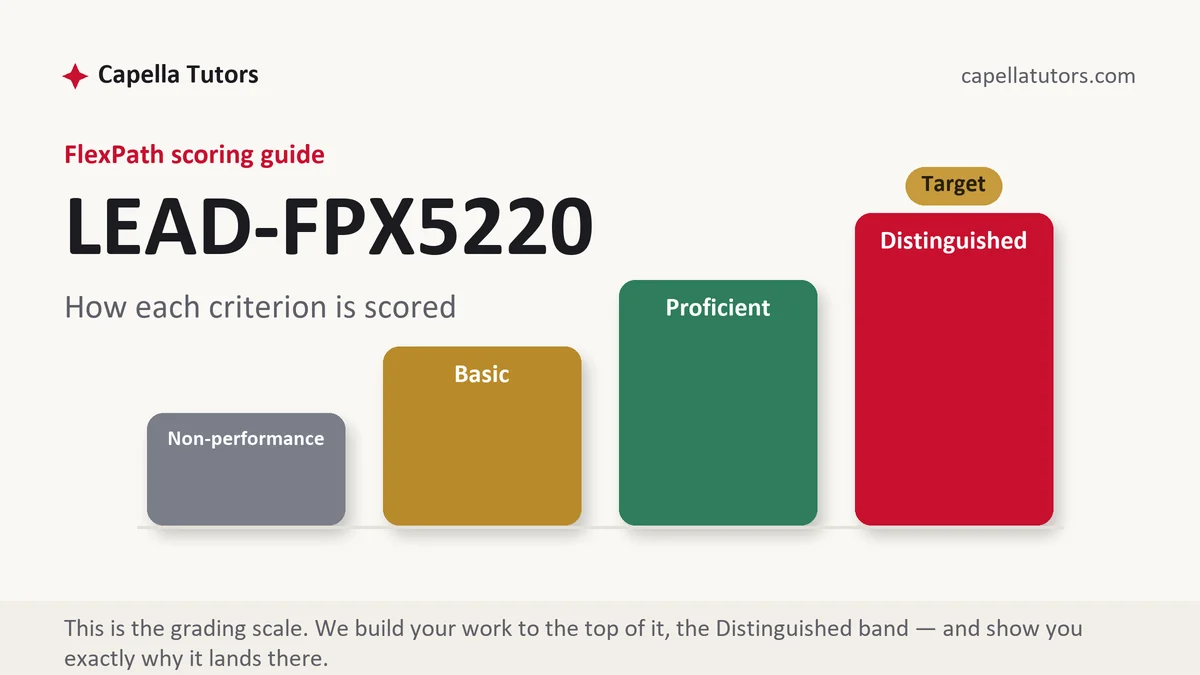
What LEAD FPX 5220 actually grades
This course is about a role rather than a project, and the distinction carries most of the criteria. A change agent is someone asked to produce a change in people who do not report to them, using influence, evidence and a sponsor's authority that can be withdrawn at any point. The first thing graded is whether you understand what has to be agreed before any of that begins. Contracting in the sense Block described is an explicit conversation with the sponsor covering what you will do, what access you need, what you will not do, what you will report and what happens if the sponsor stops supporting it, and a plan written without that conversation is a plan resting on an assumption nobody tested.
Diagnosis before design is the second strand. The tradition of action research running back to Lewin is that you gather data, feed it back to the people it came from, and act with them rather than on them, and the criteria reward a writer who takes the data collection seriously as a design problem. Who you talk to determines what you find, so a sample drawn from the names the sponsor supplied will produce a version of the sponsor's own account. Stratify deliberately across shift, level, tenure and function, keep going until new conversations stop producing new themes, and record how many independent sources support each theme before it enters the report.
The third thing graded is that feedback is itself an intervention. The moment you tell an organization what you heard, the organization has changed, because people learn what is sayable. That creates obligations: results reported at a level of aggregation that cannot identify a speaker, themes attributed to the pattern rather than to the person, and a decision made in advance about what you will do if the sponsor asks you to soften a finding. Writing that decision down before it is tested is what separates a change agent from a messenger.
Last is the role conflict, and naming it is worth a criterion on its own. A human resource practitioner acting as change agent is simultaneously the sponsor's agent, a source of advice to the employees being changed, and the person who will administer the consequences if someone refuses to comply. Those three positions are not compatible, they cannot be resolved by good intentions, and the professional response is to declare which hat is on at which moment. In current courserooms the assessments include "Immunity to Change Map", "Assessing Priorities and Planning for Change" and "Championing Organizational Change" among others, and your scoring guide decides the exact format of each.
How we help in this course
Our 5220 drafts write the contract before the plan. The sponsor agreement is set out as terms rather than as enthusiasm, the diagnosis has a sampling design with its stratification defended, the feedback approach states its aggregation rule, the communication plan has fidelity and coverage calculated separately, and the handover names who owns each change once you leave. Tell us the organization, the change, who is sponsoring it and what has already been attempted there, and the sample argues from that history rather than from a generic transformation.
The rest of the arrangement is the usual one. Each assessment gets a single premium original deliverable in 24 to 48 hours, aimed at the highest descriptor, reviewed against your guide criterion by criterion, checked separately for current APA and originality, then edited before delivery. Rework is free until the criteria are met, and anything faculty send back re enters the queue without a charge. In current courserooms the assessments include "Immunity to Change Map", "Assessing Priorities and Planning for Change" and "Championing Organizational Change" among others, and your scoring guide decides the exact format of each.
The assessments, one by one
Assessment 1: Immunity to Change Map
Diagnose your own immunity to change with an improvement goal, behaviors working against it, competing commitments and big assumptions, then plan development. Read the full Assessment 1 manual.
Assessment 2: Assessing Priorities and Planning for Change
Identify an organizational change challenge, the internal and external factors driving it, readiness for change, and a force field analysis to plan the change. Read the full Assessment 2 manual.
Assessment 3: Championing Organizational Change
Create a stakeholder map for a change, analyze stakeholder perspectives and impacts, and plan how to manage resistance. Read the full Assessment 3 manual.
How to actually write LEAD FPX 5220: where to begin
Write the contract before the plan and put it in the document. One page is enough: the change the sponsor is asking for stated in their words, the outcome you will be accountable for, the access you need to people and data, the deliverables and their dates, what you will not do, the decision points where the sponsor must choose, and what happens to the work if their priorities move. Then turn the guide into headings with the Distinguished wording underneath each while you draft. The value of the contract in a graded paper is that everything afterwards can be traced to something agreed, and a reader can see the difference between what you were asked to do and what you decided to do.
Then design the diagnosis so it can contradict the sponsor. Suppose the sponsor believes the problem is that supervisors will not use a new scheduling system. Build a sample across the strata that could disagree, which might be six groups covering day and night shift, supervisors and staff, and long tenure against recent hires, with three conversations in each, giving eighteen. Keep a running count of themes and stop adding groups when a new one produces nothing new, then require at least three independent sources before a theme goes into the report as a finding. Separate what people said from what you concluded, in two different sections, because a reader who cannot tell them apart cannot evaluate either. Then look for the disconfirming case deliberately, meaning the supervisor who does use the system, since the reason that person manages it is usually the intervention.
Then calculate the two communication failures separately, because they have different fixes and most plans conflate them. Fidelity is the first: a message routed from an executive through directors, then managers, then team leaders loses content at every retelling, and at a generous seventy percent fidelity per layer the version reaching the front line after four handoffs retains about twenty four percent of the original. The fix for that is a written artifact that travels intact, not more enthusiasm at the top. Coverage is the second: an organization with one executive, nine directors, seventy four managers and 1,180 staff depends on those seventy four managers actually holding the conversation, and if seventy percent do it inside the two week window then 826 people hear it from their manager and 354 hear it from the intranet or from a colleague's account. Raising that to ninety percent means making the conversation a scheduled event with a prepared toolkit and a completion record, which costs the managers time you should count and put in the plan. Write both numbers, and the communication section stops being a list of channels.
Then plan the feedback session and the handover, which are the two moments the criteria most often find missing. The feedback session is designed, not improvised: who is in the room, in what order the findings are presented, what aggregation protects the people who spoke, and what you will say if a senior person asks who said it. Decide in advance what you will do if the sponsor asks you to remove a finding, and write your answer into the contract at the start rather than negotiating it under pressure. The handover matters just as much, because a change agent leaves. Name the person by role who owns each change afterwards, state what evidence would show it is still operating six months later, and define what done means for your involvement. Then declare the role conflict explicitly in the document, saying which of your responsibilities is active at which stage, since a reader who can see you have thought about it will trust the rest of your judgment.
| Section | What goes in it | What Distinguished looks like |
|---|---|---|
| The contract | The ask in the sponsor's words, your accountability, access needed, boundaries and decision points. | Terms explicit enough that either party could tell whether they had been kept. |
| Diagnosis design | The strata sampled, why those, how many conversations, and when collection stops. | A sample built to contradict the sponsor's account, with disconfirming cases sought deliberately. |
| What was heard | Themes with the number of independent sources, kept separate from your interpretation. | Observation and inference in different sections, so a reader can disagree with one and not the other. |
| Feedback handling | Who hears what, at what aggregation, and the rule for protecting individual speakers. | An aggregation rule set before the session and a prepared answer to the request to soften a finding. |
| Communication design | The artifact that travels, the people who deliver it, the window, and the completion record. | Fidelity and coverage calculated separately, with the manager time it consumes counted in the plan. |
| Handover | Who owns each change afterwards, the evidence it is still running, and what ends your involvement. | A named role per change, a six month check, and a definition of done for the change agent. |
Developing the analysis
The analysis to develop is about the position you occupy rather than the model you chose, and there are two claims worth handling carefully. The first is the figure everybody repeats, that some large majority of change efforts fail. It circulates without a population, without a definition of failure and without a study behind it that would satisfy a reviewer, and quoting it as a statistic is one of the easier criteria to lose in this course. The useful version is to define failure for your own change, in advance, in terms someone could check: the behavior is not observed in a stated proportion of the population at a stated date. The second claim is about the models themselves. Staged change frameworks are sequencing heuristics distilled from cases, useful for making sure you have not skipped something, and none of them is a tested causal theory, so a paper that selects one and then reports where it did not fit your situation is doing better work than a paper that follows one faithfully. Then return to the role conflict, because it is the genuinely difficult part. The human resource change agent who is also the enforcer will find that candor dries up the first time a conversation produces a consequence, and the only real protections are transparency about the boundary and consistency in respecting it. Say what you told people you would do with what they said, and then say whether you did it.
Citations that survive faculty review
Primary attribution matters here and faculty check it. Action research and the early field work on group change go to Lewin, contracting and the practitioner's role go to Block, and process consultation, meaning the idea that how the consultant works is itself the intervention, goes to Schein. Staged change frameworks are cited to their authors and labeled as practitioner models, which is what they are, and appreciative inquiry goes to Cooperrider if your reading uses it. Peer reviewed evidence comes from Journal of Applied Behavioral Science, Journal of Organizational Change Management, Human Relations and Journal of Change Management, and any claim about what works should arrive with the study design, since much of this literature is case based and the cases were usually written by people with an interest in the outcome. Where your change touches pay, hours, discipline or representation, the relevant legal or contractual source is cited to the provision, because a change plan that cannot be implemented lawfully is not a plan. Then cite your organization's own material by name and date, including the previous attempt at the same change if there was one, since institutional memory is evidence and the people you interview will certainly cite it.
The mistakes that land Basic instead of Distinguished
- A plan written before a contract. Every commitment in it rests on access and sponsorship that were assumed rather than agreed.
- Interviews drawn from the sponsor's list of names. A sample selected by the person with a theory will return that theory, and the criteria notice the design.
- A finding softened to protect the sponsor. The credibility that makes a change agent useful is spent the first time the report is edited to please.
- A cascade assumed to arrive intact. Fidelity decays at every retelling and coverage depends on managers who may not hold the conversation.
- No handover owner. A change with nobody accountable after the change agent leaves reverts to whatever saved somebody time.
LEAD FPX 5220 questions students actually ask
I am the change agent and I am also affected by the change. How do I write that?
Declare it early and treat it as data rather than as a disclaimer. Say in the framing section that you hold a stake in the outcome, name specifically what you gain or lose, and describe the safeguards you put in place, which might be a colleague reviewing your themes before they were reported, or interviews conducted by someone with no stake in a subset of the groups. Then use the position rather than apologizing for it, because an insider has access to context, history and informal networks that an external consultant would take months to acquire. The failure mode is the paper that writes as if from nowhere, presenting conclusions with no account of how the writer's own position shaped which questions were asked. Faculty read that as a lack of self awareness, and it is avoidable in three sentences.
How many interviews or conversations are enough?
Enough that new ones stop producing new themes, which is a criterion you can actually report rather than a number you can defend in the abstract. In practice, plan by strata rather than by total, because the total that matters is coverage of the groups whose experience could differ, and three or four conversations in each of five or six well chosen groups usually gets you there for a bounded change. Then show your work: list the strata, say how many you spoke to in each, note the point at which new themes stopped appearing, and state which group you were unable to reach and how that limits the findings. A reader will accept a modest sample described honestly, and will distrust a large one whose selection you cannot explain. Where the change affects a large population, add a short survey to test whether the themes generalize.
The prompt tells me to select a change model. Which one should I pick?
Pick the one that fits the shape of your change, then say where it does not fit, because the second half is the graded part. A framework built around urgency and coalition suits a change that requires many people to move roughly together, while a stage model that emphasizes awareness and reinforcement suits a change where each individual has to adopt a new behavior at their own desk. Neither is a theory that predicts an outcome, so treat the model as a checklist for what you might have skipped rather than as a plan. Then name the step your situation makes impossible or unnecessary, which most often is the one assuming you can put the whole organization in a room, and describe what you did instead. That paragraph is usually worth more than the four preceding it.
Change deliverable due?
Send the criteria, the change, the sponsor and whatever has already been attempted there. The first premium sample is free, with the contract written and the cascade arithmetic done.