Send the prompt and the scoring guide and a premium original sample returns inside 24 to 48 hours, written to the Distinguished descriptors with every regulatory claim cited to the rule that creates it and revised free until the criteria clear. On a transcript it reads HRM FPX 5401, The Legal, Ethical, and Regulatory Environment of Health Care, worth 2 program points, one of the required courses in the Health Care specialization inside Capella's MS in Human Resource Management and an option for students on the General Human Resource Management track, delivered in FlexPath where a graded attempt is what moves you forward. In Capella's catalog the course code is written HRM-FPX5401.
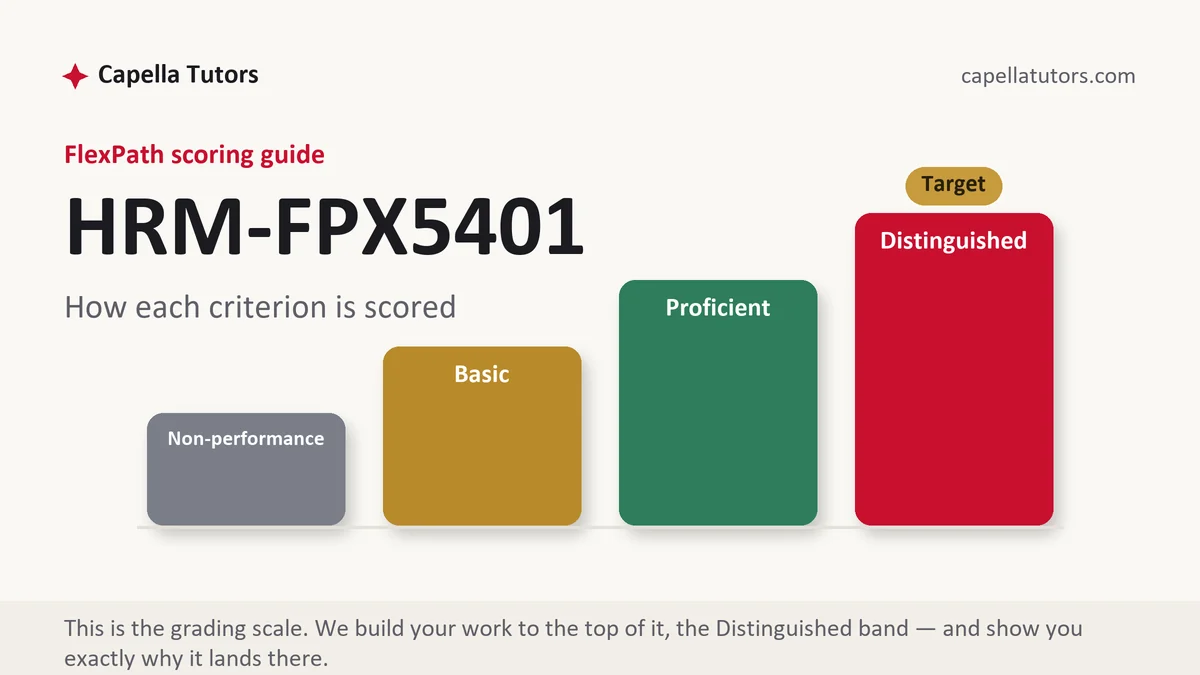
What HRM FPX 5401 actually grades
Human resource work inside a licensed, accredited and publicly funded provider organization runs on three regimes at once, and the first thing this course grades is whether you can tell them apart. Employment law governs the relationship between the organization and the worker. Licensure and scope of practice law governs who is permitted to perform the clinical work at all, and it is state law, so it differs across a system operating in four states. Payment integrity rules govern who the organization may be paid for, which turns a hiring decision into a claims question. One appointment can be defensible under the first regime and indefensible under the second or third, and a submission that analyzes only the employment dimension has answered a fraction of the criterion.
Credentialing is the operational core. A license is granted by a state board, a certification is granted by a professional body and proves something narrower, and neither is verified by the copy the candidate hands you at interview: verification runs to the primary source, which is the board or the certifying organization itself. Practitioners then go through a separate process, with the medical staff or its equivalent recommending clinical privileges specific to procedures rather than to a job title, and queries to and reports into the national practitioner data bank are obligations attached to that process rather than optional diligence. Multistate licensure compacts change who may practice where and under whose disciplinary authority, which matters enormously to a telehealth service and to any float arrangement crossing a state line. The criteria expect you to know that expiry is the recurring failure point, not initial verification.
Payment integrity is the strand practitioners from other industries miss entirely. Exclusion from federal health care programs means no payment may be made for items or services furnished by that individual, directly or indirectly, so an excluded person on a nursing unit is not primarily a policy problem, it is a problem with every claim their work touched. Screening therefore has to run at hire and on a repeating cycle against the federal list and the applicable state lists, and it has to reach contractors and vendors whose people work on site. Physician compensation carries its own constraint, because arrangements between a provider and a referral source are shaped by self referral and remuneration rules that make fair market value and commercial reasonableness terms of art rather than adjectives, which is why an HR function does not set practitioner pay by benchmark alone.
The ethical strand is concrete rather than philosophical. The questions that actually arrive are a staff member with a conscience based objection to participating in a specific procedure, a mandatory reporting duty that overrides the confidentiality an employee assumed, an impaired practitioner whose case sits between a treatment program and a disciplinary process, and a coverage decision where the obligation to patients outranks the obligation to the employee in front of you. Principle based frameworks in the tradition of Beauchamp and Childress give you respect for autonomy, beneficence, nonmaleficence and justice, and the criteria reward a writer who understands that four principles structure an argument and do not settle it, since the whole difficulty is what to do when two of them point in opposite directions.
How we help in this course
Drafts for 5401 sort the facts by regime before they analyze anything. Scope questions are answered against the practice act of a named state, verification and privileging steps are described as processes with owners and lead times, exclusion and payment questions are handled as claims exposure rather than as policy tidiness, and ethical conflicts are written with the competing duties ranked and the reason for the ranking stated. Tell us the state, the setting, the roles involved and the accreditor, and the sample argues from those rather than from a generic hospital.
The studio terms are unchanged here. One premium original deliverable inside 24 to 48 hours per assessment, aimed at the top column, taken through an eight person pipeline with a dedicated scoring guide review, a separate current APA and originality pass and a final edit. Revisions are free until the criteria are met and faculty comments come back into the same cycle at no cost. Because health care regulation is the area where a citation to an out of date provision costs a resubmission, and an evaluator has two business days with each attempt, send us the sources your course materials specify along with the prompt.
The assessments, one by one
Assessment 1: The Foundation of Law and Ethics in Healthcare
A lecture or presentation for HR staff on health care law such as the Affordable Care Act, ethical considerations in policy. Read the full Assessment 1 manual.
Assessment 2: Civil and Criminal Law in Healthcare: Memorandum
A memorandum analyzing civil and criminal legal issues arising in a health care HR situation, with questions for counsel and recommended responses. Read the full Assessment 2 manual.
Assessment 3: Legal and Ethical Considerations in Healthcare Privacy: Brief
A briefing on HIPAA's impact, the legal and ethical basis for patient privacy, compliance and quality, electronic records, and best practices to prevent violations. Read the full Assessment 3 manual.
How to actually write HRM FPX 5401: where to begin
Take the fact pattern apart by regime before writing a sentence of analysis. For each fact ask four questions in order: does this engage employment law, does it engage licensure or scope, does it engage payment or program integrity, and does it engage an accreditation standard. Most facts engage more than one, and the ones that engage three are where the criteria concentrate. Then convert each criterion into a heading and sit the Distinguished sentence beneath it while you work. In current courserooms the assessments include "The Foundation of Law and Ethics in Healthcare", "Civil and Criminal Law in Healthcare: Memorandum" and "Legal and Ethical Considerations in Healthcare Privacy: Brief" among others, and your scoring guide decides the exact format of each.
Then treat credential currency as an operating process with a workload rather than as a compliance intention. A system employs 1,240 people holding a license or a certification. Licenses on a two year renewal cycle produce roughly 52 expirations a month on average, and because state boards commonly renew by birth month or on a fixed date, the real pattern is peaks running two or three times that. If verification takes about 12 minutes per credential and the eight percent that do not renew on time take another 40 minutes each of chasing, an average month is 624 minutes of verification plus 160 minutes of follow up, near 13 hours, while a peak month runs past 30. Then price the failure rather than describing it. One nurse who works three 12 hour shifts after a license lapses has delivered 36 hours of care without current authorization, which in many states is a reportable matter for the licensee, a condition of participation question for the organization and a claims question for the revenue cycle. The recommendation that follows is not a reminder email, it is a block at the scheduling layer so that an expired credential removes the person from the assignment automatically.
Then handle exclusion screening as a staffing decision with a number attached. Take an organization with 4,800 employees and 620 contracted personnel who work on site, which is 5,420 records to screen. The federal exclusion list is updated monthly, which is the reason a monthly cadence is the common recommendation, and applicable state lists run on their own schedules. Name matching at that volume produces false positives, so at a two percent hit rate you get about 108 potential matches a month, and at six minutes each to resolve against date of birth and other identifiers that is around 11 hours of work every month that has to belong to somebody by name. On the penalty side, resist quoting a dollar figure from a textbook. Civil monetary penalty amounts are set in statute and adjusted for inflation on an annual cycle, so cite the current amount from the current regulation and say the date you checked, then make the argument on the claims exposure and the repayment obligation rather than on the headline number.
Then write the ethical analysis so it reaches a decision. Name the parties and the duty owed to each, set out the options including the one nobody wants to write down, and for each option say which obligation it honors and which it sacrifices. Then rank the obligations for this specific situation and give the reason, because the ranking is the argument and everything before it is preparation. A conscience based objection is the clearest teaching case: the accommodation question and the patient coverage question are separate, the organization can often satisfy both by reassigning the individual while ensuring the service is staffed, and the analysis fails only when a writer pretends one duty simply outweighs the other without saying why. Finish with the procedural safeguard, meaning who reviews the decision, what record is kept and what escalation exists if the same conflict recurs, and state plainly that the analysis is a management analysis requiring review by counsel and by the ethics committee before action.
| Section | What goes in it | What Distinguished looks like |
|---|---|---|
| The clinical facts | What happened, in which setting, involving which roles, over what period, sourced to records. | Facts stated in clinical and operational terms rather than translated into generic employment language. |
| Regimes engaged | Employment, licensure and scope, payment integrity, and accreditation, each identified by fact. | Overlap made explicit, with the regime that constrains the decision most tightly named first. |
| Credentialing and scope | Licenses, certifications, privileges, verification route and expiry status for each person involved. | Verification traced to the primary source, with scope answered against a named state practice act. |
| Payment integrity | Exclusion status, screening cadence, and any arrangement touching referral relationships. | Screening described as a recurring process with a named owner, volume and resolution workload. |
| The ethical question | Parties, duties owed, options available, and what each option honors and sacrifices. | A ranked obligation with the reason stated, rather than four principles listed and a conclusion asserted. |
| Controls and limits | Automatic system controls, escalation route, record kept, and the boundary of the analysis. | A control that operates without anyone remembering, plus counsel and ethics review named as required. |
Developing the analysis
What this course wants developed is the reasoning that happens when duties conflict, and the test of it is whether you can say what you gave up. Listing four principles and then announcing an answer is the standard mid rubric move, because the framework supplies the vocabulary and never the ordering. Argue the ordering for this case, on these facts, and say what would change it. Two evidence cautions belong nearby. The literature on compliance programs is not as strong as their prominence implies: the evidence that a published code of conduct changes conduct is thin, while the evidence that reporting channels get used is better when employees can see that a report was acted on and that retaliation was punished, which suggests where the recommendation should go. The second caution is about the gap between three standards that students routinely collapse into one. What the law permits, what an accreditor requires and what the profession considers ethical are separate tests, and a practice can clear the first, fail the second and be argued either way on the third. A paper that keeps them distinct and states which one is doing the work in each conclusion is doing the analysis the top column describes.
Citations that survive faculty review
Regulatory sources come first and are cited as documents. Federal program requirements, including the conditions of participation and the payment rules that constrain them, are cited to the regulation with its section, and program integrity material comes from the enforcement agency's published compliance guidance and its exclusion authorities rather than from a summary. State law does most of the work on scope, so the nurse practice act or the equivalent professional statute is cited to the section along with the board rules interpreting it, and the state matters enough that a paper analyzing scope without naming one has not answered the question. Accreditation standards are cited by standard designation with the manual year, since the numbering changes and an undated reference cannot be checked. Data bank obligations are documented in the published guidebook for that system, which is the source to use rather than an article describing it. Ethics claims go to primary statements, meaning the framework text for principle based reasoning and the profession's own code, whether that is the nursing code of ethics or the physician equivalent, cited as normative documents rather than as evidence. Peer reviewed work from health law and health policy outlets supports empirical claims about what these rules produce in practice. Then cite your own organization's medical staff bylaws, credentialing policy and compliance plan by title, version and date, because those documents are the ones a surveyor will actually ask for.
The mistakes that land Basic instead of Distinguished
- Scope of practice assumed from what the person did at a previous employer. Scope is set by the practice act of the state where the care is delivered, and it varies.
- Exclusion screening performed only at hire. The list updates monthly, so a single check at onboarding leaves every later exclusion undetected.
- Practitioner compensation treated as an ordinary benchmarking exercise. Arrangements touching referral relationships carry constraints that a market survey does not address.
- Four ethical principles listed and a conclusion announced. The criterion is the ordering and the reason for it, and neither appears in a list.
- An accreditation standard quoted without its manual year. Standards are renumbered and revised, so an undated citation cannot be verified by the reader.
HRM FPX 5401 questions students actually ask
Can I write about a real safety event from my own hospital?
Only in a de-identified form, and often not at all in the form you first reach for. Records generated inside a peer review or quality improvement process carry statutory protection in many states, and pulling that material into a course document is the kind of mistake that creates a problem well beyond the assessment. Work instead from what is already public, such as an event described in a state reporting summary or an accreditor sentinel event alert, or construct a scenario from conditions you know and say in the opening that it is constructed. If you do use something real, remove the unit, the dates, the roles held by one person, and any clinical detail that would let a colleague identify the case, and check whether your employer requires approval before staff write about internal events at all.
The prompt says to analyze the ethical implications. What is actually being asked?
A structured argument that ends in a decision. Begin by naming every party with an interest, including the ones without a voice in the room, then state the duty owed to each and where those duties collide. Set out the realistic options, and for each one write what it protects and what it costs, since an option with no cost has been described dishonestly. Then rank the duties for this situation and justify the ranking on the facts rather than on a general preference, because a reader can accept a ranking they would not have chosen if the reasoning is visible. Close with the procedural element, meaning who else reviews it, what gets documented and how a recurrence is escalated. That structure answers the criterion whichever framework your course materials use.
Do I have to name a specific state?
Yes, whenever scope, licensure, mandatory reporting or staffing requirements are in play, because every one of those is state law and the differences are not trivial. Independent practice authority for advanced practice nurses varies, mandatory reporting duties differ in who must report and within what period, and some states impose staffing requirements that others leave to the organization. Naming the state also makes your paper checkable, which is the point. If your employer operates across several states, pick the one where the situation occurred and note in a sentence that the analysis would differ elsewhere, then say in which direction. A submission that keeps the location vague to stay generally correct ends up specifically unhelpful, and the criteria read that as avoidance.
Regulatory deliverable due?
Send the criteria, the state, the setting and the roles involved. The first premium sample is free, with every rule cited to the provision and the ethical conflict argued to a decision.