Send the prompt with the scoring guide and one premium original sample returns within 24 to 48 hours, written against the Distinguished descriptors, with the statistics in it checked by a second reader and revisions free until the criteria are met. On the transcript the course is HRM FPX 5080, Evidence-Based Decision Making for HR Professionals, carrying 2 program points, a core course in Capella's FlexPath MS in Human Resource Management alongside its General Human Resource Management and Health Care specializations. In Capella's catalog the course code is written HRM-FPX5080.
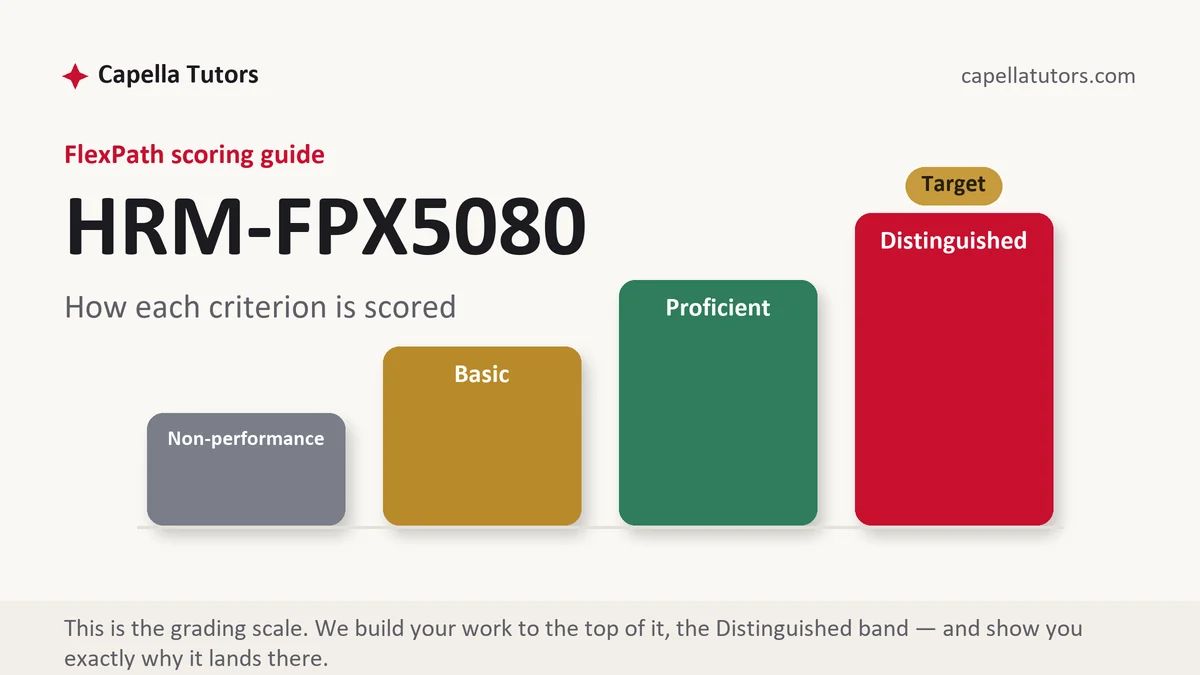
What HRM FPX 5080 actually grades
This course grades a habit rather than a subject. The evidence-based movement in management, which Denise Rousseau put on the agenda and Eric Barends and colleagues turned into a working method, holds that a decision should draw on four sources at once: findings from research, data from the organization itself, the judgment of experienced practitioners, and the concerns of the people the decision lands on. The criteria check whether you use all four and whether you can say which one is carrying the weight. A recommendation resting only on published research ignores the organization in front of you. One resting only on experience is the practice this course exists to correct.
Appraisal is the second demand and the one students find hardest. Evidence is not equal, and the ranking has nothing to do with prestige and everything to do with what a design can rule out. A randomized comparison can rule out selection differences, a longitudinal study can establish sequence, and a cross-sectional survey can establish only that two things occurred together in one sample at one moment.
Third comes the arithmetic of inference, and two calculations do most of the work. Statistical significance and practical importance are different questions, and large samples make the first easy: a correlation of 0.11 across 4,200 employees clears conventional thresholds while accounting for about 1.2 percent of the variance in the outcome, which is a real finding and a poor basis for spending money. Relative against absolute change is the other trap. A vendor claiming its assessment cuts turnover by 40 percent is describing a relative reduction, and on a base rate of 12 percent that is 4.8 percentage points, or roughly 41 fewer departures a year in a workforce of 850. The point is that the honest version is the one you can still defend when the CFO asks what the base rate was.
How we help in this course
Bring the question, whatever data you hold, and the decision it feeds, and the draft comes back as an appraisal rather than a literature summary. The search is documented so it can be rerun, each study enters carrying its design and sample, findings are aggregated instead of listed, and your internal data is checked for the two faults that break it, an unstable denominator and a definition that changed part way through the period.
Studio terms apply here as everywhere. One premium original sample per deliverable within 24 to 48 hours, eight readers between the database search and the last proof, free revision until the criteria are satisfied, and faculty feedback re-entered at no cost. Statistical work gets a dedicated check, because a misread confidence interval or a percentage point reported as a percentage is the kind of error that costs a criterion outright. Build your schedule around the two business days faculty are given with an attempt.
The assessments, one by one
Assessment 1
The opening deliverable in an evidence course is about the question and the reading, so the assessment usually asks you to frame a practice question a study could actually answer, run and document a search somebody else could rerun, and appraise what you find by what each design is capable of ruling out. Read the full Assessment 1 manual.
Assessment 2
Where the earlier work in this course interrogates published research, the middle deliverable turns the same suspicion on your employer's own numbers, so the assessment usually asks you to audit an internal measure, establish its definition, denominator and provenance, and recompute a headline. Read the full Assessment 2 manual.
Assessment 3
The closing deliverable turns appraisal into a decision, so the assessment usually asks you to combine research findings, organizational data, practitioner judgment and stakeholder concerns into a single recommendation carrying a value, a condition and a review date. Read the full Assessment 3 manual.
How to actually write HRM FPX 5080: where to begin
Turn the guide into headings, then spend real effort on the question, because a badly framed question cannot be answered well. Does mentoring work is unanswerable. Whether formal mentoring assignments reduce first-year voluntary turnover among newly hired registered nurses compared with informal support is a question with a literature, a measure and a comparison inside it.
Then run the search and record it while you run it. Name the databases, the terms and Boolean strings, the date limits, the inclusion rule and how many records survived each stage, since a search you cannot reproduce is an assertion about the literature rather than a review of it. Read the methods before the conclusion in the abstract, and record for each study the design, the sample size, the setting and the effect, so your table shows the shape of the evidence rather than a column of author names.
Then interrogate your own organization's data with the same suspicion. Every rate needs a denominator and a window stated before it means anything, and the denominator has to be an average across the period rather than a headcount at the end of it, or growth alone will make retention look better than it is. Ask who entered the data and what incentive they had while entering it. Exit reason codes selected by a departing employee's manager are not a neutral record of why people left.
Then convert the finding into a decision with a value attached. Utility analysis is the standard method and it is arithmetic once the terms are named: the number hired, the years they stay, the gain in validity, the dollar value of a standard deviation of performance, and how selective you were able to be. Replace a screening method whose validity is 0.15 with one at 0.35 for 24 hires drawn from 120 applicants, expect three years of tenure, and value a performance standard deviation at $18,000, roughly 40 percent of salary, and the estimate is 24 times 3 times 0.20 times $18,000 times 1.40, or $362,880, less about $10,200 in testing costs. Then attack your own number, because the CFO will. The performance standard deviation is the softest input, and at $12,000 the same calculation returns $241,920, so quote a range rather than a point and say which assumption moves it.
| Section | What goes in it | What Distinguished looks like |
|---|---|---|
| The question | Population, intervention or factor, comparison and outcome, in one sentence. | A question a study could actually answer, with the comparison made explicit. |
| The search | Databases, terms, limits, inclusion rules, and the count surviving each stage. | A search another person could rerun and arrive at the same set. |
| Appraisal | Each study's design, sample, setting, measures and effect, recorded before use. | Studies weighed by what their design rules out, with the weakest labeled as such. |
| Organizational data | The internal measures, their definitions, denominators, windows and origin. | Definition changes and data-entry incentives identified rather than assumed away. |
| Aggregation and decision | What the four sources jointly support, and the recommendation drawn from them. | A value or a range attached, with the softest assumption named and tested. |
| Assessment and references | How the decision will be reviewed, on what measure, and current APA. | A review date and a measure chosen before the decision is implemented. |
Developing the analysis
The most useful idea to argue in this course is that a good decision and a good outcome are different things, and that HR is usually judged on the second. A process that gathered the available evidence, weighed it honestly and chose under acknowledged uncertainty is a good decision even when the result disappoints, while a lucky guess remains a guess. That distinction gives you something to say about the two failure modes the criteria are hunting. The first is the confident practitioner who has seen this before, whose experience is real evidence and also a sample of one organization with no control group and a memory that keeps the successes. The second is the analytics dashboard reporting twenty metrics and supporting no decision, which is data with no question standing in front of it.
Citations that survive faculty review
Source discipline is the whole subject here, so the paper should model it. Peer-reviewed empirical research is the only support for a causal claim, and systematic reviews and meta-analyses in Personnel Psychology, the Journal of Applied Psychology, the Academy of Management Journal and Human Resource Management sit above single studies because they aggregate rather than select, reached through Business Source Complete, PsycINFO and ABI/INFORM Global. The evidence-based practice framework itself is cited to Denise Rousseau and to Eric Barends and colleagues at the Center for Evidence-Based Management, not to a secondary description of the six steps. Organizational data is cited like any other source, with the report name, the system it came from, the extraction date and the definition used. Vendor research is named as vendor research with its funding disclosed. Then apply current APA to both the in-text citations and the reference list before submitting.
The mistakes that land Basic instead of Distinguished
- A literature summary standing in for an appraisal. Ten studies described in sequence is a reading list, and the criterion asks which of them can carry the claim.
- Statistical significance treated as importance. A tiny effect across a large sample clears the threshold and changes almost nothing.
- Relative improvement quoted without the base rate. Forty percent better is meaningless until the reader knows forty percent of what.
- A rate with a moving denominator. Comparing periods with different populations produces a trend the organization never had.
- No plan to check the decision. Evidence-based practice ends with assessment, and a recommendation nobody will review is untested advice.
HRM FPX 5080 questions students actually ask
How do I appraise a study when I am not confident with statistics?
Read four things and you will get most of the way. What was the design, and could it rule out the alternative explanations. How many people, in what setting, and do they resemble your workforce. What was actually measured, and is that the outcome you care about or a proxy for it. And how big was the effect, in units somebody could act on rather than as a p value. Those habits do more work in an HR paper than any additional statistics training.
Our HR data is inconsistent and incomplete. Should I change topic?
No, document it. Data quality is part of the appraisal and the criteria reward a writer who audits their own source. Then work with the subset that holds and state the limit it places on your conclusion.
Can I ever cite a vendor case study?
Yes, framed correctly. A vendor case study is evidence that an implementation happened and sometimes evidence of how it was received, and it is not evidence that the product caused the result, because there is no comparison group and the client who failed never appears in the brochure. Cite it for the description, name the vendor inside the sentence, and pair it with independent research if you want to claim an effect.
Analytics assessment due?
Send the prompt, the guide and whatever data you can share. The first premium sample is free and every statistic inside it is shown with its assumption.