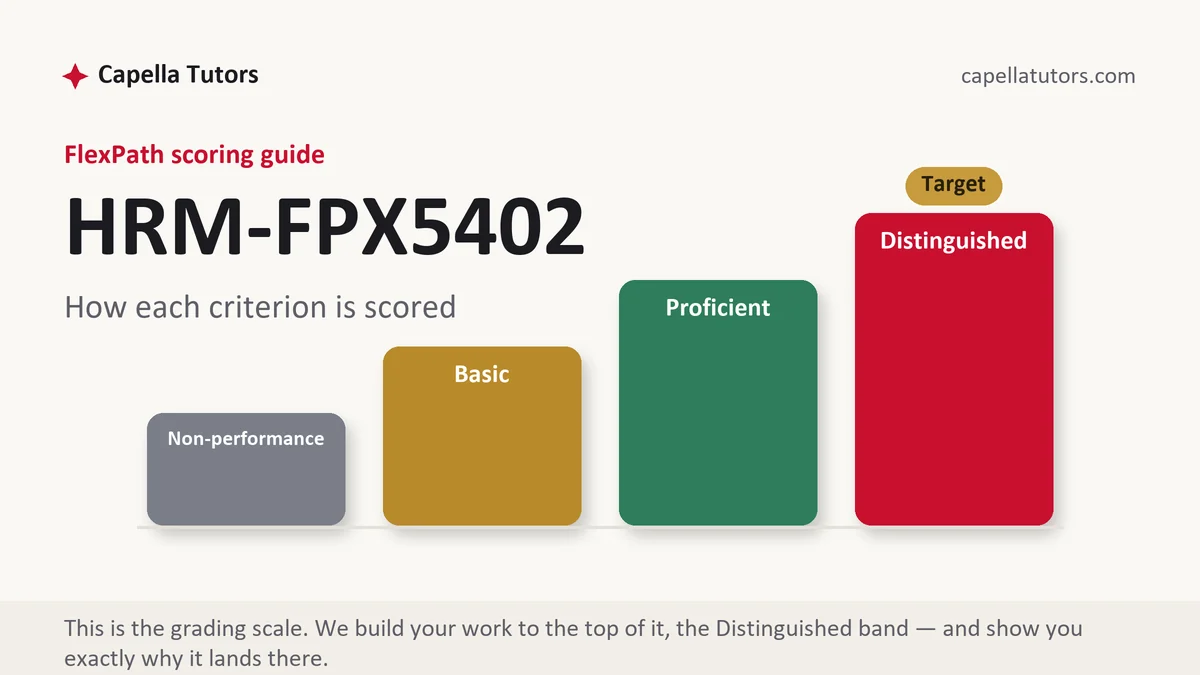
Give us the deliverable, the scoring guide and whatever workforce figures you are permitted to describe, and a premium original sample comes back inside 24 to 48 hours, written to the Distinguished descriptors with every calculation shown and revised at no charge until the criteria are met. The course reads HRM FPX 5402, Planning, Sourcing, and Developing Talent in Healthcare Organizations, carrying 2 program points, required within the Health Care specialization in the Capella MS in Human Resource Management and open as an elective to students on the General Human Resource Management track, taught in FlexPath where submitting for a grade is what advances you. In Capella's catalog the course code is written HRM-FPX5402.
What HRM FPX 5402 actually grades
Workforce planning for a clinical organization is not workforce planning with hospital vocabulary attached. Supply here is licensure constrained, which means the number of people who could take the job is fixed years in advance by how many seats a nursing or allied health program had, and how many clinical placement sites were available to those students. You cannot recruit your way past that in a quarter. The criteria reward a candidate who plans on the horizon the pipeline actually has, and they penalize a plan whose first year assumes the market will supply what it has not supplied for several years running.
Demand is graded on coverage rather than on headcount, and the difference decides several criteria. A department that runs around the clock needs shifts covered, not positions filled, and the two diverge the moment leave, orientation and education time enter the picture. Definitions matter more than most students expect. A vacancy rate computed on budgeted positions and a vacancy rate computed on filled positions answer different questions and produce different numbers from the same data, so a rate quoted without its denominator is not a measurement. Time to fill is another trap, because a clinical vacancy is still being covered by premium labor until the new person is actually working, and license verification, health screening and, for practitioners, credentialing and privileging all sit between the accepted offer and the first shift.
Sourcing is graded on economics rather than on effort. Agency and travel labor is a structural feature of this industry, not a symptom of a badly run department, and the strong papers treat it as a purchased coverage option with a price rather than as waste to be eliminated. The interesting analysis is where the alternatives break even: an internal float pool with a differential, a per diem roster, incentive shifts paid to existing staff, or a permanent hire that will not start for two months. Each carries a second order effect the criteria expect you to notice, and the sharpest one is internal equity, since a traveler earning substantially more than the staff nurse precepting them is a retention problem that the coverage decision created.
Development closes the course and is the strand most often written thinly. Competency in clinical work is validated at the bedside rather than certified by course completion, transition to practice programs exist because the first year after licensure is where turnover concentrates, and preceptor availability is the true constraint on how many new graduates a unit can absorb. Assessments here usually ask for a plan that carries people from hire to independent practice and then into a career structure, and your scoring guide decides how far into succession for charge and frontline manager roles it has to go.
How we help in this course
Our 5402 drafts arrive with the coverage arithmetic done. Demand is expressed in shifts and hours before it is expressed in positions, every rate has its denominator printed, sourcing options are compared at their break even point, and development plans carry preceptor capacity as a costed constraint rather than as an assumption. Send us the service line, the shift pattern, the vacancy count and any rate information you are allowed to share, and the numbers in the sample belong to your organization instead of to a case study.
Pricing and turnaround here are the studio's standard arrangement. One premium original deliverable per assessment inside 24 to 48 hours, targeted at the Distinguished column, with a second reader whose specific job on this course is recomputing every figure and checking that each rate names what it was divided by. Revisions are free until the criteria are satisfied and faculty feedback re enters the queue at no cost. If you are running the two courses FlexPath permits at once, tell us which weeks are heavy at work and we will sequence the analytical deliverable away from them.
The assessments, one by one
Assessment 1
The opening deliverable in Planning, Sourcing, and Developing Talent in Healthcare Organizations usually asks you to size a workforce requirement rather than to solve it, which means the paper lives or dies on whether the demand figure was built or assumed. Read the full Assessment 1 manual.
Assessment 2
Once a requirement has been sized, the next deliverable in Planning, Sourcing, and Developing Talent in Healthcare Organizations usually asks how the organization should buy the coverage, and that is an economics question rather than a recruitment one. Read the full Assessment 2 manual.
Assessment 3
The later work in Planning, Sourcing, and Developing Talent in Healthcare Organizations moves from buying coverage to building capability, and the deliverable usually asks for a plan that carries someone from hire to independent practice and then into a career structure. Read the full Assessment 3 manual.
How to actually write HRM FPX 5402: where to begin
Set the unit of analysis and the horizon in the first paragraph, because a workforce plan that does not say what it is planning for cannot be graded. Name the role or the service line, state the period, and say whether you are planning for coverage, for growth, for a new service or for a known retirement wave, since those produce different plans. Then turn the guide into headings with the Distinguished language sitting underneath each while you draft. The assessments in this course usually ask you to assess a workforce situation, build or evaluate a plan for staffing it, and set out how people will be developed once hired, with the scoring guide fixing the sections.
Then work the sourcing economics, because it is the calculation that separates the columns. Take a medical surgical service carrying 18 registered nurse vacancies and needing 36 twelve hour shifts a week covered, which is 432 hours a week and 22,464 hours a year. Agency coverage bills at 118 dollars an hour, so covering the whole gap that way costs 2,650,752 dollars a year. An employed nurse at a 41 dollar base with benefits and taxes at 41 percent is 58 dollars loaded, and an internal float pool paid a six dollar float differential comes to 64 dollars. Ten float nurses at 1,872 productive hours each cover 18,720 hours for 1,198,080 dollars, leaving 3,744 hours to buy at agency rates for 441,792 dollars, so the blended model costs 1,639,872 dollars and saves 1,010,880 against full agency coverage. Now attack your own model, because that is the graded part. The plan assumes you can recruit ten float nurses in a market that has not produced eighteen unit nurses, which is the assumption a director will challenge first, and it assumes a six dollar differential is enough to attract internal candidates without creating a compression grievance on the units they left. State both, and give the reader the answer at a nine dollar differential as well.
Then decompose time to start rather than reporting time to fill, since the vacancy costs money until somebody works a shift. A posted staff nurse role might run nine days to the first qualified applicant, eleven to interview, six to offer and four to acceptance, which is 30 days of recruiting, then two days for license verification, nine for background and health screening, and an average seven day wait for the next fixed onboarding cohort, giving 48 days to first shift. For an advanced practice role the same 30 day recruiting cycle is followed by credentialing and privileging that commonly runs 60 to 120 days depending on when the credentials committee and the governing body next meet, so time to start lands near 150 days. Present both measures and label them, because the recruiting function is accountable for the first number and the organization pays for the second, and a plan built on time to fill will under budget premium coverage by months.
Then build the development side with the constraint visible. Orientation for a new graduate typically runs ten to twelve weeks with a preceptor, and a preceptor can carry one orientee at a time while also carrying a modified patient assignment, so a unit hiring 40 new graduates a year needs 40 orientation slots and enough preceptors to fill them without collapsing the schedule. Write out that capacity: how many staff are prepared to precept, how many cycles each can realistically take in a year given their own leave and education time, and what the reduced assignment costs in coverage hours. Then attach a competency measure that is observed rather than attended, meaning a validated skills check at a stated point, and a retention measure at twelve months with the cohort defined. Close with the pipeline work that operates on the multi year horizon, principally academic partnerships and the clinical placement capacity your own organization supplies, because a system that will not host students is competing for graduates it declined to help produce.
| Section | What goes in it | What Distinguished looks like |
|---|---|---|
| Scope and horizon | The role or service line, the planning period, and the reason the plan exists. | A horizon matched to the longest pipeline in the plan rather than to the budget cycle. |
| Demand and coverage | Shifts and hours required, skill mix, and the leave and education time that has to be covered. | Demand expressed in coverage hours first, with positions derived from them rather than assumed. |
| Supply and pipeline | Current staff, expected departures, local graduate output, and placement capacity constraints. | Supply evidenced from licensure and program data, with the bottleneck named rather than implied. |
| Sourcing options | Agency, float pool, per diem, incentive shifts and permanent hiring, each priced. | Options compared at their break even point, with second order equity effects identified. |
| Time to competence | Orientation length, preceptor capacity, competency validation and the cost of reduced assignments. | Preceptor capacity costed in coverage hours, with competency observed rather than recorded as completed. |
| Measures and governance | Rates with denominators, the reports they come from, the owner and the review cadence. | Time to start reported beside time to fill, with every rate naming what it was divided by. |
Developing the analysis
The analysis this course rewards is skepticism about workforce numbers, because almost every figure in the field is either a projection resting on assumptions or a benchmark resting on inconsistent definitions. National projections of clinician supply and demand are model outputs, and their conclusions move sharply with assumptions about retirement age, hours worked per clinician and the rate at which care shifts between settings, so quote a projection with its assumptions rather than as a fact about the future. Turnover cost estimates are worse, since figures circulated by vendors and professional bodies bundle different components, some counting only recruitment and orientation while others add premium coverage, lost productivity during ramp and the effect on remaining staff, which is why two published numbers for the same role can differ by a factor of three. Build your own from named components and the reader can audit it. The evidence on transition to practice programs is genuinely encouraging on first year retention, but much of it comes from single site before and after comparisons without a control group, in organizations motivated to report success, so describe the design when you cite it and argue the program on the mechanism as well as on the reported effect. Doing that, rather than quoting the most favorable figure available, is what the top column is describing.
Citations that survive faculty review
Four groups of source hold this one up. Public workforce data comes from the federal health workforce projections and survey programs, from state boards of nursing licensure counts, and from the occupational employment and wage statistics that give you defensible local rates, and all three are cited as datasets with their collection year. Education pipeline evidence comes from the national nursing education organizations that publish enrolment and graduation figures along with the number of qualified applicants turned away, which is the statistic that makes the placement capacity argument for you. Peer reviewed research from Journal of Nursing Administration, Nursing Economics, Health Affairs and Medical Care supports claims about turnover, staffing and the effects of development programs, and each claim should carry the design that produced it since so much of this literature is observational or single site. Practitioner benchmark reports from staffing vendors and consulting firms are usable for orientation when labeled as vendor data with their sampling described, and they are not evidence of effect at any sample size. Then cite your own organization's position control report, premium labor report and human resources information system extracts by name and date, because a workforce plan built on figures nobody can locate afterwards will not be implemented.
The mistakes that land Basic instead of Distinguished
- A vacancy rate quoted with no denominator. Budgeted positions and filled positions produce different rates from identical data, and the reader cannot tell which you used.
- Time to fill reported as though the vacancy ended at offer acceptance. Premium coverage continues until the first shift, and for practitioners that is often three more months.
- Agency spend described as waste. It is the price of coverage the organization chose to buy, and the analysis is the break even rather than the outrage.
- A pipeline plan with no clinical placement capacity in it. Graduate supply is limited by placement sites, and a system that hosts no students has removed its own lever.
- A turnover cost taken from a benchmark report. Published figures bundle different components, so build the number from named parts or do not use it.
HRM FPX 5402 questions students actually ask
My employer will not release headcount, vacancy or agency figures. Can I still write the plan?
Yes, by constructing the inputs from public data and labeling the construction in your opening paragraph. Local wage rates come from the federal occupational wage series for your metropolitan area, licensee counts by profession are published by most state boards, bed counts and occupancy are frequently available through state hospital association reports or federal provider data, and typical premium rates can be described as a range from published market commentary rather than from your own contracts. Put every input in a short table with its source and date, then run the analysis on those figures. A constructed model with visible assumptions is often stronger in a course paper than the real numbers would be, because the reader can follow the reasoning instead of taking your access on trust, and it keeps confidential contract terms where they belong.
How far into the future should the plan reach?
As far as the longest pipeline it depends on, and then say so explicitly. If the plan relies on recruiting experienced nurses from a local market, the horizon is months and the constraint is compensation and time to start. If it relies on new graduates, the horizon is at least two to four years, because the people you need are currently in a program or have not yet applied to one. If it relies on advanced practice clinicians, add the graduate program length plus a credentialing period that is measured in months rather than weeks. State the horizon for each source of supply separately rather than giving the plan a single end date, and then show which parts of the demand each source can realistically meet in each year. That structure is what makes a plan look like a plan rather than a wish list with dates on it.
The prompt asks for a development plan. What makes one score well?
Three things, and none of them is a curriculum. First, competency has to be validated by observation against a stated standard at a stated point, not recorded as a completed module, because the criteria are looking for evidence that the person can do the work rather than evidence that they attended. Second, the capacity to deliver it has to be costed, which means naming how many preceptors or mentors exist, how many cycles each can take, and what the reduced patient assignment costs in coverage hours, since a development plan that quietly assumes free supervision has hidden its largest expense. Third, there has to be an outcome measure with a defined cohort and window, most usefully retention at twelve months among the people who went through it, compared against the people who did not.
Workforce plan due?
Send the criteria, the service line, the shift pattern and the vacancy count. The first premium sample is free, with the coverage arithmetic shown and every rate carrying its denominator.