Send the prompt and the scoring guide and a premium original sample comes back inside 24 to 48 hours, written to the Distinguished wording in your own guide and revised at no charge until every criterion clears. On a transcript the course reads HRM FPX 5075, Leading and Influencing for the Human Resource Practitioner, worth 2 program points, one of the electives in the General Human Resource Management specialization of Capella's MS in Human Resource Management, taught in FlexPath where a submitted attempt is what advances you. In Capella's catalog the course code is written HRM-FPX5075.
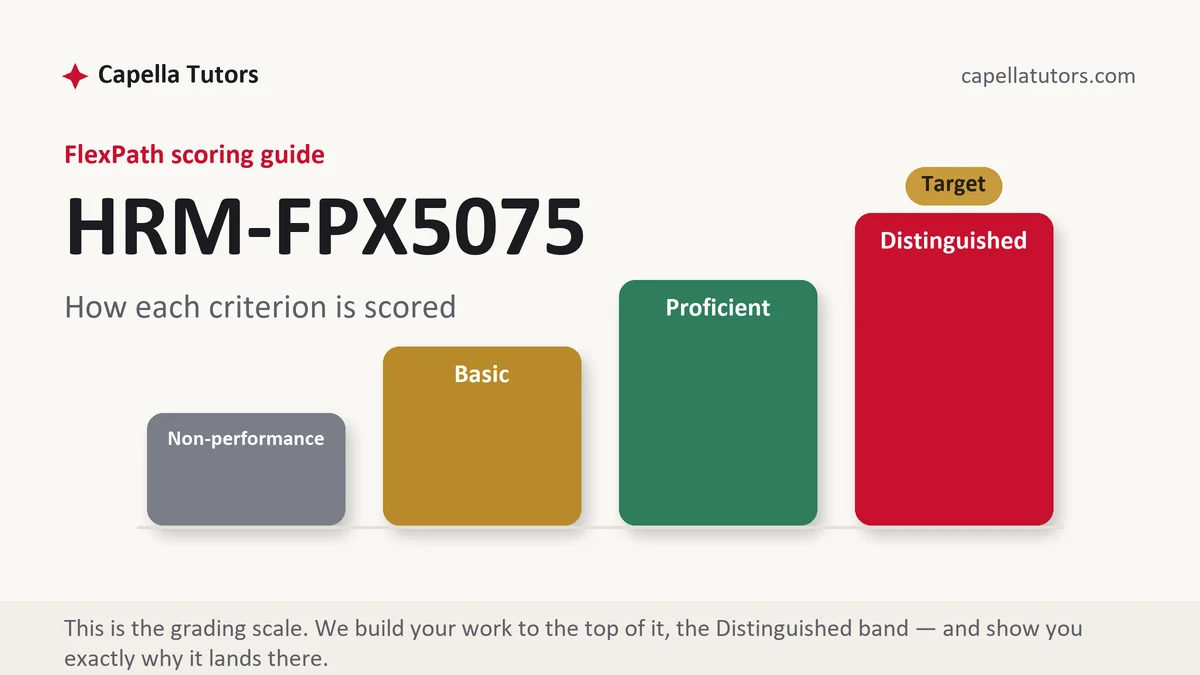
What HRM FPX 5075 actually grades
The premise of this course is structural rather than inspirational. A human resource practitioner sits in a staff function, controls no line budget, and has no direct reports among the people whose behavior a proposal is meant to change, so every criterion here is asking one question: can you move a decision that belongs to somebody else. Papers that answer with a survey of leadership styles land mid-rubric. Papers that name the decision, name the person who signs it, and show how the signature was obtained reach the top.
Power is graded on precision, and the five bases described by French and Raven are the vocabulary the criteria expect you to use correctly. Reward and coercive bases mostly sit with the line manager rather than with you. Legitimate power in a staff role is borrowed, which is why an initiative introduced as a policy requirement collapses the moment an operating leader decides the requirement is optional. Expert and referent bases are the two an HR practitioner can build, and both are accumulated rather than assigned. Credibility in this setting is a record of having been right in public about small things, and a writer who explains an influence success without reference to that history has left out the mechanism.
The third strand is the artifact. Executives approve asks that state a cost, an owner, and a date, and the most common defect in HR proposals is that the cost to the line is never counted. A new review cycle, a redesigned onboarding path, a competency framework, each one spends manager minutes that already belong to something else, and a proposal that presents itself as free is asking a leader to sign a blank check. The criteria reward a candidate who prices the burden their own idea creates and then argues it is worth carrying.
Last comes conflict, because influence includes refusal. Part of the role is declining a request an executive has already decided on, and the graded version of that is not a flat no. Interest based negotiation in the tradition of Fisher and Ury asks what the manager is actually trying to achieve, separates that interest from the specific action requested, and offers a route to the interest that does not create the exposure. Assessments in this course usually want that exchange written out, with the alternative specified and the escalation path named, and your scoring guide decides how much of the dialogue has to appear.
How we help in this course
Our 5075 drafts start from the decision rather than from the theory. The stakeholder analysis names people by role and states what each of them controls, the case carries a figure the finance function would recognize, the influence approach is matched to the base of power actually available, and the follow through has a measure attached. Tell us the organization, the change you are trying to land, who has to approve it, and what has already been tried, and the sample argues from that rather than from a generic scenario.
Terms are the same as everywhere else in the studio. One premium original deliverable inside 24 to 48 hours, aimed at the top descriptor, moved through an eight person pipeline with a dedicated scoring guide pass, a separate current APA and originality check, and an editor reading last. Revisions run free until the criteria are satisfied and faculty comments re enter the same cycle at no cost. Because an evaluator has two business days with a submitted attempt, tell us your intended submit date and we build the schedule backward from it.
The assessments, one by one
Assessment 1
The opening deliverable in an influence course establishes the situation rather than the solution, so the assessment usually asks you to identify a specific decision you do not own, analyze who controls it and what each party stands to lose, and locate the base of power actually available to a staff function. Read the full Assessment 1 manual.
Assessment 2
Influence includes refusal, so the middle deliverable in this course usually asks you to handle a disagreement with somebody senior to you: state the request, separate it from the interest underneath it, and offer a route to that interest which does not create the exposure the original request would. Read the full Assessment 2 manual.
Assessment 3
The closing deliverable treats influence as a result rather than an event, so the assessment usually asks what will be observably different once the approval is won, who reports it and from which existing report, and how honestly you can appraise your own effect on the outcome. Read the full Assessment 3 manual.
How to actually write HRM FPX 5075: where to begin
Open the guide and write the decision at the top of the page in one line: who has to say yes, to what, by when. Each criterion then becomes a heading with the Distinguished sentence parked beneath it while you draft, and nothing enters the document that does not sit under one of those headings. The assessments in this course usually ask you to examine an influence situation, choose an approach and defend it, and set out how you would carry it through, with your scoring guide fixing the sections and the format. A paper that never identifies a specific decider has written about influence in general, which is the safest way to stay in the middle of the rubric.
Then cost the ask in the currency the line actually spends, which is manager time. Suppose you propose quarterly development conversations across an organization with 240 people managers and an average span of nine direct reports. Preparation runs about 25 minutes per report and the conversation itself about 30, so 55 minutes each, or 495 minutes per manager per quarter, which is 8.25 hours. Across 240 managers that is 1,980 hours a quarter and 7,920 hours a year, and at a loaded rate of 61 dollars an hour the organization is being asked for 483,120 dollars of supervisory attention. Put that number in the proposal yourself. A leader who finds the cost after approving the idea stops trusting the function, and a leader who is handed the cost with an argument for why it beats the alternative starts treating you as a peer.
Then map the room rather than the org chart. For each person write what they control, what they are measured on, what they lose if this proceeds, and whether they can stop it by doing nothing, since silent veto through inaction is the most common way an HR initiative dies. Sequence the conversations so that nobody meets the proposal for the first time in the meeting where it is decided, and take the objections you collect in those conversations into the document rather than around it. A recommendation that names the strongest argument against itself and answers it reads as competence, and one that pretends the objection was never raised reads as a memo written alone.
Then close on follow through, because the criteria treat influence as a result rather than an event. Say what will be different in observable behavior, who reports it, from which existing report, and at what interval. Adoption is the measure, not attendance and not agreement in the room, so state a denominator and a window: the proportion of eligible managers who completed a conversation within the quarter is a claim, while positive feedback from the pilot group is a mood. Then write the sentence most drafts omit, which is what you will do if the approval holds and the behavior does not follow, because that is the difference between an advocate and an owner.
| Section | What goes in it | What Distinguished looks like |
|---|---|---|
| The decision at stake | The specific action, the person authorized to approve it, and the date it has to be made by. | A decision stated so plainly that a reader could put it in a meeting agenda unchanged. |
| Stakeholders and control | Each party's role, what they control, what they are measured on, and what the change costs them. | Silent veto by inaction identified, with the person who holds it named and addressed. |
| The evidence assembled | Internal data, comparable practice, and research, each labeled by what kind of claim it can support. | Evidence sized to the claim, with weak sources named as weak rather than quietly promoted. |
| The cost to the line | Manager and employee time, system change, and money, calculated rather than asserted. | A burden figure produced by the writer before anyone else could produce it against them. |
| The influence approach | The power base being used, the sequence of conversations, and the framing chosen for each audience. | An approach matched to a base actually available to a staff function, not to borrowed authority. |
| Follow through | The observable behavior, the report it comes from, the interval, and the response if it does not appear. | Adoption measured with a denominator and a window, and a stated action for the failure case. |
Developing the analysis
The scholarship under this course is thinner than its confidence suggests, and saying so is worth a criterion. Most published work on influence tactics rests on self report collected at one moment from one person, which means the same respondent supplies both the tactic and the judgment of whether it worked. The classic social influence principles associated with Cialdini came out of field observation and laboratory experiments, and several well known results in that broader literature have been re examined during the replication wave with mixed outcomes, so the defensible move is to describe the mechanism a principle proposes and then argue from your own situation rather than quoting an effect size as though it were a constant. Practitioner models deserve the same handling. The business partner framing that dominates HR writing is a role description advanced by consultants and academics working with employers, not a tested causal theory, and using it as scaffolding is fine as long as you label it. Take one contested claim, such as the idea that HR influence follows from proximity to the executive team, and test it against your own case, since plenty of practitioners sit in the meeting and change nothing while others without the invitation move decisions weekly. Naming that gap and explaining what actually produced the difference is the analytical move the top column is describing.
Citations that survive faculty review
Four families of source do the work in a paper of this kind. Peer reviewed research on influence, negotiation and organizational politics comes from Journal of Applied Psychology, Organizational Behavior and Human Decision Processes, Human Resource Management Journal and Negotiation Journal, reached through Business Source Complete and the Capella library, and each empirical claim should arrive with the design that produced it. Frameworks go to the people who introduced them, so the bases of power to French and Raven, interest based negotiation to Fisher and Ury, and the framing of gains against losses to the prospect theory literature rather than to a management textbook summarizing it. Professional bodies supply the role expectations and the competency language, principally the Society for Human Resource Management competency model and comparable published frameworks, and those are cited as professional standards rather than as evidence about outcomes. Then cite your own organization's documents, naming the policy, the version and the date, because an influence argument that rests on what the handbook says needs the reader to see which handbook and when. Run the two way check between text and reference list in current APA before submission, since a reference that appears in one place only is the fastest criterion to lose.
The mistakes that land Basic instead of Distinguished
- Leadership style described instead of a decision moved. The criteria ask what changed and who authorized it, and an inventory of styles answers neither.
- A proposal with no cost to the line. Manager minutes are the real currency, and an initiative that appears free is refused later rather than sooner.
- Stakeholders listed without their control. A name in a table means nothing until the reader knows what that person can approve, delay or ignore.
- Objections answered only in the writer's head. Naming the strongest counterargument and addressing it is graded, and omitting it is visible.
- Influence claimed from attendance. A well received presentation is not adoption, and the criteria want a denominator, a window and a source report.
HRM FPX 5075 questions students actually ask
My workplace has no conflict I can write about. Can I construct one?
Yes, and a constructed situation handled openly is worth more than a real one described vaguely. Build it from conditions you actually know, meaning a real span of control, a real approval path and a real budget cycle, then invent the disagreement and say in the first paragraph that the scenario is constructed for the assessment. Keep identifiable colleagues out of it entirely, since a paper that a coworker could read and recognize creates a problem for you that no grade compensates for. What faculty are grading is whether your reasoning about power, sequence and evidence holds together, and a well specified invented case demonstrates that as fully as a real one, provided the details stay internally consistent from the first page to the recommendation.
How do I write about influencing my own manager without it reading as a complaint?
Describe behavior and consequence, never character. The sentence my director is resistant to data is a judgment about a person and it invites a reader to discount everything that follows, while the sentence three of the last four proposals were returned with a request for cost detail is an observation anyone could verify, and it points straight at what to do differently. Write your manager's interests as you would write a client's, including the pressures you can see from below and the ones you can only infer, and mark the inference as inference. Then propose the approach in the same neutral register. Faculty are reading for professional judgment under an asymmetry of power, and the register you choose is most of the evidence they have.
The prompt asks me to assess my own leadership. How much self report is acceptable?
Use the instrument if the course provides one, report what it produced, and then say what a self assessment can and cannot capture. Self ratings of influence and leadership correlate only modestly with ratings from other people, and the gap tends to run in a flattering direction, so a paper that treats a questionnaire result as a measurement rather than as one perspective has already conceded a criterion. The stronger move is to place the self report beside something external, which might be feedback you have on file, a specific outcome you can point to, or a decision that went the other way, and then reason about the disagreement. Where you have no external check, say the claim rests on self report alone and keep the conclusion proportionate to that.
Influence deliverable due?
Send the criteria, the change you are trying to land, and the names of the people who have to approve it. The first premium sample is free, with the cost to the line already calculated.