Give us the deliverable and the criteria, and a premium original sample is back with you in 24 to 48 hours, pitched at the Distinguished wording with every cultural claim held to what its evidence can carry, then rewritten at no cost until the guide is satisfied. LEAD FPX 5210, Leading Globally, carries 2 program points and sits in the elective pool for the General Human Resource Management specialization of the Capella MS in Human Resource Management, run in FlexPath, where a graded attempt rather than attendance is what moves you along. In Capella's catalog the course code is written LEAD-FPX5210.
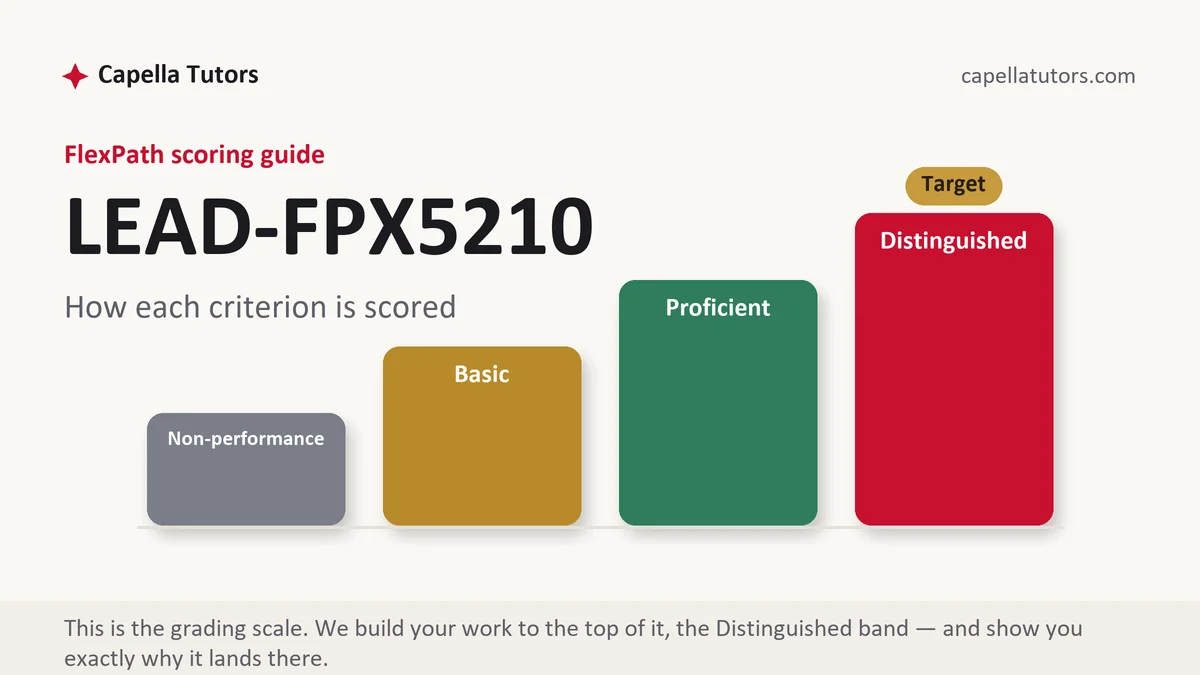
What LEAD FPX 5210 actually grades
The unit of analysis in this course is the leader's behavior rather than the organization's policy, and keeping that straight decides several criteria. You are being assessed on how you run a meeting whose participants are awake at different hours, how you assign work to people whose assumptions about authority and disagreement you did not set, and how you decide something when the people affected cannot all be in the conversation. Assessments here usually ask you to analyze a global leadership situation and propose how you would lead through it, and your scoring guide decides how much of the analysis has to rest on published frameworks.
Cultural frameworks are graded on restraint. Dimension scores of the kind Hofstede produced are country means calculated from survey responses, and the single most common error in this course is treating a country mean as a prediction about the colleague in front of you, which is the ecological fallacy in its clearest form. Variation inside a country routinely exceeds the difference between country averages on the same dimension, so a score can be a useful hypothesis about a norm and is never a description of a person. The GLOBE program improved on this by separating what respondents said their society does from what they said it should do, and by reporting which leadership attributes are seen as effective across clusters and which are contested, which is a more useful output for a leader than a national score. Cultural intelligence, framed by Earley and Ang as a capability with distinguishable components rather than as a trait, is the construct most likely to appear in your reading, and it is worth knowing that it is largely measured by self report.
The third strand is distance, and it is the practical half of the course. A distributed team does not lose trust because people are unfriendly, it loses it because the small unplanned exchanges that build trust locally do not occur, and because a delay in a written reply is ambiguous in a way that a pause in a corridor is not. Time zones convert an ordinary meeting into a cost that somebody pays outside their working day, and if the leader never decides who pays, the answer defaults to whoever is furthest from headquarters. Language creates a second asymmetry the criteria expect you to address, because in a synchronous discussion conducted in one person's first language and another's third, contribution is a measure of processing speed as much as of insight.
Last is ethics, and the graded position is not relativism. A leader operating across borders faces situations where local practice, the organization's code and the law of a home jurisdiction with extraterritorial reach all point differently, and anti bribery statutes are the standing example because they can make conduct criminal for the employee regardless of what is customary where it happens. The criteria want a decision procedure rather than a philosophical survey: name which standard is the floor, name which is stricter, and say who the leader escalates to when the two conflict.
How we help in this course
Drafts for 5210 keep the claims the size of the evidence behind them. Country level findings are used to generate hypotheses and then tested against what the team actually does, framework attributions go to the researchers who built them, meeting and communication designs come with the burden calculated, and ethical questions arrive with a standard named and an escalation route rather than with a shrug. Tell us the team, the sites, the languages, the reporting lines and the decision at issue, and the sample argues from your situation rather than from a set of national stereotypes.
The money side of this course is no different from any other. You get one premium original deliverable per assessment in 24 to 48 hours, written at the Distinguished column, carried through an eight person pipeline in which one reader does nothing but check each framework against the source it is credited to. Rework stays free for as long as the guide demands it, and faculty comments cost nothing to fold back in. With an evaluator entitled to two business days on every attempt, a resubmission caused by a dimension score credited to the wrong research program is an expensive week to lose.
The assessments, one by one
Assessment 1: Cross-Cultural Leadership Capabilities
Interpret your results on the Intercultural Effectiveness Scale across its six domains and write a personal global leadership plan. Read the full Assessment 1 manual.
Assessment 2: Building Global Leadership
Explain cultural intelligence and its components, compare two cultural models, and apply them to leading in a cross-cultural environment. Read the full Assessment 2 manual.
Assessment 3: Global Leadership Presentation
Compare two countries on cultural dimensions, culture and economics, and explain what leaders operating in both should do differently. Read the full Assessment 3 manual.
How to actually write LEAD FPX 5210: where to begin
Describe the team before you describe the theory. Name the sites, the number of people at each, the reporting lines, the working languages, who the client is and what the team is actually accountable for delivering, because a paper that opens with a cultural framework and then attaches a team to it has written the argument backwards. Then turn the guide into headings with the Distinguished language beneath each while you draft. A concrete team makes every later claim testable, and testability is most of what separates the top two columns in a course like this one.
Then work the time arithmetic, since it turns a fairness argument into an operations one. Take three sites, with the second six hours ahead of the first and the third thirteen hours ahead. Site one works eight in the morning until five, site two nine until five, site three nine until six. Convert everything into site one's clock: site two is working from three in the morning until eleven, and site three is working from eight the previous evening until five in the morning. Site one and site two share three hours, from eight until eleven. Site three shares none of its normal working day with either of the others. That is the finding, and it changes the recommendation completely, because no clever scheduling produces a comfortable slot and the only honest question is who bears the cost and how often. A single fixed weekly call puts all forty eight of the year's meetings outside one site's working hours. Rotating across three slots gives each site sixteen. And moving the status portion to an asynchronous decision log with a twenty four hour comment window removes the meeting for most weeks entirely, at the price of one calendar day, which is usually the trade a distributed team should make.
Then design for the language asymmetry rather than hoping it resolves. Circulate the agenda and the substantive material far enough in advance that people can read in advance rather than translate in real time, ask for written input before the discussion so the quietest channel is not the only channel, and call on people by name in a planned order instead of relying on who interrupts fastest. Watch your own inference too, because the leader who reads hesitancy in a third language as a lack of conviction, or reads elaborate courtesy as agreement, will misjudge both the plan and the person. Write into the paper the check you will use: a specific commitment restated by the person who owns it, in writing, in their own words, which surfaces a misunderstanding while it is still cheap.
Then set the ethical standard and the escalation before the situation arrives. The workable order is to identify the strictest applicable requirement, which is often a home country statute with extraterritorial reach rather than the local rule, then the organization's own code where it goes further, then the local legal floor, and to say which one governs the decision in front of you. Facilitation payments are the case worth working through, because the practice may be tolerated locally, prohibited absolutely by some home statutes, and treated differently again by the company code, and a leader who improvises in the moment has exposed themselves personally. Give the paper a procedure instead of a position: what the leader does at the point of demand, who they call, what gets recorded, and what protection the person reporting has. Then close on measurement, because the criteria treat global leadership as observable, so state what you would look at, whether that is participation distribution across sites, the proportion of decisions made asynchronously, or whether the same site keeps supplying the person who joins at midnight.
| Section | What goes in it | What Distinguished looks like |
|---|---|---|
| The team described | Sites, headcount, reporting lines, working languages, and what the team is accountable for. | A description concrete enough that every later claim can be checked against it. |
| Cultural evidence used | The frameworks applied, what each measures, and the level at which its data was collected. | Country level findings used as hypotheses about norms, never as predictions about individuals. |
| Time and channel design | Working hours converted to one clock, the overlap window, and what happens synchronously. | Meeting burden calculated and distributed, with asynchronous work chosen where it fits. |
| Participation and language | How input is gathered, in what order, in writing or aloud, and how understanding is confirmed. | A confirmation step that catches misunderstanding early, plus attention to who is not speaking. |
| Ethical standard | The applicable requirements ranked, the governing standard named, and the escalation route. | A procedure the leader could follow under pressure, with the record and the reporting protection stated. |
| Measures | What would be observed to know the approach is working, from which source, at what interval. | Measures that would expose an unfair arrangement rather than confirm the leader's impression. |
Developing the analysis
The analytical work in this course is holding cultural evidence to the right level, and a paper that does it well will say so out loud. The dimension scores most students reach for were derived from survey data collected inside a single multinational corporation several decades ago, refined since but still national averages, and their author was explicit that they describe societies rather than people. The GLOBE program improved the design and widened the sample, and it also separated societal practices from societal values, which matters because respondents frequently report that their society is one way and should be another, and a leader who plans against the values score when the practices score describes the workplace will be surprised. Cultural intelligence adds a useful idea, that the capability to function across differences is learnable and has separable components, and it inherits the standard problem of self report measures, which is that people who feel competent report competence. So use the frameworks the way a clinician uses a differential: they tell you where misunderstanding is likely to arise, they narrow what you check first, and they never substitute for asking. Then take one prediction a framework makes about your own team and report whether it held, because a paper that tests a framework against evidence outranks any paper that only applies one.
Citations that survive faculty review
Attribution is checked closely in this course, so give each framework to the people who built it. National dimension scores go to Hofstede and to the later work extending them, the practices and values distinction and the leadership prototypes go to House and the GLOBE researchers, and cultural intelligence goes to Earley and Ang rather than to a textbook chapter describing it. Peer reviewed evidence comes from Journal of International Business Studies, Journal of World Business, Management and Organization Review and Journal of Cross-Cultural Psychology, and any claim about effects should arrive with the sample, the countries involved and whether the data were self reported. Popular practitioner books mapping cultural differences are readable and widely assigned, and they are cited as practitioner interpretation rather than as evidence, which is a distinction faculty reward when you make it explicitly. Legal material in the ethics section is cited to the statute and to the enforcement agency's published guidance, since anti bribery obligations are legal rules and a secondary description of one is not authority. Then cite your own organization's code of conduct and any regional supplement by title and version, because the code is frequently stricter than the law and the difference is exactly what the leader has to know.
The mistakes that land Basic instead of Distinguished
- A country score applied to a named individual. The data were collected at the level of societies, and within country variation swamps the average.
- A single fixed meeting time for a team spread across many hours. The cost does not disappear, it accumulates in one place, and the criteria expect you to have counted it.
- Fluency read as capability. Contribution in a synchronous discussion measures processing in a second language as much as it measures judgment.
- Practitioner culture books cited as research. They are useful heuristics with thin sampling, and presenting them as evidence loses the criterion.
- Local custom used to settle a question a statute settles. Some obligations follow the employee across borders, and relativism is not an available answer.
LEAD FPX 5210 questions students actually ask
My team is not international. Can I still write this assessment?
Yes, using any team that is genuinely distributed, and saying so in the opening. A team spread across two time zones inside one country already has the meeting equity problem, the asynchronous decision problem and the trust at distance problem, and those carry most of the criteria. If you also want cultural difference in the analysis, look at the differences you actually have, which might be professional cultures between clinical and administrative staff, or the difference between a long tenured site and one acquired two years ago, and treat them with the same discipline you would apply to national data. Failing that, construct a plausible team and label the construction. What loses credit is writing about a global team in the abstract, because abstraction removes every fact the criteria need to grade.
How many cultural dimensions should I use?
Two, used properly, beats six listed. Choose the dimensions that plausibly bear on the specific situation you described, say what each one measures and how the underlying data were gathered, state the hypothesis it generates about your team, and then report what you observed. That sequence demonstrates the reasoning the criteria are looking for. Running through an entire framework dimension by dimension produces a paper that describes a country rather than analyzing a problem, and it tends to invite generalizations that the evidence cannot carry. If your reading assigns a full framework, summarize it briefly, then narrow explicitly and say why you narrowed, which reads as judgment rather than as omission.
Do I need to know the employment law of each country I mention?
Not in this course, but you do need to know which standard governs and who answers the question. Leading globally requires you to recognize that a request that is ordinary in one place may be prohibited for you personally somewhere else, that a decision affecting employees may need a consultation step you do not have at home, and that the answer comes from local counsel or a regional human resources lead rather than from your own judgment. Write that into the plan as a named role and a trigger, since the graded skill is recognizing the boundary rather than crossing it competently. Where the assessment does require a specific legal claim, cite the instrument itself and note its date, and say plainly that implementation would be confirmed locally.
Global leadership deliverable due?
Send the criteria, the sites, the languages and the decision at issue. The first premium sample is free, with the meeting burden calculated and every framework cited to its source.