In Capella's RN-to-BSN sequence, NURS FPX 4905, capstone Project for Nursing, carries 3 pts / 6 qcr and runs in both FlexPath and GuidedPath. In Capella's catalog the course code is written NURS-FPX4905.
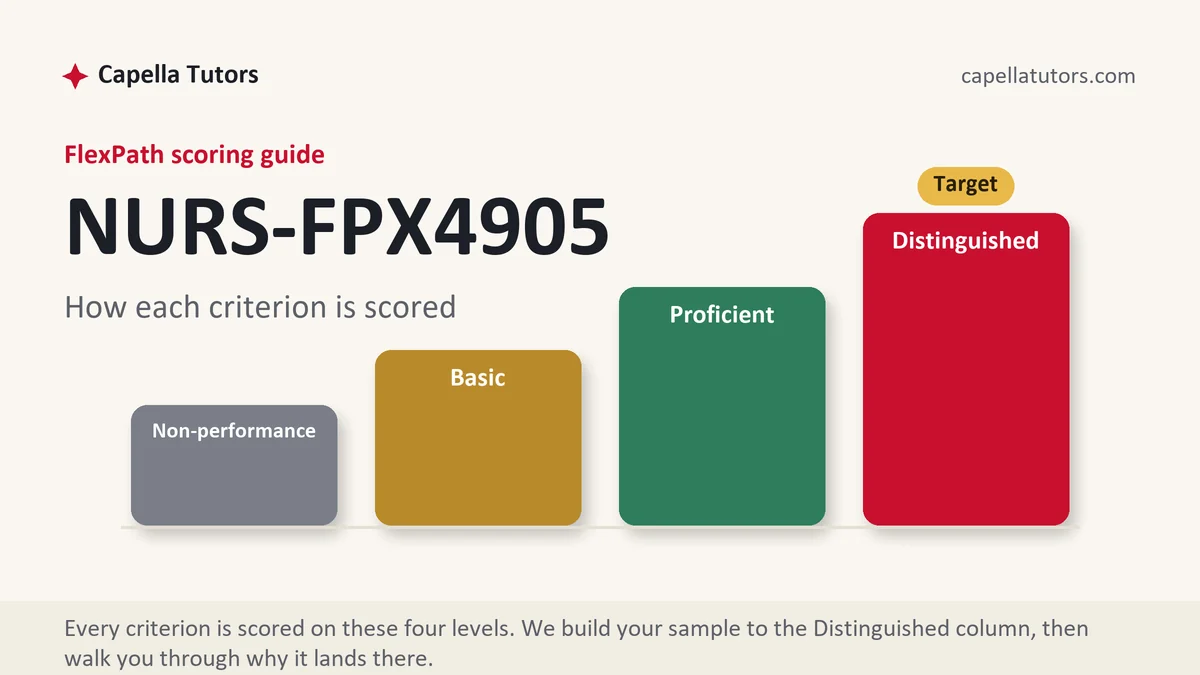
What NURS FPX 4905 actually grades
The finale carries double weight: a capstone project that synthesizes the whole program and a practicum requirement of roughly 40 hours with paperwork approved before enrollment. The writing criteria expect integration, evidence, quality thinking, coordination, and community lens working together on one sustained problem, and the logistics punish anyone who discovers the paperwork late.
How we help in this course
We run both tracks at once: capstone chapters drafted through the standard pipeline while the virtual practicum support keeps hours and logs current, so neither stalls the finish. Start the paperwork conversation one course early; every on-time graduation we have watched did.
Orders here get the standard machinery: your scoring guide decoded by the research analyst, a subject-matched writer, scoring-guide QA then APA and originality QA, delivery inside 24 to 48 hours, and the revise-until-target guarantee.
Assessment manuals for this course
Every assessment in NURS FPX 4905 has its own manual now: the walkthrough, the structure that maps to the criteria, an annotated sample excerpt, and the done-for-you door. Open Assessment 1, Assessment 2, Assessment 3, Assessment 4, Assessment 5, or start from the list in the sidebar.
In NURS FPX 4905 right now?
Send the assessment number and the scoring guide from your courseroom. First premium sample free, back in 24 to 48 hours.
The finale's two tracks, run in parallel
NURS FPX 4905 closes the RN-to-BSN carrying double weight: a capstone that synthesizes the whole program's competencies and a practicum requirement of roughly 40 hours whose paperwork must be approved before enrollment. The desk runs both tracks at once by design. Capstone chapters move through the standard pipeline, written to the Distinguished descriptions that audit integration itself, while the virtual practicum support keeps hours and logs current alongside, so neither track ever stalls the other inside the billing session.
The paperwork clock nobody warns you about
The documented failure mode of this course is administrative, not academic: students discover the practicum approval requirement late and lose weeks they had already paid for. Start that conversation one course early. Every on-time graduation we have watched did, and under the Expedite Plan's bachelor's arithmetic, one billing session for the remaining courses, weeks lost to paperwork are the most expensive weeks there are.
How is a capstone scoped differently from a normal assessment?
It gets a staged plan rather than a single delivery: sections dated across your remaining session, each returning in 24 to 48 hours, integration checked by both QA passes because integration is what the scoring guide reads for.
Can the free sample apply to a capstone section?
Yes, one full section with its criterion map, which is the honest way to evaluate a desk you are about to trust with the program's last word. Judge the integration in that one section; it predicts the rest.
The assessments, one by one
Assessment 1
Practicum planning for the capstone: the faculty call, setting, goals and the 40 hours. Read the full Assessment 1 manual.
Assessment 2
Define a process problem in your practicum setting and analyze its effect on quality, safety and cost. Read the full Assessment 2 manual.
Assessment 3: Technology and Professional Standards
The BSN nurse's role, collaboration, agency guidance and technology for the problem. Read the full Assessment 3 manual.
Assessment 4
The intervention, argued and evidenced and carried out in the practicum. Read the full Assessment 4 manual.
Assessment 5
A reflection connecting the capstone to the four spheres of care. Read the full Assessment 5 manual.
How to actually write NURS FPX 4905: where to begin
Start with the scoring guides, plural, and read all of them on day one. The capstone is one project assembled across the term, and its assessments usually walk a single problem through the program's lenses in sequence: plan the practicum with your faculty, define a process problem in your practicum setting and weigh its quality, safety, and cost dimensions, examine the technology and professional standards that bear on it, propose and deliver an intervention during practicum hours, then reflect on how the work connects to the four spheres of care. Choose your problem only after reading every guide, because a problem that serves the first assessment and starves the fourth costs you the term.
The right problem comes from your practicum setting: a measurable baseline you can state today, a published evidence base, and an intervention deliverable inside roughly forty practicum hours. One unit's fall rate, thirty-day readmissions for one condition, a medication reconciliation gap; problems at that scale work. Then outline each assessment the standard way, every criterion copied in as a heading with its Distinguished description underneath, and keep a running document of baseline numbers, sources, and decisions; you will cite your own earlier sections more than anything else.
Log practicum hours as you go, in Capella's tracking system, not reconstructed at the end. The hours are not separate from the writing. The baseline data, the delivery of the intervention, the audience response you will describe, all of it comes out of documented practicum time.
| Section | What goes in it | What Distinguished looks like |
|---|---|---|
| Problem definition and assessment | The problem, its population, its baseline numbers, and the leadership and policy context around it. | A problem narrow enough to move in one term, with a measurable baseline from your practicum setting. |
| Quality, safety, and cost analysis | What the problem costs in outcomes and dollars, at the unit and system level. | Cost claims carried by cited data, and the quality-safety-cost relationships argued, not just listed. |
| Technology, coordination, and community resources | The levers available: what technology, care coordination, and local resources can do about the problem. | Each lever assessed honestly, including the one that will not help this problem and why. |
| The intervention | What you built or taught, delivered to a real patient, family, or group during practicum hours. | The delivery documented with time, place, and audience response, and every design choice traced to evidence. |
| Reflection on program outcomes | How the project demonstrates the program's competencies and your growth against them. | Specific moments in the project mapped to specific competencies, with an honest account of what you would redo. |
Developing the synthesis
The capstone grades synthesis on two planes. Across sources, the move is the same as everywhere in the program: pair evidence that disagrees and adjudicate. One study finds education-only interventions fade within months; another finds bundled interventions, education plus a workflow change plus audit, holding their gains. Listing both is Basic; weighing them, design against design, setting against your setting, and letting the verdict shape your intervention is Distinguished. Across assessments, synthesis means the sections talk to each other: the cost analysis cites the baseline from your problem assessment, the intervention design answers the barriers your technology and coordination sections found, the reflection points back at all of it. Set your baseline against the literature's effect sizes to say what improvement is realistic in one term. Then name what the evidence cannot settle, usually whether short-term gains persist, and build your evaluation plan to watch exactly that.
Citations that survive faculty review
Capstone evidence has to span domains, quality improvement, safety, cost, technology, coordination, and every domain criterion expects sources doing named work: this study establishes the problem's scope, this one justifies the intervention design. Keep peer-reviewed sources within roughly the last five years, gathered through the Capella library's CINAHL and PubMed, and hold the mechanics tight: author-date citations integrated into the sentences making the claims, reference list matching both ways, nothing cited that is not used. Practicum-site data, your unit's fall numbers, gets cited honestly as internal data rather than dressed up as literature. Carry your strongest sources forward deliberately; recasting the same trial from problem evidence into design justification is synthesis, provided each appearance does new work, while a fresh bibliography per assessment reads as searching, not building.
The mistakes that land Basic instead of Distinguished
- A problem too broad to move, nurse burnout in general instead of one unit's measurable gap.
- Assessments written as strangers to each other, when integration is exactly what the guides read for.
- Practicum hours reconstructed at the end of the term, with the approval paperwork discovered late.
- A reflection that summarizes the project instead of judging growth against the program outcomes.
NURS FPX 4905 questions students actually ask
How do I pick a capstone problem that will not collapse mid-term?
Apply three tests: a baseline number you can state today without a records request you may never win, real intervention evidence from the last five years, and a delivery that fits inside roughly forty practicum hours. A unit-level problem passes all three; a system-level cause usually fails the first and third. Small and measurable finishes the term, ambitious and vague does not.
Do the assessments in 4905 have to connect to each other?
Yes, structurally. They are chapters of one project, and the scoring guides reward integration: the later assessments expect the problem, baseline, and evidence established earlier, and the reflection expects all of it. Keep a running master document with your numbers, sources, and decisions, and cite your own earlier findings as you go. Writing each assessment cold, as if the others did not exist, is how strong writers land Basic in this course.
How do the practicum hours fit into the writing?
The hours generate the paper. Baseline data comes from time in the setting, the intervention is delivered during logged hours, and the delivery details, when, where, to whom, how they responded, become the substance of the later assessments. Log hours in Capella's tracking system as they happen, and start the practicum paperwork one course early; approval must be in place before the course starts.