This manual is for NURS FPX 4905 Assessment 3, start to submission. Technology and Professional Standards takes the process problem from Assessment 2 and asks how professional standards and technology can improve it: the role of the BSN-prepared nurse in process improvement, how interprofessional collaboration supports it, what government agencies recommend, which technology your setting uses now and where it falls short, which technology the literature recommends, and the implementation issues you would expect. The grade turns on fit. Technology described in general scores lower than a recommendation tied to your setting's process and a named standard. Below is the method our tutors use, a structure that maps to the criteria, and an annotated sample excerpt. Prefer to hand it off? A premium original sample for this exact assessment comes back in 24 to 48 hours, revised free until it meets the guide. Capella's catalog lists the course as NURS-FPX4905, and some courserooms print NURS4905; both point to this same Assessment 3. In current courserooms this assessment typically appears as "Technology and Professional Standards".
One honesty note before the manual: Capella revises courses and scoring guides over time, so always write to the exact scoring guide attached to your assessment in the courseroom. The course identity above is verified on capella.edu; the method and structure below are our tutors' approach to it, not Capella's official rubric text.
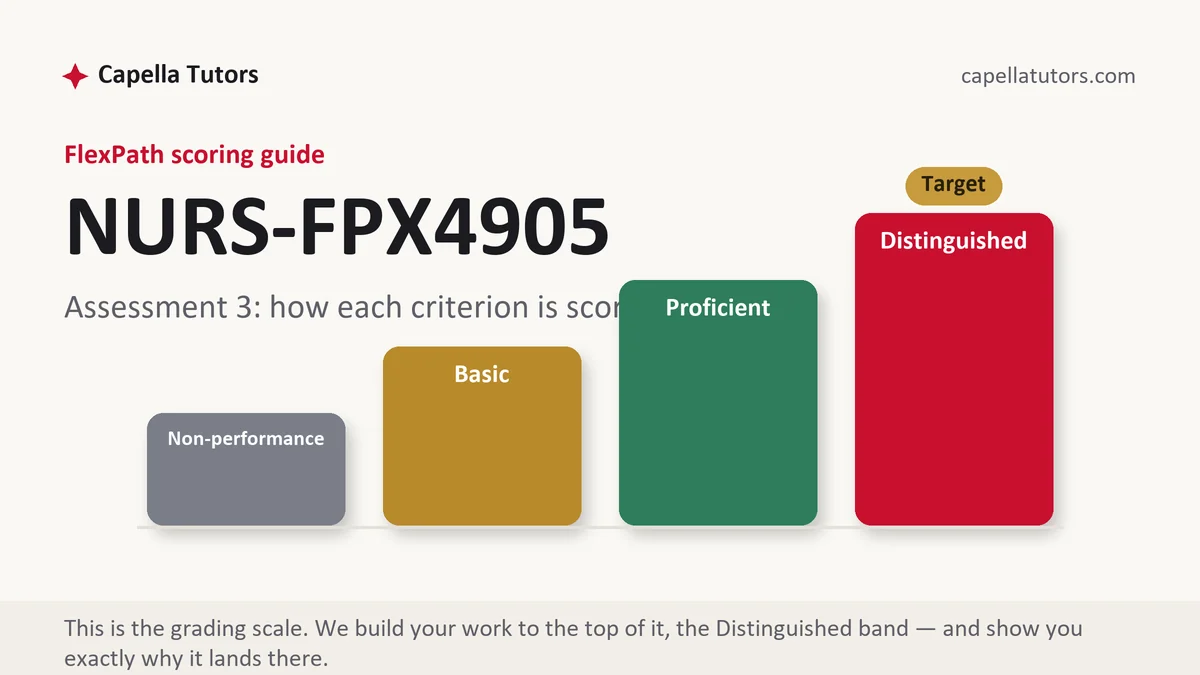
How NURS FPX 4905 Assessment 3 is scored
FlexPath does not use letter grades. Each criterion in the scoring guide lands on one of four levels, and the level descriptions are the real writing brief:
| Level | What it means on a technology and standards paper |
|---|---|
| Distinguished | The BSN nurse's role and interprofessional collaboration are tied to the process problem, agency recommendations are cited specifically, current technology and its gaps are described from the setting, the recommended technology is supported by literature, and implementation issues have solutions. |
| Proficient | All parts are present and accurate, but the recommendation and the implementation discussion stay general. |
| Basic | The paper surveys technology and standards broadly with little reference to the practicum process problem. |
| Non-performance | A required part, such as the agency recommendations or the implementation issues, is missing. |
Keep the same process problem and setting from Assessment 2. Assessment 4 builds an intervention from what you conclude here.
The NURS FPX 4905 Assessment 3 method, step by step
-
Restate the process problem
Two sentences with the figure that sizes it, carried from Assessment 2.
-
Explain the BSN nurse's role
How BSN-prepared nurses contribute to process improvement, with reference to professional standards such as the AACN Essentials or the ANA Scope and Standards.
-
Describe interprofessional collaboration
Which disciplines touch the process and how working together improves it, with evidence.
-
Cite government agency recommendations
Specific recommendations from AHRQ, CMS, CDC or another relevant agency that apply to the problem.
-
Assess current and recommended technology
The technology your setting uses now and its limits, then a technology the literature supports for this problem, with sources.
-
Anticipate implementation issues
Cost, training, workflow, interoperability or privacy, each with a practical solution.
A structure that maps to the criteria
Word counts are planning targets our tutors use for this paper, not Capella rules; follow the length your scoring guide states.
| Section | What it must do | Guide |
|---|---|---|
| Introduction | The process problem restated and the paper's purpose. | ~125 words |
| The BSN nurse and professional standards | Role in process improvement with named standards. | ~200 words |
| Interprofessional collaboration | Disciplines involved and evidence for team approaches. | ~175 words |
| Government agency recommendations | Specific, cited recommendations. | ~150 words |
| Current and recommended technology | What exists, its gaps, and the evidence-based option. | ~275 words |
| Implementation issues and conclusion | Issues with solutions, then references. | ~175 words |
Annotated sample excerpt
An original model excerpt from our team, written to show the register that reaches the top of the guide. Learn the moves, then write your own version.
The clinic currently tracks outstanding diagnostic results on a shared spreadsheet that one nurse updates at the end of each day, so a delayed result is noticed only when someone reads the sheet.1 That design explains why several patients last quarter waited more than two weeks for follow-up on abnormal results: the system records delays but does not flag them.2 Studies of electronic result-tracking with automated alerts in ambulatory care report fewer missed follow-ups, which makes an alert-based tracking module in the existing record the recommendation here, provided alert thresholds are agreed with the clinicians who will receive them.3
- 1Describes the setting's current technology concretely.
- 2Connects its design to the process problem's measured harm.
- 3Recommends a technology from the literature and names the condition for it to work, which is the fit the criteria reward.
The full premium sample for your exact assessment, written fresh to your scoring guide and topic, is free to request. Study it, revise it into your own voice, and submit work you understand.
The five mistakes that cost Distinguished
- A new problem. Carry the Assessment 2 process problem forward.
- Standards named but not applied. Show how the standard shapes the nurse's role in this problem.
- Agency guidance in general. Cite a specific recommendation.
- Technology without evidence. Support the recommendation with studies.
- Implementation ignored. Every recommendation meets cost, training or workflow issues.
Pre-submission checklist
- Same process problem and setting as Assessment 2
- BSN nurse's role tied to named standards
- Interprofessional collaboration supported by evidence
- Specific government agency recommendations
- Current technology assessed and a recommended technology supported
- Implementation issues with solutions, current APA references
Want the technology paper written for your setting?
Send the scoring guide and your Assessment 2 work. Our team returns a premium original paper in 24 to 48 hours, revised free until it meets the guide.