This manual is for NURS FPX 4905 Assessment 4, start to submission. Assessment 4 is where the capstone stops analyzing and delivers. You build one intervention for the problem you have carried since the opening assessment, defend every design decision with current evidence, put the thing in front of real people during your practicum hours, and state the measure that would show whether it moved the baseline. Three items have to agree: your number, your design, and what roughly forty hours can realistically produce. Below is the scoring pattern, our six-step method, a criterion-mapped structure, and an annotated excerpt. Want the draft carried for you? A premium original written to your exact scoring guide arrives in 24 to 48 hours, revised free until it reaches your level. Capella's catalog lists the course as NURS-FPX4905, and some courserooms print NURS4905; both point to this same Assessment 4.
One honesty note before the manual: Capella revises courses and scoring guides over time, so always write to the exact scoring guide attached to your assessment in the courseroom. The course identity above is verified on capella.edu; the method and structure below are our tutors' approach to it, not Capella's official rubric text.
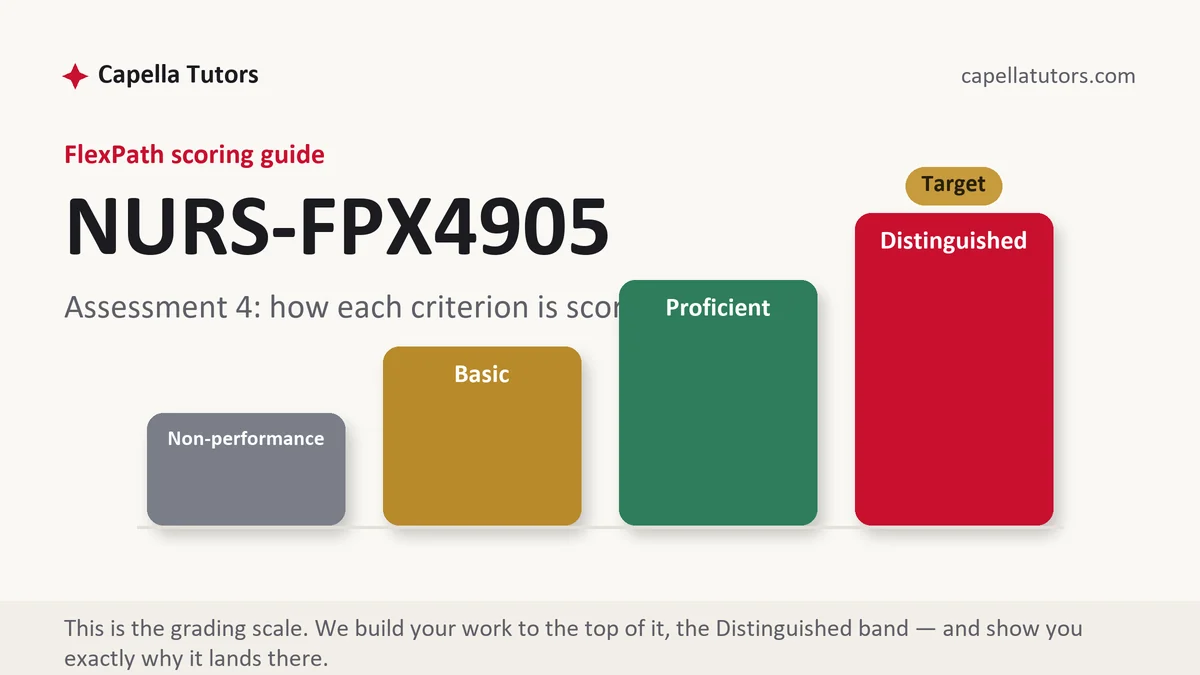
How NURS FPX 4905 Assessment 4 is scored
Four levels per criterion, no letter grades, and on the intervention paper the levels sort almost entirely by tense. Papers that describe what will happen sit in the middle of the guide. Papers that report what happened, to whom, on what day, reach the top of it.
| Level | What it means on the intervention |
|---|---|
| Distinguished | The intervention is specified closely enough that a colleague could run it next week, each design choice traces to a cited source or to the writer's own earlier findings, the delivery is reported with participants, setting, and date, and the evaluation measure points straight back at the baseline from Assessment 2. |
| Proficient | A defensible, evidence-backed plan written entirely in the future tense. Nothing in it is wrong, and nothing in it has occurred, which is the ceiling for a criterion that asks about implementation. |
| Basic | A recommendation rather than an intervention: more education, better handoffs, improved communication. No artifact, no audience, no schedule, and an evaluation that measures how people felt about the session. |
| Non-performance | The evaluation element never appears, or the intervention answers a different problem than the one the capstone has carried, which reads as a substitution rather than a solution. |
Everything upstream converges here. The opener gave you a baseline, the second assessment priced the problem, the third ruled levers in and out, and this paper spends all three. The reflection that closes the course will describe this delivery in detail, so anything vague you leave in these pages you will be asked to be specific about later, with less time on the clock.
The NURS FPX 4905 Assessment 4 method, step by step
-
Start from the design brief, never from a blank page
Reopen the closing section of your third assessment and treat its surviving levers as constraints you agreed to. The intervention should look like the obvious consequence of that audit. When a writer's Assessment 4 surprises the reader, it usually means the design came from enthusiasm rather than from the analysis the course spent eight weeks building.
-
Size the intervention against the hours you actually have
Take the roughly forty practicum hours, subtract what data gathering and meetings already consumed, and design inside what remains. A twelve-week mentorship pairing you can launch and train fits. A unit-wide protocol rewrite requiring committee approval does not, and the guide gives no partial credit for ambition that never reached a patient or a nurse.
-
Specify it until a stranger could run it
Name the artifact, the audience, the schedule, the script or handout, and who does the work. "A structured mentorship program" is a category. "New graduates paired with a unit nurse for twelve weeks, guided check-ins at weeks one, four, eight, and twelve, thirty minutes protected inside the mentor's assignment" is an intervention, and only the second version can be evaluated.
-
Make the evidence defend specific choices
Attach sources to decisions rather than to the topic. Why twelve weeks, why a structured guide instead of an informal buddy, why protected time. Each of those questions gets a current citation, and where a carried source from an earlier assessment still answers one, cite it again and say so. Reuse with acknowledgment reads as a project; silent reuse reads as filler.
-
Deliver it, then write down what actually occurred
Run the session, hold the meeting, hand out the tool, train the people. Then record the date, who attended, how long it took, what went sideways, and what you changed on the spot. These details cost nothing to collect while they are happening and are unrecoverable a month later, when the reflection needs them.
-
Attach one measure, then self-score and log
Say what number would tell you this worked, where it comes from, and when you would read it, and make it the same metric your opener established so improvement is comparable. Then grade yourself criterion by criterion, hardest on implementation and evaluation, copy the delivery record into your master document, and log the practicum hours the delivery consumed before you submit.
A structure that maps to the criteria
The weights below are how our tutors budget a typical 4905 intervention paper, not Capella's figures; your scoring guide decides where the length actually belongs.
| Section | What it must do | Guide |
|---|---|---|
| Introduction and carry-forward | Restate problem, population, and baseline in two cited sentences, then name the intervention in one. | ~150 words |
| The intervention specified | Artifact, audience, schedule, materials, and who performs each part, written so a colleague could run it. | ~300 words |
| Evidence behind the design | Current sources attached to individual design decisions, carried sources cited again by name of function. | ~300 words |
| Implementation in the practicum setting | What happened: date, participants, duration, obstacles met, adjustments made on the spot. | ~300 words |
| Evaluation and measures | The metric, its source, the reading interval, and what result would count as success against the baseline. | ~200 words |
| Conclusion and references | What the delivery leaves behind for the unit, plus current APA matched both ways, internal data labeled honestly. | ~100 words |
Annotated sample excerpt
A model passage from our team showing the specification and delivery moves in one breath. Read what each sentence is doing, then run your own project through the same shape.
Nine of the fourteen nurses hired onto my practicum unit in the past two years resigned inside twelve months, and every exit conversation on file points at the same first ninety days.1 The intervention pairs each new graduate with an experienced unit nurse for twelve weeks, with a one-page conversation guide for weeks one, four, eight, and twelve and thirty protected minutes written into the mentor's assignment rather than added on top of it.2 I presented the pairing model to the unit practice council in week nine of my practicum and trained four mentors in a single sixty-minute session; twelve-month retention in the next hire cohort, read against that nine-of-fourteen baseline, is the number that will settle whether this worked.3
- 1The baseline returns as the same fraction the opener established, and the exit pattern narrows the intervention window before any design appears.
- 2Specification carried to the point of scheduling, including where the time comes from. Vagueness about who gives up what is the usual cap on this criterion.
- 3Delivery in past tense with an audience and a count, then one measure aimed back at the original number. On most guides those are two separate criteria, satisfied in one sentence.
The full premium sample for your exact assessment, written fresh to your scoring guide and issue, is free to request. Study it, revise it into your own voice, and submit work you understand.
The five mistakes that cost Distinguished
- The proposal that never shipped. A beautifully evidenced plan with no delivery date and no participants is the most common Proficient paper in this course, and the fix is usually one hour in the practicum setting.
- The oversized fix. Designing something that needs budget approval or a policy change guarantees the implementation section has nothing to report, because approval calendars outlast billing sessions.
- Evidence bolted to the topic. Citations that establish mentorship matters, without a source behind twelve weeks or protected time, leave every real design decision unsupported.
- The satisfaction survey. Measuring whether attendees liked the session instead of whether the baseline moved abandons the only number the capstone has been building since the opener.
- The undocumented day. Delivering the intervention and writing nothing down that afternoon costs you the concrete detail here and the honest reflection later, and no source can replace it.
Pre-submission checklist
- Problem, population, and baseline carried in unchanged and cited as your own prior work
- The intervention specified to artifact, audience, schedule, and owner, with nothing left as a category
- A current source attached to each significant design decision, carried sources acknowledged as carried
- Implementation reported in past tense with date, participants, duration, and what went wrong
- One evaluation measure named, sourced, and matched to the original baseline metric
- Delivery record copied into the master document and practicum hours logged in Capella's tracker
Turning eight weeks of analysis into one deliverable?
Send this scoring guide with your earlier assessments, because the intervention is graded on how well it inherits them. Eight specialists, research analyst through two QA passes, return a premium original intervention paper written to the Distinguished descriptions in 24 to 48 hours, revised free until it lands. You still deliver in your own setting; we handle the document around it.