This manual is for NURS FPX 4905 Assessment 2, start to submission. In the current capstone, Assessment 2 asks you to define and analyze a health care process problem or issue of concern in your practicum setting: describe the setting and how clinical and operational decisions are made there, identify the process problem, and analyze its impact on quality of care, patient safety and cost. The evaluator is reading for two things: whether each of the three lenses is carried by cited data, and whether they are argued as one system rather than filed as separate paragraphs. This manual covers the scoring logic, our six-step method, a structure keyed to the criteria, and an annotated excerpt. Prefer to hand it off? A premium original sample for this exact assessment comes back in 24 to 48 hours, revised free until it meets the guide. Capella's catalog lists the course as NURS-FPX4905, and some courserooms print NURS4905; both point to this same Assessment 2.
One honesty note before the manual: Capella revises courses and scoring guides over time, so always write to the exact scoring guide attached to your assessment in the courseroom. The course identity above is verified on capella.edu; the method and structure below are our tutors' approach to it, not Capella's official rubric text.
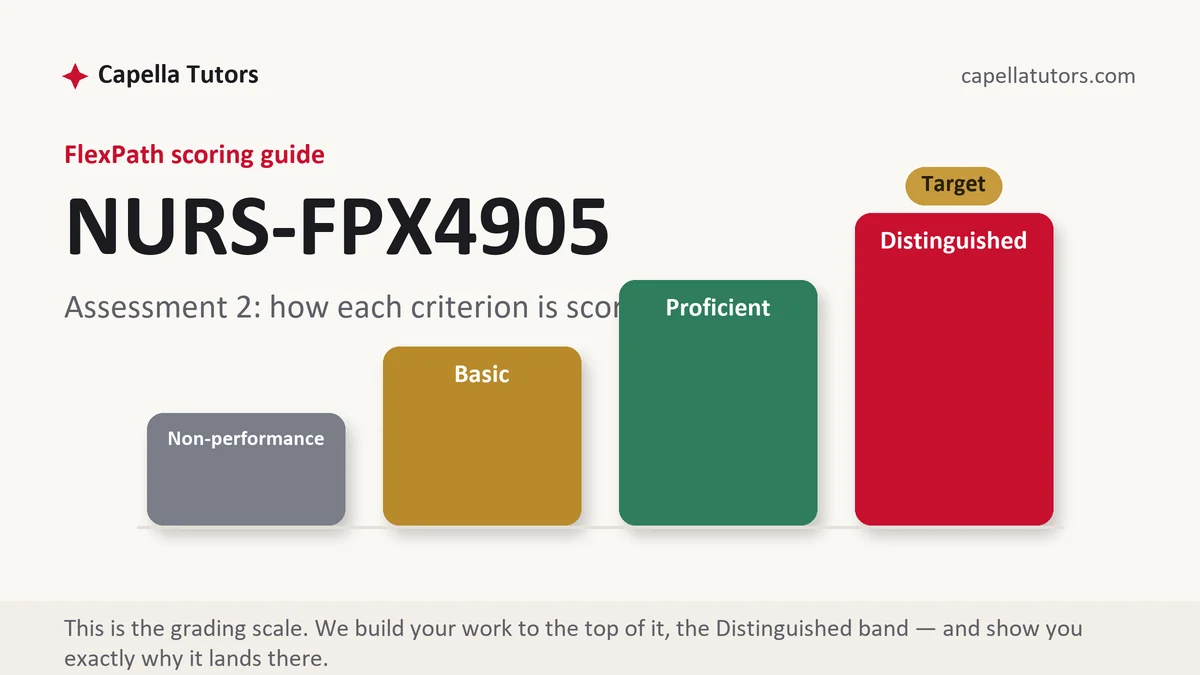
How NURS FPX 4905 Assessment 2 is scored
Four levels per criterion, no letter grades, and at this stage of the capstone the guide starts auditing continuity: whether this paper knows what your first one said. The levels tend to sort like this on a quality-safety-cost analysis:
| Level | What it means on the quality, safety, and cost analysis |
|---|---|
| Distinguished | All three lenses run on the writer's own baseline, cost claims arrive in cited dollars, and the paper argues how quality failures create safety events that generate cost, one mechanism, three views of it. |
| Proficient | Each lens is covered accurately and separately. Three clean sections that never speak to each other, which is exactly the ceiling of this level. |
| Basic | General statements about quality and cost in healthcare, detached from the specific problem chosen last assessment, or a cost section written entirely in adjectives. |
| Non-performance | One of the three lenses simply never gets its analysis, usually cost, because the data took effort to find. Effort skipped is a criterion floored. |
Placement matters here too. This analysis inherits Assessment 1's problem and baseline, and everything it finds becomes ammunition later: the cost figure you establish now is what justifies Assessment 4's intervention, and the safety mechanism you trace is what Assessment 3 will hunt technology and coordination fixes for. Write it as the middle of a book, not a fresh essay.
The NURS FPX 4905 Assessment 2 method, step by step
-
Define the setting and the process problem first
Describe the practicum setting, how clinical and operational decisions are made there, and the process that is failing, in two or three sourced paragraphs. A process problem, such as a diagnostic delay or a broken handoff, gives the three lenses something concrete to measure.
-
Split the problem into its three ledgers
Take the one problem and ask it three questions separately: what does it do to outcomes, what does it do to patients in the moment, and what does it bill. For a sepsis-bundle compliance gap, that is missed benchmarks, delayed antibiotics, and extended ICU days. Draft each ledger with its own evidence before you let them touch.
-
Cost the problem in cited dollars, not adjectives
Find published per-case or per-event cost figures from the last five years, multiply against your unit's own event count, and show the arithmetic. "Costly" is a Basic word; "roughly $16,000 of avoidable cost per delayed case, against our nine delayed cases last quarter" is an argument a CFO could check.
-
Argue the relationships between the lenses
This is the move the top level pays for. Trace one causal chain through all three: the quality gap produces the safety event, the safety event produces the cost. Written as a chain, your three sections become one analysis; written as a list, they cap at the middle of the guide.
-
Add the sources this stage needs, keep the ones that still work
Carry forward the Assessment 1 sources that still earn their place, then recruit new ones for the jobs this analysis creates: a quality benchmark, a safety mechanism study, a cost analysis. Recasting a carried source into a new role is synthesis; rebuilding the bibliography from zero reads as searching, not building.
-
Score the draft against the guide, one lens at a time
Audit each criterion yourself and be strict about the cost lens, the one writers grade themselves gently on. Update the master document with every figure you established, log the practicum hours you spent gathering unit data, and submit early enough that the two-day evaluation window cannot eat your weekend.
A structure that maps to the criteria
Targets below are our tutors' planning proportions for a typical 4905 second assessment; treat your scoring guide as the final word on emphasis and length.
| Section | What it must do | Guide |
|---|---|---|
| Introduction, setting and problem | The practicum setting, its clinical and operational decisions, and the process problem defined. | ~250 words |
| Quality analysis | Your problem against published benchmarks and quality frameworks, with the gap quantified. | ~250 words |
| Safety analysis | The mechanism by which the problem reaches patients, traced with current safety literature. | ~250 words |
| Cost analysis | Published cost figures applied to your unit's own numbers, arithmetic shown, sources named. | ~250 words |
| The three lenses as one system | The causal chain argued: quality gap to safety event to cost, and what that chain implies for the intervention ahead. | ~200 words |
| Conclusion and references | What the deepened problem now demands, plus current APA matched both ways. | ~100 words |
Annotated sample excerpt
A model passage from our team showing the lens-linking move on a live capstone problem. Read it for the mechanics, then run your own numbers through the same shape.
The bundle audit from my practicum unit's emergency department shows first-dose antibiotics beating the three-hour window in 71 percent of flagged sepsis cases, against the 85 percent the organization committed to two years ago.1 That fourteen-point quality gap is not abstract: each hour of delay is associated in the current literature with measurably higher mortality and, in our own nine delayed cases last quarter, a median of two additional ICU days.2 Priced with published per-day ICU costs, the same nine cases represent avoidable spending in the low six figures, which is the number this capstone's intervention will be asked to move.3
- 1The quality lens opens on the writer's own audit with the organization's own target, continuity with Assessment 1's baseline doing quiet work.
- 2One sentence carries the gap from quality into safety, literature and local chart data cited side by side, each labeled as what it is.
- 3Cost lands as arithmetic on the same nine cases, and the final clause hands the number forward to Assessment 4 by name of function.
The full premium sample for your exact assessment, written fresh to your scoring guide and issue, is free to request. Study it, revise it into your own voice, and submit work you understand.
The five mistakes that cost Distinguished
- The amnesia draft. Writing this analysis as if Assessment 1 never happened, new framing, drifted baseline, forfeits the integration the capstone guides read for above everything.
- Three silos. Quality, safety, and cost each handled cleanly and never connected is textbook Proficient; the causal chain between them is where the top level lives.
- The adjective budget. A cost section built on "significant expense" and "financial burden" with no dollar figure and no arithmetic cannot satisfy a criterion that asks for analysis.
- National numbers only. Citing what sepsis costs the United States while never pricing your own unit's cases keeps the whole section at arm's length from your capstone.
- Fresh bibliography syndrome. Abandoning every Assessment 1 source signals to the evaluator that the project is being re-searched, not deepened.
Pre-submission checklist
- Baseline requoted exactly as Assessment 1 stated it, with your own earlier work cited
- Each of the three lenses anchored by at least one current peer-reviewed source doing named work
- A dollar figure with visible arithmetic connecting published costs to your unit's counts
- One causal chain argued explicitly from quality gap through safety event to cost
- Master document updated with every figure and source this assessment established
- Practicum hours for data-gathering logged in Capella's tracker before you submit
Deep in the three-lens analysis?
Send this scoring guide plus your Assessment 1, because continuity is half the grade here. The eight-person team, research analyst through double QA, returns a premium original analysis aligned to the Distinguished column in 24 to 48 hours, revised free until it lands. The numbers established now carry the rest of your capstone; establish them properly.