This manual is for NURS FPX 4905 Assessment 1, start to submission. The BSN capstone opens with practicum planning: you hold a conference call with your faculty and complete the worksheet that records it, covering your practicum setting, your goals for the capstone, the schedule for the 40 practicum hours the current catalog requires, how you will document clinical activity, and what each side expects. The worksheet is brief, but the setting and goals you record here frame the process problem you analyze in Assessment 2 and everything after it. Below is how to prepare, what to record, and an annotated sample excerpt. Prefer to hand it off? A premium original sample for this exact assessment comes back in 24 to 48 hours, revised free until it meets the guide. Capella's catalog lists the course as NURS-FPX4905, and some courserooms print NURS4905; both point to this same Assessment 1.
One honesty note before the manual: Capella revises courses and scoring guides over time, so always write to the exact scoring guide attached to your assessment in the courseroom. The course identity above is verified on capella.edu; the method and structure below are our tutors' approach to it, not Capella's official rubric text.
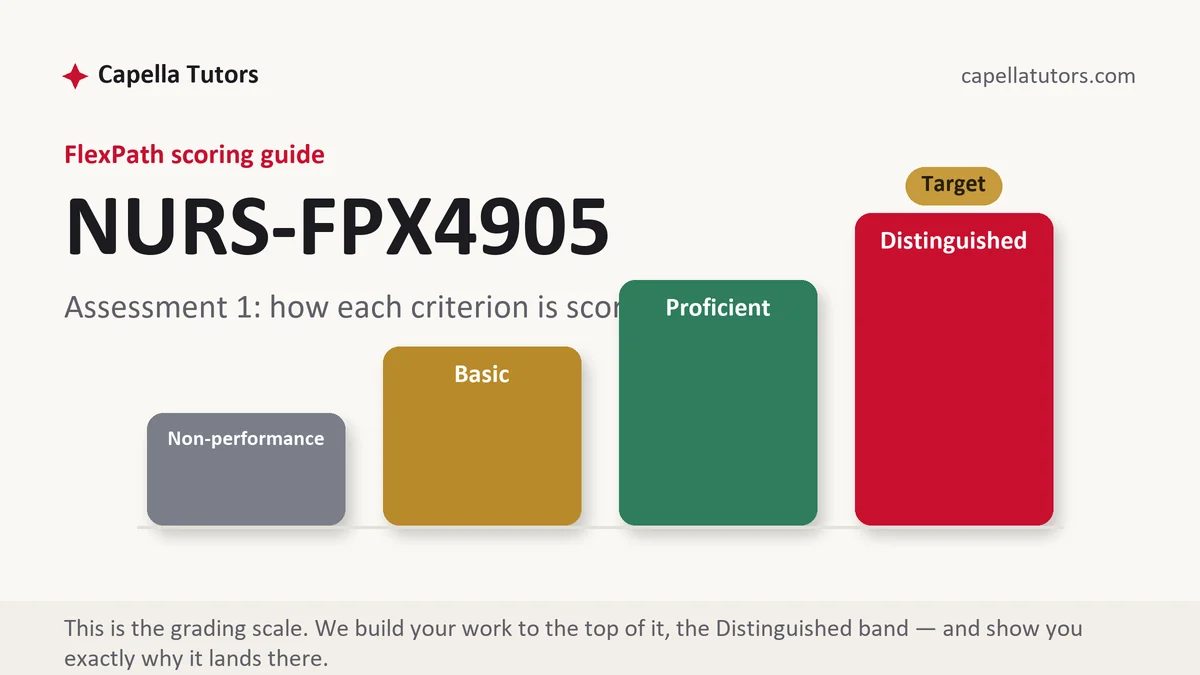
How NURS FPX 4905 Assessment 1 is scored
FlexPath does not use letter grades. Each criterion in the scoring guide lands on one of four levels, and the level descriptions are the real writing brief:
| Level | What it means on the capstone call worksheet |
|---|---|
| Distinguished | Every section is complete, the practicum setting is described, goals point toward a process problem you can analyze, the hours schedule is realistic, documentation is specified and action items carry owners and dates. |
| Proficient | The worksheet is complete, but goals are broad and the schedule is loose. |
| Basic | Sections are brief or generic, with little sign the call shaped the plan. |
| Non-performance | The worksheet is incomplete or the call did not happen. |
Some versions add a short written summary to the worksheet; check the scoring guide. Either way, arrive at the call with a setting and a draft goal, not a blank page.
The NURS FPX 4905 Assessment 1 method, step by step
-
Confirm your practicum setting
Know where the hours will happen, who your contact is there, and what kinds of patients and processes you will see.
-
Draft capstone goals
Goals that lead toward a process problem worth analyzing, such as delays in a diagnostic pathway or gaps in discharge teaching.
-
Plan the 40 hours
A week-by-week schedule that leaves time for the intervention in Assessment 4.
-
Agree on documentation
Which log records hours and activities, how often you update it, and what faculty review.
-
Record expectations both ways
What faculty expect from you, and what support you need from them and the site.
-
Write action items and submit
What, who and by when for each next step, then submit the completed worksheet.
A structure that maps to the criteria
Follow the worksheet template in your courseroom; the parts below are what the evaluator checks.
| Section | What it must do | Guide |
|---|---|---|
| Meeting topic | Date, participants by role and purpose. | short entry |
| Practicum setting and goals | Where the hours happen and what you aim to achieve. | 2 to 3 goals |
| Practicum schedule | How the 40 hours are spread across the course. | short plan |
| Clinical documentation | Log, frequency and review. | short notes |
| Expectations | Faculty, site and student expectations. | short notes |
| Action items | What, who and by when. | a short list |
Annotated sample excerpt
An original model excerpt from our team, written to show the register that reaches the top of the guide. Learn the moves, then write your own version.
My practicum setting is an outpatient specialty clinic where I will work with the nurse manager, who has agreed to be my site contact for the capstone.1 My first goal is to map how a referral moves from intake to the first appointment and identify where delays occur, because staff describe patients waiting weeks for test results before a plan is made.2 I will complete roughly ten hours in each of the first four weeks, log every session in the course practicum tool the same day, and confirm the process problem with my faculty before drafting Assessment 2.3
- 1Names the setting and the site contact, the basics the worksheet needs.
- 2States a goal that points directly at a process problem for the next assessment.
- 3Turns the plan into a schedule and documentation habit with a checkpoint.
The full premium sample for your exact assessment, written fresh to your scoring guide and topic, is free to request. Study it, revise it into your own voice, and submit work you understand.
The five mistakes that cost Distinguished
- No setting confirmed. The capstone depends on a real practicum site.
- Goals with no problem in sight. Aim the goals at a process you can analyze.
- Hours left unplanned. Schedule the 40 hours so the intervention fits.
- Documentation unclear. Agree on the log before you start.
- Action items without dates. Each next step needs an owner and a deadline.
Pre-submission checklist
- Practicum setting and contact confirmed
- Goals aimed at a process problem
- Schedule for the 40 practicum hours
- Documentation method agreed
- Expectations recorded both ways
- Action items with owners and dates
Want the capstone papers covered?
The call and the hours are yours. The process analysis, the technology paper, the intervention proposal and the reflection are written assessments we support, with premium original samples in 24 to 48 hours, revised free.