This manual is for NURS FPX 4905 Assessment 5, start to submission. The current capstone closes with a reflection: you answer reflection questions about how your practicum experience and capstone project connect to the four spheres of care in the AACN Essentials, wellness and disease prevention, chronic disease management, regenerative or restorative care, and hospice or palliative care, and what you take into your practice as a BSN-prepared nurse. Reflection is graded on evidence too. A paragraph that says you learned a great deal scores lower than one that names a moment from the practicum and the sphere it belongs to. Below is the method our tutors use, a structure that maps to the criteria, and an annotated sample excerpt. Prefer to hand it off? A premium original sample for this exact assessment comes back in 24 to 48 hours, revised free until it meets the guide. Capella's catalog lists the course as NURS-FPX4905, and some courserooms print NURS4905; both point to this same Assessment 5.
One honesty note before the manual: Capella revises courses and scoring guides over time, so always write to the exact scoring guide attached to your assessment in the courseroom. The course identity above is verified on capella.edu; the method and structure below are our tutors' approach to it, not Capella's official rubric text.
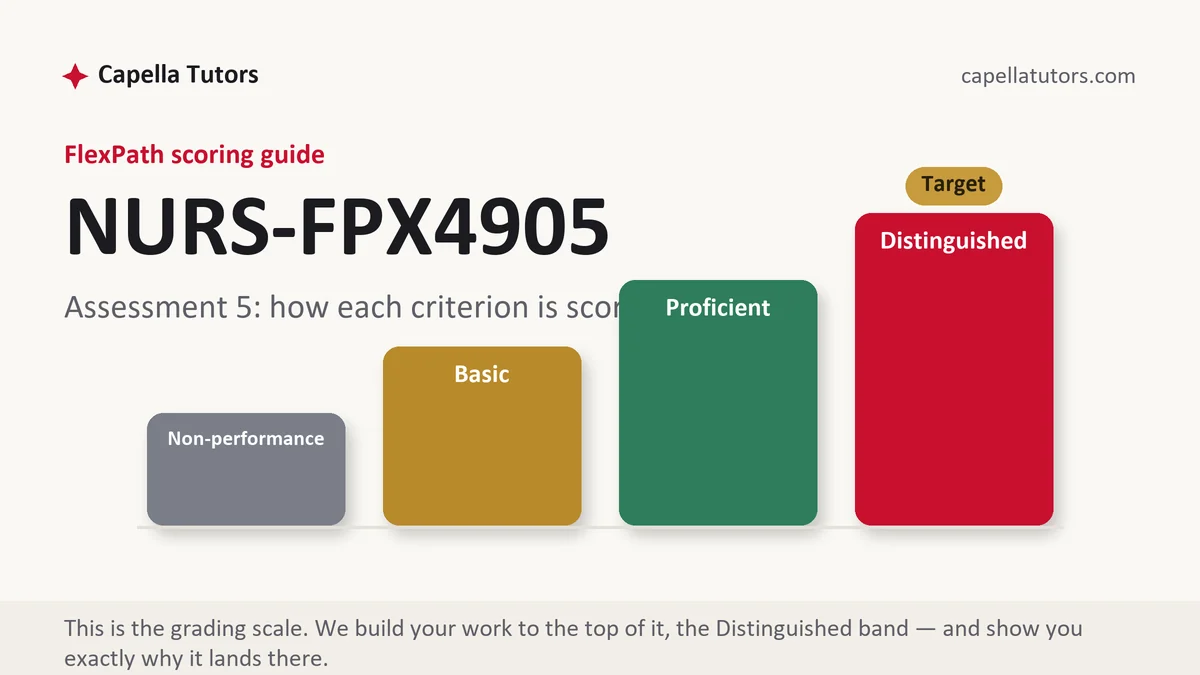
How NURS FPX 4905 Assessment 5 is scored
FlexPath does not use letter grades. Each criterion in the scoring guide lands on one of four levels, and the level descriptions are the real writing brief:
| Level | What it means on the capstone reflection |
|---|---|
| Distinguished | Each sphere of care is connected to a specific practicum experience or part of the project, the reflection is supported with evidence where the guide asks for it, and it ends with concrete changes to your practice. |
| Proficient | All spheres are addressed accurately, but the examples are general. |
| Basic | The reflection describes the capstone in general terms and only some spheres are connected. |
| Non-performance | A sphere of care or the reflection questions are not answered. |
Use your practicum log. Dates and activities you recorded make the reflection specific and save you reconstructing the term from memory.
The NURS FPX 4905 Assessment 5 method, step by step
-
Read the reflection questions first
Answer the questions your courseroom asks, in order, using them as headings.
-
Gather moments from your log
Pick one experience for each sphere: a screening conversation, a chronic disease follow-up, a rehabilitation discussion, an end-of-life conversation.
-
Connect each moment to its sphere
Explain what the experience showed about nursing in that sphere and how your project touched it.
-
Bring in evidence where asked
Support observations with a current source when the guide asks for scholarly support.
-
Name what changes in your practice
One concrete change per sphere or an overall commitment.
-
Close the capstone
Confirm your practicum hours are logged as required and submit.
A structure that maps to the criteria
Word counts are planning targets our tutors use, not Capella rules; follow the questions and length your scoring guide states.
| Section | What it must do | Guide |
|---|---|---|
| Introduction | The capstone project and practicum setting in brief. | ~100 words |
| Wellness and disease prevention | A practicum moment and what it showed. | ~175 words |
| Chronic disease management | A practicum moment and what it showed. | ~175 words |
| Regenerative or restorative care | A practicum moment and what it showed. | ~175 words |
| Hospice or palliative care | A practicum moment and what it showed. | ~175 words |
| Practice commitments and references | What you will do differently, then current APA. | ~125 words |
Annotated sample excerpt
An original model excerpt from our team, written to show the register that reaches the top of the guide. Learn the moves, then write your own version.
In week three I sat in on follow-up calls for patients whose abnormal results had been delayed before the new tracking process began, and one patient with diabetes had gone six weeks without a medication adjustment.1 That call made the chronic disease sphere concrete for me: management depends less on any single visit than on the system that connects results to decisions between visits.2 It is also why my intervention focused on result tracking, and it is the lesson I will carry into practice by checking, at every chronic care visit, whether the last result reached the person who needed to act on it.3
- 1Anchors the reflection in a dated practicum moment.
- 2States what the moment showed about the sphere, which is the insight the criterion asks for.
- 3Links the sphere to the project and ends with a concrete practice change.
The full premium sample for your exact assessment, written fresh to your scoring guide and topic, is free to request. Study it, revise it into your own voice, and submit work you understand.
The five mistakes that cost Distinguished
- General statements of growth. Name the moment and the sphere.
- Skipping a sphere. Each of the four needs an answer.
- Ignoring the questions. Use the courseroom questions as your structure.
- No link to the project. Show how the capstone touched each sphere.
- Hours not logged. Confirm the practicum record is complete before submitting.
Pre-submission checklist
- Reflection questions answered in order
- One practicum experience for each sphere of care
- Each experience connected to the capstone project
- Evidence included where the guide asks
- Concrete practice commitments
- Practicum hours logged as required
Want help closing the capstone?
Send the scoring guide and your practicum notes. Our team returns a premium original reflection organized by the four spheres in 24 to 48 hours, revised free until it meets the guide.