This manual is for DB FPX 9980 Assessment 1, start to submission. Assessment 1 of DB FPX 9980, Doctoral Project Development, usually asks you to define the work of the term before starting it: an inventory of what is approved, drafted, blocked and untouched, the single stage that is actually holding the project, and a deliverable named with dates a chair has agreed to. Because the outstanding piece differs for every learner, your scoring guide and your chair decide what that deliverable is. Below is the sequence our tutors use, a structure keyed to the criteria, and an annotated excerpt. Want it scoped for you? A premium original sample of this deliverable returns inside 24 to 48 hours and is revised free until the guide is met. Capella's catalog lists the course as DB-FPX9980, and some courserooms print DB9980; both point to this same Assessment 1.
One honesty note before the manual: Capella revises courses and scoring guides over time, so always write to the exact scoring guide attached to your assessment in the courseroom. The course identity above is verified on capella.edu; the method and structure below are our tutors' approach to it, not Capella's official rubric text.
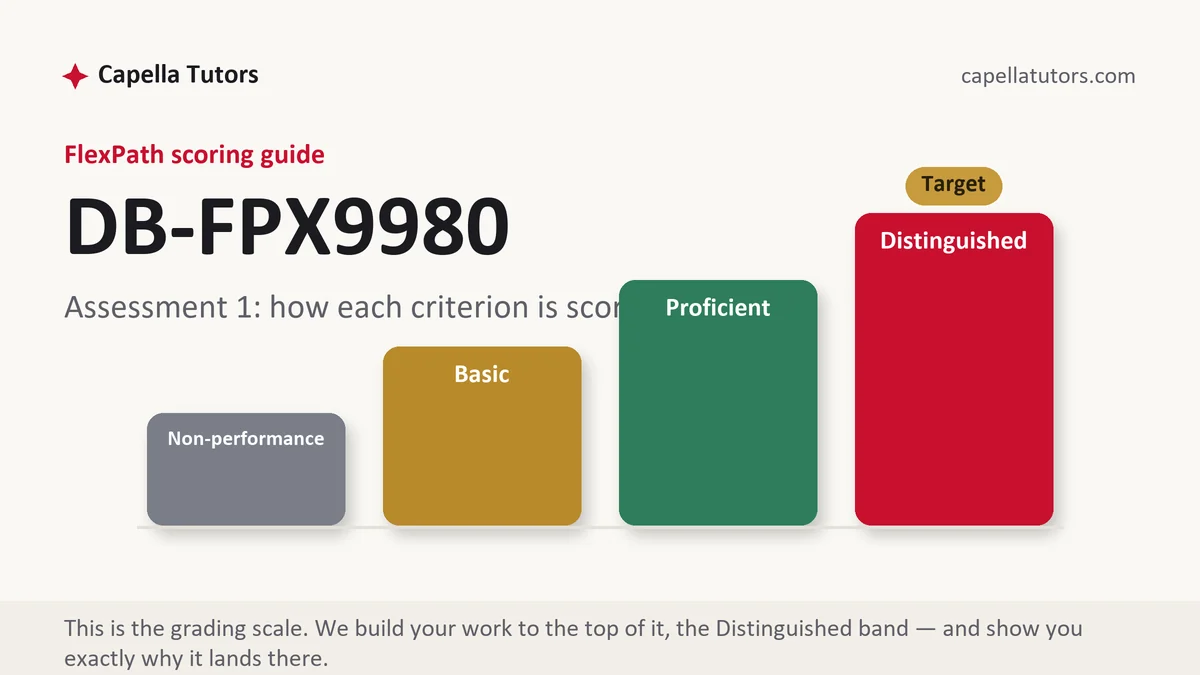
How DB FPX 9980 Assessment 1 is scored
There are no letter grades in FlexPath. Each criterion on the scoring guide lands on one of four levels, and the level language is the writing brief:
| Level | What it means on a progress plan submission |
|---|---|
| Distinguished | Every stage carries a state, the real obstacle is named including the ones that are your own habits, and the deliverable has dates that account for review time rather than ignoring it. The extra move is a fallback with the week that triggers it. |
| Proficient | The plan is complete and the stages are accurately described. Workable, and still built on dates that assume every review returns immediately. |
| Basic | A plan that says the project will be advanced, with the comfortable chapter scheduled first and no obstacle named. |
| Non-performance | A required element is absent, most often the agreement with the chair or the named deliverable, so the term begins with no definition of what would count as progress. |
This course exists to attach time to supervision, and what it grades is documented movement rather than effort, so the plan is the artifact that makes movement checkable. The course carries 2 program points and sits outside the standard 45 point sequence, adding calendar and cost rather than credit toward the total, and how many terms you need is a conversation between you, your chair and the university. The diagnosis governs everything after it, because the wrong one buys months of honest work on the wrong document.
The DB FPX 9980 Assessment 1 method, step by step
-
Inventory the stages on one page
List the stages down the left and mark each approved, drafted, blocked or untouched. One page, no narrative, no explanation of why anything is late. The point is a list somebody else can read in a minute, because a chair cannot act on a feeling of being behind.
-
Name the blocked stage out loud
Stalls fall into a few shapes: a problem never narrowed enough to study, a site that never confirmed, a protocol circling in revision, a collection window that closed short, a results chapter that no longer matches its purpose, and the revision loop where each pass repairs something different. Pick yours.
-
Separate the blockers you own from the ones you do not
Write who has to act for each blocked item. Where the answer is somebody else, the plan needs a request with a date and a fallback; where the answer is you, the plan needs a session schedule. Confusing the two produces patience where production was needed.
-
Write one deliverable, not a programme
Name the single thing that will exist at the end of the term, in one sentence a chair could quote. A term aimed at finishing everything reliably finishes nothing, and the criteria want a named artifact closer to done than it was at the start.
-
Date it against real review time
Assume your chair needs a fortnight on a section and that a section takes more than one pass to be accepted, then build the calendar backwards from the end of the term. Dates that assume instant returns are the commonest reason a plan and a term diverge in week five.
-
Get it agreed in writing, then self-score
Send the plan and ask for agreement rather than comment, because an agreed plan is the evidence the criteria want at the end of the term. Then score each criterion at Distinguished, Proficient, Basic or Non-performance and repair anything below the top.
A structure that maps to the criteria
These lengths are our tutors' planning figures for a progress plan submission, not Capella rules; your scoring guide and your chair decide what the document has to carry.
| Section | What it must do | Guide |
|---|---|---|
| Stage inventory | Every stage of the project with a state beside it: approved, drafted, blocked or untouched. | ~250 words |
| Diagnosis of the stall | Which stage is blocked, by what, and who can unblock it, including the habits that are yours. | ~300 words |
| Deliverable for the term | One artifact named in a sentence, with the milestones that build it and the dates each is sent. | ~300 words |
| Review time and calendar | How long reviews take, how many passes to expect, and the schedule built backwards from the term end. | ~250 words |
| Access and fallback | Status of the site, sample and collection window, with the alternative drafted and its trigger date. | ~300 words |
| Agreement and communication record | What the chair agreed to, when, and how contact with committee and site is logged. | ~200 words |
Annotated sample excerpt
An original model excerpt from our team, written on a freight brokerage scenario, showing what a diagnosis looks like when it is written to be acted on. Learn the format, then build your own on one page.
Stage inventory at week one: problem and purpose approved in March, literature review approved with two comments outstanding, method approved, protocol approved, collection complete at 214 of 240 planned broker files, results chapter drafted to the end of the second research question, discussion untouched.1 The blocked stage is the third research question, which needs margin data at load level that the operations director has agreed to release and the systems team has not scheduled, so the blocker sits with somebody else and has a name.2 Deliverable for this term: a complete results chapter covering all three questions, sent in two parts, the first by week four and the second by week nine, with the load-level extract requested in writing this week and a fallback to monthly summary margins if it has not arrived by week five.3
- 1Every stage carries a state rather than a feeling, which turns a vague sense of being behind into a list somebody else can read in a minute.
- 2Names the blocked stage, the data it needs and the person who holds it, so the plan can act on the obstacle instead of around it.
- 3One deliverable split into two dated sends, with a fallback and the week that triggers it. This is the paragraph a chair can agree to in one message.
The full premium sample for your exact assessment, written fresh to your scoring guide and setting, is free to request. Study it, revise it into your own voice, and submit work you understand.
The five mistakes that cost Distinguished
- Treating the term as a pause. Registration with no written plan produces a full term and no deliverable to show for it.
- A plan that aims at finishing everything. A term pointed at the whole project finishes none of it, and the criteria want one named artifact.
- Dates that assume instant reviews. A schedule built without review time diverges from reality by week five and stays diverged.
- The comfortable chapter scheduled first. Progress on anything except the blocked stage is motion rather than movement, and a reader can tell.
- A diagnosis written to be reassuring. Naming the wrong obstacle buys months of honest work on the wrong document.
Pre-submission checklist
- Every stage of the project marked approved, drafted, blocked or untouched, on one page
- The blocked stage named, with what it needs and who has to act
- Blockers separated into the ones you own and the ones somebody else owns
- One deliverable for the term, described in a sentence a chair could quote
- Milestone dates built backwards from the term end with real review time allowed
- The plan agreed with the chair in writing, and a fallback with the week that triggers it
Registered for a continuation term and not sure what to work on?
Send whatever manuscript exists, the most recent chair comments and the guide. The first thing back is scope rather than prose: an inventory of what is approved, drafted, missing and blocked by somebody other than you, with the next deliverable named in one sentence. Then a premium original sample of that deliverable inside 24 to 48 hours, written to the Distinguished descriptors of your guide, revised at no cost until the criteria clear.