This manual is for DB FPX 9980 Assessment 2, start to submission. Assessment 2 of DB FPX 9980, Doctoral Project Development, usually asks for the work itself rather than the plan for it: the blocked deliverable produced, the writing turned into a session count somebody can audit, and the access problem either solved or converted into a design that no longer needs solving. What counts as the deliverable is set by your scoring guide and by what your chair agreed to. The sequence our tutors follow is below, with the structure it produces and an annotated excerpt. Prefer the drafting handed over? One premium original sample comes back inside 24 to 48 hours, revised at no cost until every criterion clears. Capella's catalog lists the course as DB-FPX9980, and some courserooms print DB9980; both point to this same Assessment 2.
One honesty note before the manual: Capella revises courses and scoring guides over time, so always write to the exact scoring guide attached to your assessment in the courseroom. The course identity above is verified on capella.edu; the method and structure below are our tutors' approach to it, not Capella's official rubric text.
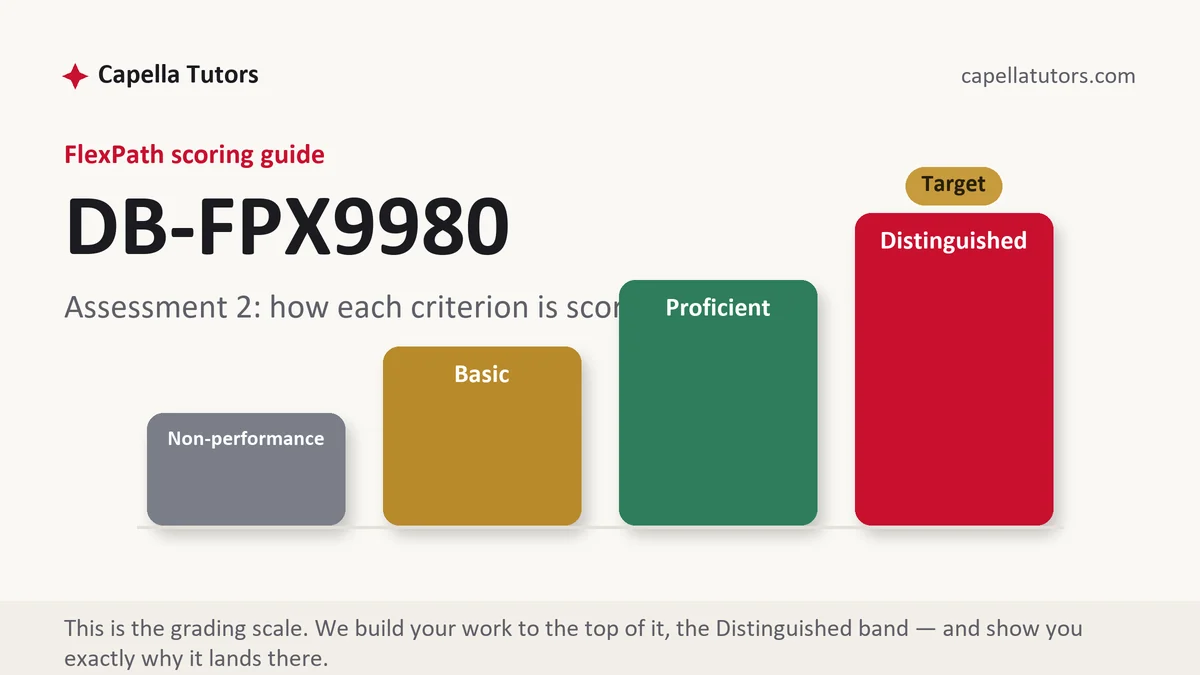
How DB FPX 9980 Assessment 2 is scored
There are no letter grades in FlexPath. Each criterion on the scoring guide lands on one of four levels, and the level language is the writing brief:
| Level | What it means on a production submission |
|---|---|
| Distinguished | The named deliverable exists, output is logged against a schedule, and the access problem has either moved or been converted with the chair's agreement. The extra move is a second section kept moving while the first is out for review. |
| Proficient | The work was produced and the schedule was followed. Solid, and still sequential, so every review left the desk empty while it was out. |
| Basic | Words produced on the easiest available section, with the blocked stage described as pending and no conversion drafted. |
| Non-performance | A required element is absent, most often the deliverable itself, or a term of registration with nothing sent to the chair inside it. |
Production in a continuation term is governed by arithmetic rather than by motivation, and the arithmetic is unforgiving in one direction only. If a section needs more than one pass and each pass costs a fortnight of elapsed time, sequential working spends most of the term waiting, so send earlier and rougher than instinct allows and keep a second section moving while the first is out. A section that returns marked up should meet a writer who spent the interval on the next one. The same discipline decides whether waiting is a plan: if access has been three weeks away for nine weeks, it is not three weeks away, and the project needs a different design rather than more patience.
The DB FPX 9980 Assessment 2 method, step by step
-
Convert the deliverable into a session count
Take the word target, divide by the words you actually produce in a working session rather than the number you would like to, and multiply out. A 4,200 word findings section at 350 usable words a session is twelve sessions, which is a fortnight and not the two months it feels like.
-
Fix the mechanics that fatigue attacks first
One session length, one time of day, one place. Start each session by rereading only the previous paragraph, because rereading the chapter is how a writing session quietly becomes an editing session and produces nothing new.
-
Schedule the hardest section first
The blocked stage goes at the front of the term while your energy and the chair's availability are both intact. Anything else at the front is displacement, and restarting chapter one is the most polished form of it.
-
Keep two sections in motion
Send the first piece and begin the second the same day. The point is never to have a review return to an empty desk, since the elapsed time you cannot control is only lost if nothing was moving while it passed.
-
Convert the access problem rather than waiting on it
The usual conversions are archival: records the organization already holds, a second site in the same sector, or filings answering a narrower version of your question. Draft the conversion, cost what it gives up, and take it to the chair as a decision rather than as a question.
-
Log output where somebody else can see it
Words per session, sends and returns, with dates. A log is what turns a term into evidence of movement, and it is also the fastest way to notice in week four that the pattern is not working, while there is still time to change it.
A structure that maps to the criteria
The targets below are our tutors' planning figures for a production submission, not Capella rules; the criteria in your guide and your chair's agreement decide the real ones.
| Section | What it must do | Guide |
|---|---|---|
| The deliverable | The section produced this term, identified as the piece the plan named and the chair agreed to. | as agreed |
| Production arithmetic | Word target, usable words per session, sessions per week, and the resulting elapsed time. | ~250 words |
| Session pattern | Length, time of day, place, and the routine that starts and ends each session. | ~200 words |
| Parallel work | What was kept moving while a section was out for review, and what returned when. | ~250 words |
| Access status and conversion | Where access stands, the conversion drafted, what it gives up, and the chair's decision on it. | ~350 words |
| Output log | Words per session, sends, returns and open items, with dates against every entry. | as needed |
Annotated sample excerpt
An original model excerpt from our team, written on a warranty adjudication scenario, showing production and access recovery stated as arithmetic. Learn the shape, then run the numbers on your own section.
The blocked deliverable is the findings section for the second research question, 4,200 words, and the production plan is 350 usable words per session, five sessions a week, which is twelve sessions and about two and a half weeks rather than the two months it feels like from the outside.1 Sessions run from 06:30 to 08:00 on weekdays and open by rereading only the previous paragraph, because rereading the chapter is how a writing session becomes an editing session.2 Access to the second dealer group has been three weeks away for the last nine, so it is not three weeks away, and the conversion already drafted for the chair uses the 1,860 adjudicated warranty claims across 14 dealers that the manufacturer already holds, which answers a narrower version of question two with no new site agreement.3
- 1Turns a chapter into a session count, which is the arithmetic separating a stalled project from a merely slow one.
- 2Fixes the mechanics that decision fatigue attacks first, and names the habit that quietly converts writing time into editing time.
- 3States the waiting honestly, then arrives with the alternative already drafted rather than with a request for advice.
The full premium sample for your exact assessment, written fresh to your scoring guide and setting, is free to request. Study it, revise it into your own voice, and submit work you understand.
The five mistakes that cost Distinguished
- Polishing before sending. A rough section reviewed this week beats a perfect one reviewed next month, every time.
- Working sequentially. One section out for review and nothing else moving spends the part of the calendar you never get back.
- Waiting on a site that has gone quiet. No conversion drafted means the delay quietly becomes another term of registration.
- Restarting chapter one. A beautifully polished introduction to a study that still has no data is the classic displacement activity.
- Changing topic late. A new question at the results stage restarts a project that was weeks from finished.
Pre-submission checklist
- The deliverable produced is the one the plan named and the chair agreed to
- Word target converted into sessions at the rate you actually produce
- Session length, time and place fixed, with each session opening on the previous paragraph
- The blocked section scheduled first, not the comfortable one
- A second section moving whenever the first is out for review
- Access either advanced or converted, with the alternative drafted and its cost stated
A term running out and one section still unwritten?
Send the manuscript, the guide and whatever the chair last said. Inside 24 to 48 hours a premium original sample of the blocked section returns, drafted to the Distinguished descriptors of your guide, with the production arithmetic and a drafted conversion attached if access is what is holding you. An eight person pipeline builds it, chair comments re-enter the same cycle free, and revisions continue at no charge until the criteria clear.