This manual is for DB FPX 9980 Assessment 3, start to submission. Assessment 3 of DB FPX 9980, Doctoral Project Development, usually asks you to close the term on evidence: one running register of what went out, came back, changed and remains open, a literature and data refresh with the date it was run, and a statement of where the named deliverable now stands against where it stood in week one. Your scoring guide decides the form all of that takes. What follows is the method our tutors use, a criterion-mapped structure, and an annotated excerpt. Want this assembled for you? A premium original sample of the deliverable arrives within 24 to 48 hours, revised free until the criteria clear. Capella's catalog lists the course as DB-FPX9980, and some courserooms print DB9980; both point to this same Assessment 3.
One honesty note before the manual: Capella revises courses and scoring guides over time, so always write to the exact scoring guide attached to your assessment in the courseroom. The course identity above is verified on capella.edu; the method and structure below are our tutors' approach to it, not Capella's official rubric text.
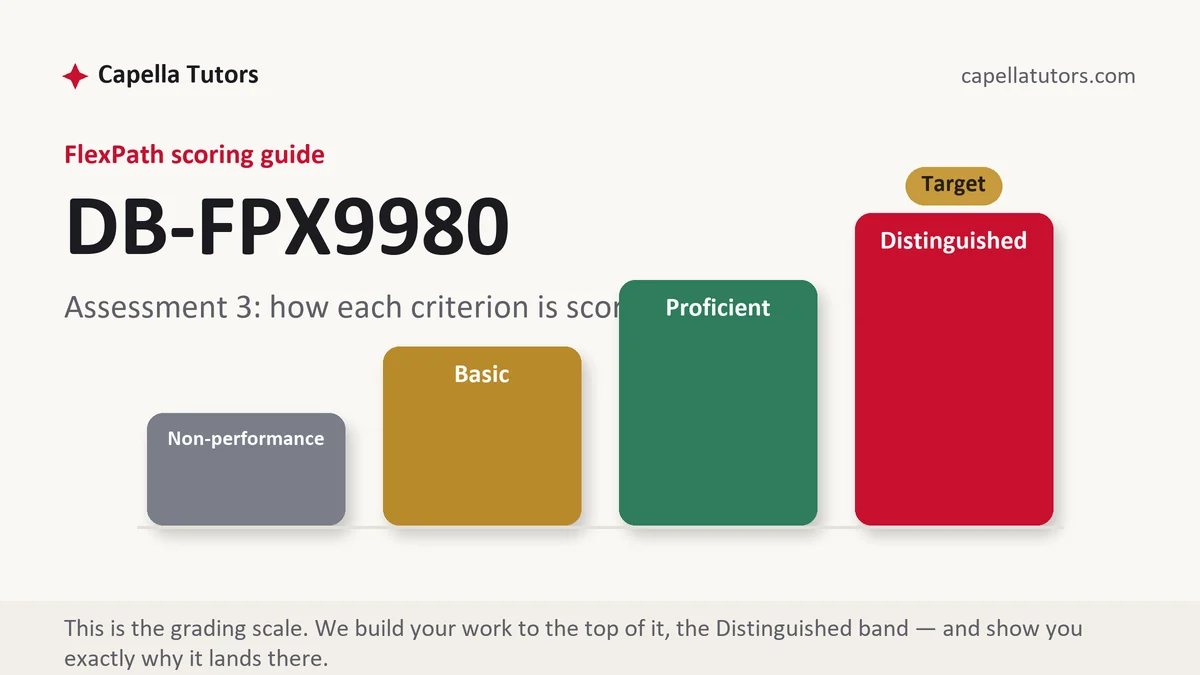
How DB FPX 9980 Assessment 3 is scored
There are no letter grades in FlexPath. Each criterion on the scoring guide lands on one of four levels, and the level language is the writing brief:
| Level | What it means on a revision and currency submission |
|---|---|
| Distinguished | One register holds every comment with a state and a date, the search has been re-run and the gap claim adjusted to what it now supports, and the deliverable is demonstrably closer to finished than in week one. The extra move is narrowing a claim because new evidence closed part of it. |
| Proficient | The record is complete and the refresh was done. Sound, and still leaving a reader to work out which comments are still open. |
| Basic | A revision narrative describing what was worked on, with comments answered in some places twice and in others not at all. |
| Non-performance | A required element is absent, most often the record of open items, or a term closing with no evidence that anything moved. |
Long projects age, and the analytic argument ages fastest, so the refresh is not housekeeping. Re-run the search with the same terms and an extended window, record the date, and read what appeared. Now and then a new paper sits very close to your own study, which lands badly and usually helps, since it hands the discussion something to compare against. The register matters for a different reason: it is the artifact that lets a new reader pick the project up without a meeting, and in a sequence where committee membership can change across terms, that is worth more than any narrative of how hard the term was.
The DB FPX 9980 Assessment 3 method, step by step
-
Keep one register, not one per send
Every comment gets a number, a state and a date: open, drafted, closed, or declined with a reason. A single running list is how no comment gets answered twice and none gets quietly dropped between sends, which is the failure a reader spots immediately.
-
Close comments in writing, not in silence
For each closed item, say what changed and where, in one line. A chair reading a returned section wants to check the change rather than hunt for it, and an item marked closed with no location invites the whole comment to be reopened.
-
Re-run the search and date it
Same terms, extended window, and the date recorded in the text. Report how many records returned and how many were relevant, then read the relevant ones properly rather than adding them to the reference list to look current.
-
Narrow the claim the new evidence touches
Where recent work has closed part of your gap, say what it settles and what it leaves open, and rewrite the gap sentence to the smaller true version. Ignoring a paper that a reviewer will find is a far worse position than conceding it and adjusting.
-
Refresh the data as well as the reading
Figures describing your organization in a year that has ended need the year attached, and where the business has changed shape since collection, one sentence acknowledging it. Verify that every reference still resolves and that anything cited as a preprint now points at the version of record.
-
State where the deliverable stands, against week one
Two short paragraphs: what existed at the start of the term, what exists now, and what remains before the piece is accepted. That comparison is the evidence the criteria are looking for, and it is also the honest basis for deciding whether another term is needed.
A structure that maps to the criteria
Word counts below are our tutors' planning targets for an end-of-term submission, not Capella rules; your scoring guide decides what the document must carry.
| Section | What it must do | Guide |
|---|---|---|
| Open items register | Every comment with a number, a state, a date, and the location of the change that closed it. | as needed |
| Sends and returns | What went to the chair, when it returned, and what was moving in the interval. | ~250 words |
| Literature refresh | Search terms, extended window, the date it was run, records returned and records relevant. | ~300 words |
| Adjusted gap claim | What recent evidence settles, what it leaves open, and the narrowed claim in the purpose statement's words. | ~300 words |
| Data and reference currency | Vintages attached to internal figures, references re-verified, preprints updated to the version of record. | ~250 words |
| Position against week one | What existed then, what exists now, and what remains before the deliverable is accepted. | ~250 words |
Annotated sample excerpt
An original model excerpt from our team, written on a workplace utilization scenario, showing a register entry beside a currency refresh. Learn the format and keep your own running from week one.
Open items register at week eight: comment 14, add the response rate comparison to the discussion, closed in the send of 6 May at page 88; comment 15, reconcile the occupancy figure in the abstract with Table 6, closed in the same send; comment 16, justify treating badge data and desk bookings as one measure, drafted and awaiting the chair, still open.1 The literature search was re-run on 12 May with the original terms and the window extended, returning 31 new records of which four are relevant, including one study of occupancy sensing in professional services reporting the same direction at a smaller magnitude.2 The gap claim narrows accordingly: recent evidence settles that utilization falls under hybrid scheduling, and leaves open whether desk-sharing ratios rather than headcount explain the size of the fall, which is what this study measures.3
- 1One register with a state, a date and a location per comment, so nothing is answered twice and nothing disappears between sends.
- 2The search re-run with its date recorded, which is what converts an aging chapter into a current one and pre-empts the question you otherwise cannot answer.
- 3Narrows the claim instead of ignoring the new paper, turning a threat to the gap into a comparison the discussion can use.
The full premium sample for your exact assessment, written fresh to your scoring guide and setting, is free to request. Study it, revise it into your own voice, and submit work you understand.
The five mistakes that cost Distinguished
- A revision narrative instead of a register. A paragraph describing the term leaves a reader unable to tell which comments are still open.
- Comments closed without a location. Marked as addressed with no page behind it invites the whole comment to be reopened.
- A search never re-run. A newest source that predates the current shape of your topic invites the one question with no good answer.
- A new paper ignored. Recent work that closes part of your gap is found by the reviewer if it is not conceded by the writer.
- Internal figures with no vintage. A percentage describing a year that has ended needs the year attached, and a changed business needs a sentence.
Pre-submission checklist
- One running register, with a number, a state, a date and a location for every comment
- Every closed item names what changed and where
- The search re-run with the same terms, an extended window, and the date recorded
- Records returned and records relevant both reported, and the relevant ones actually read
- The gap claim narrowed to what current evidence leaves open, in the purpose statement's words
- Internal figures dated, references re-verified, and preprints updated to the version of record
Term closing and the comment history is scattered?
Send the manuscript, every set of chair comments you have, and the guide. Inside 24 to 48 hours a premium original sample returns with one register built from the whole comment history, each item stated as open, closed or declined with its location, the search re-run and dated, and the gap claim narrowed to what recent evidence leaves open. Revisions run free until the criteria clear, and the next round of comments re-enters the same queue at no charge.