This manual is for DB FPX 9804 Assessment 3, start to submission. Assessment 3 of DB FPX 9804, Final Reviews and Presentation, usually asks for the talk: a deck at the length your guide specifies, speaker notes timed by rehearsal, a recommendation somebody could fund, and answers prepared for the questions your own findings invite. The criteria read the talk as executive communication rather than as a lecture. Below is the method our tutors use, a structure that maps to the criteria, and an annotated excerpt. Prefer to have it built? A premium original sample of this deliverable returns within 24 to 48 hours, revised free until the criteria clear. Capella's catalog lists the course as DB-FPX9804, and some courserooms print DB9804; both point to this same Assessment 3.
One honesty note before the manual: Capella revises courses and scoring guides over time, so always write to the exact scoring guide attached to your assessment in the courseroom. The course identity above is verified on capella.edu; the method and structure below are our tutors' approach to it, not Capella's official rubric text.
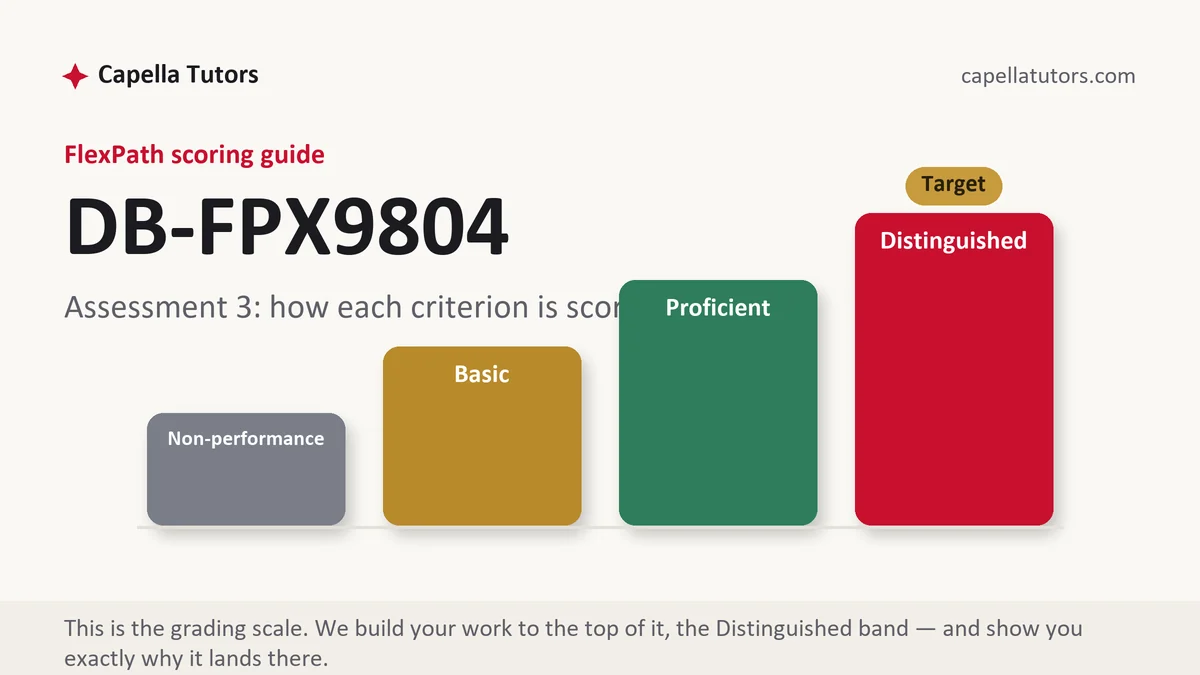
How DB FPX 9804 Assessment 3 is scored
There are no letter grades in FlexPath. Each criterion on the scoring guide lands on one of four levels, and the level language is the writing brief:
| Level | What it means on a presentation submission |
|---|---|
| Distinguished | The deck opens on the decision, compresses method to what an audience needs in order to trust the numbers, delivers findings with magnitude, and closes on an action carrying a cost, an owner and a review date. The extra move is conceding out loud what the study cannot answer. |
| Proficient | Structure, content and notes are in place and the timing works. Professional, and still asking the audience to infer why the recommendation deserves funding. |
| Basic | A deck that walks the chapters in order, spends its first third on literature, and ends on findings with no recommendation attached. |
| Non-performance | A required element is absent, most often speaker notes or the recommendation itself, or a slide set longer than the guide allows. |
You are graded on how you answer as much as on what you present, which means separating what the data shows from what you believe and using the words a doctoral audience respects most, that the study cannot answer that and here is the study that would. Build the question list from your own limitations rather than from imagination, since the three questions you least want are the three most likely to arrive first. The deck is also the last artifact anybody in the program sees, so its numbers have to match the manuscript exactly; one figure rounded differently from the table it came from restarts an audit you had already finished.
The DB FPX 9804 Assessment 3 method, step by step
-
Budget the deck by arithmetic
Take the length the guide specifies, allow roughly a spoken minute per slide, and hold back a fifth of the time for questions, so a 25 minute slot becomes about 20 slides with five minutes in reserve. Guessing the length is how a talk runs into the discussion it needed.
-
Open on the decision, not the literature
Two slides establishing why somebody with a budget should care, expressed in the organization's own numbers. Prior work appears later and briefly, because the audience is not examining your reading; it is deciding whether to act.
-
Compress method to the point of trust
Design, sample and the single limitation an audience needs in order to believe the findings. Anything further belongs in the notes, ready if asked, which is a better place for it than a slide nobody can read.
-
Deliver findings with magnitude
One finding per slide, carrying the number and its precision in words a non-specialist can hold. Reproduced software output is unreadable from four rows back and tells a room that you did not decide what mattered.
-
Cost the recommendation
The action, its first-year cost built from components somebody can check, the owner by role, a measure the organization already reports, a review date, and the assumption the case rests on. Name what happens to the case if that assumption moves.
-
Rehearse aloud, standing, against a timer
Twice, without reading the slides, because the version you have only read silently always runs long and always sounds like a document. Then write the three questions you least want and answer each in two sentences, conceding first where the concession is honest.
A structure that maps to the criteria
Slide counts below are our tutors' planning figures for a 25 minute slot, not Capella rules; the length in your scoring guide sets the real budget.
| Section | What it must do | Guide |
|---|---|---|
| Decision and problem | Why an executive should care, in the organization's own numbers, inside two slides. | 2 slides |
| Method, compressed | Design, sample, and the one limitation an audience needs in order to trust the findings. | 2 slides |
| Findings | One finding per slide, with magnitude and precision, and no reproduced software output. | 5 slides |
| Recommendation, costed | The action, its first-year cost, the owner, the measure already reported, and the review date. | 3 slides |
| Limitations and next study | The design boundary stated as fact, and the study that would settle what this one cannot. | 1 slide |
| Speaker notes and question list | Notes timed to a spoken minute per slide, plus the questions your findings invite and their answers. | as needed |
Annotated sample excerpt
An original model excerpt from our team, written on a beverage distribution scenario, showing a recommendation slide with the notes that carry it. Learn the components, then cost your own.
Recommendation: consolidate 14 delivery routes into 12 in the northern territory, starting with the two lowest-density routes identified in Table 9.1 First-year cost is $47,000, being $38,000 for re-sequencing and routing software and $9,000 for driver training; annual saving is about $188,000, being two driver positions redeployed at a loaded $71,000 each plus $46,000 in fuel and maintenance, so the change returns its cost inside the first year.2 Owner is the director of distribution, the measure is on-time delivery percentage, which this business already reports weekly, the review point is 90 days, and the case rests on volume growing no faster than 3 percent, because above that the twelfth route saturates and the saving reverses.3
- 1The recommendation arrives as an instruction with a starting point, tied to the table that produced it, so nobody has to ask where it came from.
- 2Cost and saving built from components an operator can check, which is what separates a fundable recommendation from an aspiration.
- 3Owner, existing measure, review date, and the assumption that would break the case, stated by the presenter before anybody in the room finds it.
The full premium sample for your exact assessment, written fresh to your scoring guide and setting, is free to request. Study it, revise it into your own voice, and submit work you understand.
The five mistakes that cost Distinguished
- A talk that spends its minutes on chapter two. The audience came for the findings, and a literature-heavy opening spends the attention you needed later.
- Software output on a slide. A pasted regression table is illegible from four rows back and announces that nothing was prioritized.
- A recommendation nobody has costed. An action nobody owns and nobody funds is a wish in doctoral binding.
- Slide figures that differ from the manuscript. One differently rounded number restarts the consistency audit you had already passed.
- Defending a question the study cannot answer. Conceding the boundary earns credibility, and improvising past it spends the credibility you arrived with.
Pre-submission checklist
- Deck length inside the guide's limit, budgeted at a spoken minute per slide with a fifth held for questions
- Opens on the decision and the organization's own numbers rather than on the literature
- One finding per slide with magnitude and precision, and no reproduced output
- Recommendation carries first-year cost, owner by role, a measure already reported, and a review date
- Speaker notes written, then rehearsed aloud twice against a timer, standing
- Every figure on a slide matches the manuscript exactly, and borrowed figures carry their sources
Talk to give, and the deck still reads like a chapter?
Send the finished manuscript together with the guide. Inside 24 to 48 hours a premium original sample returns as a slide set at the length your guide asks for, speaker notes timed to a spoken minute per slide, a recommendation costed with an owner and a review date, and a list of the questions your findings invite with an answer to each that concedes what needs conceding. Revisions cost nothing until the criteria clear.