This manual is for DB FPX 9804 Assessment 1, start to submission. Assessment 1 of DB FPX 9804, Final Reviews and Presentation, usually asks for the pass nobody enjoys and every manuscript needs: the whole document read backwards, every claim checked against the table that supports it, every repeated figure traced across chapters, and a reconciliation log recording what moved and why. Consistency is the criterion here, and it gets checked mechanically. Below is the sequence our tutors use, the structure it produces, and an annotated excerpt. Rather have it audited for you? A premium original sample of this deliverable returns in 24 to 48 hours with revisions free until the guide is met. Capella's catalog lists the course as DB-FPX9804, and some courserooms print DB9804; both point to this same Assessment 1.
One honesty note before the manual: Capella revises courses and scoring guides over time, so always write to the exact scoring guide attached to your assessment in the courseroom. The course identity above is verified on capella.edu; the method and structure below are our tutors' approach to it, not Capella's official rubric text.
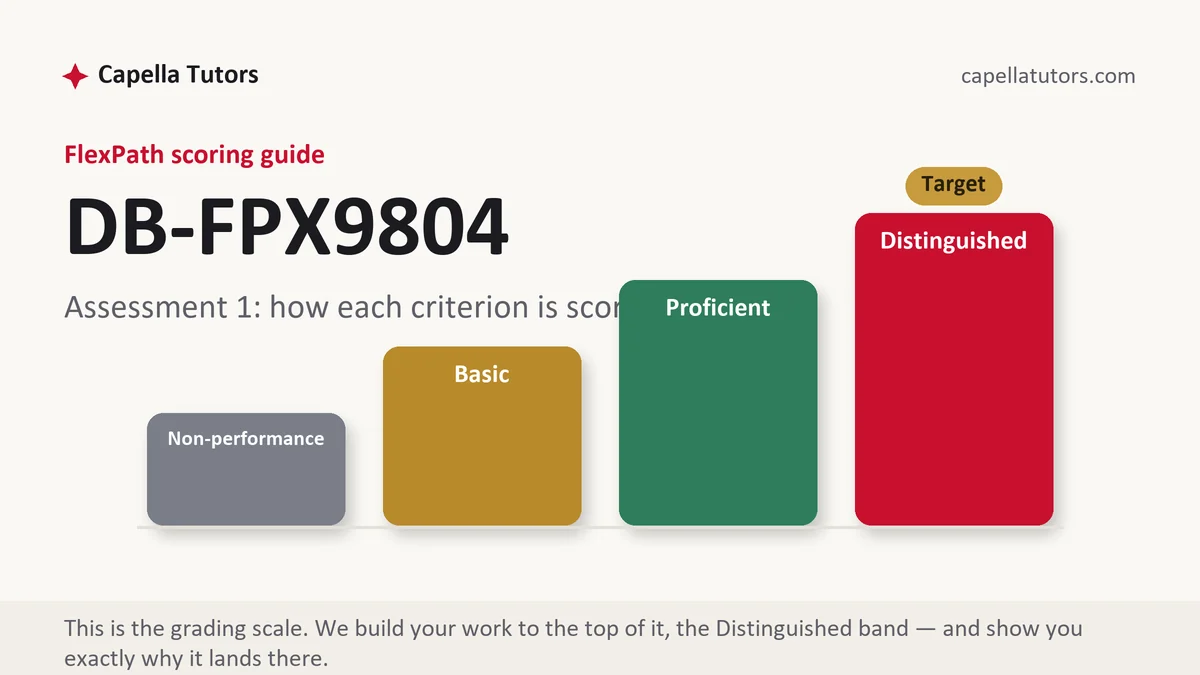
How DB FPX 9804 Assessment 1 is scored
There are no letter grades in FlexPath. Each criterion on the scoring guide lands on one of four levels, and the level language is the writing brief:
| Level | What it means on an alignment audit submission |
|---|---|
| Distinguished | Every interpretive claim traces to a table inside this manuscript, no promise in the early chapters goes unkept, nothing sits in future tense, and the log lets a reader verify each change. The extra move is explaining a divergence from published estimates rather than noting it. |
| Proficient | The document is consistent and the corrections are made. Clean, and still leaving a reader to discover which changes happened and why. |
| Basic | A proofread rather than an audit, with tense fixed in places, claims unverified, and the abstract still describing the study that was planned. |
| Non-performance | A required element is absent, most often the alignment check itself, or a discussion claim with nothing behind it anywhere in the document. |
Read the document in the order a reviewer under time pressure reads it, which is backwards. Reviewers hunt seams rather than prose: an abstract describing the study you designed instead of the one you ran, a problem statement promising something the data never touched, a purpose sentence in future tense three chapters after collection ended. This audit also fixes what the presentation is allowed to say, because a claim deleted here cannot appear on a slide, and a recommendation resting on a deleted claim has to be rebuilt before anyone stands up to deliver it.
The DB FPX 9804 Assessment 1 method, step by step
-
Start at the last paragraph and work back
Begin with the final sentence of the discussion and move toward chapter one, asking one question of every claim: which table in this manuscript proves that. A claim with no table behind it gets evidence or gets deleted, and there is no third option that survives a careful reader.
-
Fix the tense and the promise together
Collection almost always changed, so the early chapters have to describe what happened rather than what was intended, in past tense, with the purpose sentence rewritten to the population you actually reached. These two failures travel together and are usually found in the same paragraph.
-
Run the number census
List every figure appearing more than once and trace each across the document: usable sample, response rate, effect size, interval, the percentage in the abstract, the count in the discussion. Decide which instance is correct, correct the rest, and write down why the drift happened.
-
Set the rounding conventions once
Two decimals for effect sizes and coefficients, one for percentages, whole dollars for money, and the same convention in the appendices as in the chapters. Mixed rounding reads as carelessness and costs a criterion that has nothing to do with your analysis.
-
Keep the reconciliation log as you go
One line per change: the claim, where it lives, the evidence or the decision, and the action taken. A chair can verify a log in ten minutes and cannot verify a silent rewrite at all, which is why the log is an artifact rather than a courtesy.
-
Re-read the contribution claim last
Name the practice that changes, the setting where it changes, and the boundary past which your evidence stops covering it. Claim contribution to practice or to theory, not both from one study inside one organization, then defend the scale of the claim you kept.
A structure that maps to the criteria
These lengths are our tutors' planning figures for an alignment audit submission, not Capella rules; the criteria in your guide decide the real proportions.
| Section | What it must do | Guide |
|---|---|---|
| Backwards claim audit | Every interpretive sentence in the discussion, with the table that supports it or the decision to cut it. | ~400 words |
| Alignment across chapters | Problem, purpose, questions and method rewritten to describe the study that actually happened. | ~400 words |
| Number census | Every figure appearing more than once, traced chapter by chapter, resolved to one correct value. | ~350 words |
| Rounding and units | One convention per quantity type, applied through the tables, the prose and the appendices. | ~200 words |
| Reconciliation log | What changed, where, why, and what a reader should check to confirm it. | as needed |
| Contribution and limitations | The practice that changes, the setting it applies to, and the boundary past which the evidence stops. | ~350 words |
Annotated sample excerpt
An original model excerpt from our team, written on a distribution scenario, showing what a reconciliation log entry looks like when a chair has to verify it. Learn the format and keep your own.
Discussion, paragraph four: the claim that realignment shortened quote turnaround for national accounts is supported by no table in this manuscript, since Table 11 reports turnaround for regional accounts only. The claim is narrowed to regional accounts and the sentence about national accounts is deleted.1 Purpose statement, chapter one: read will examine three sales regions, while collection closed with two after the southern region declined access in week six. Rewritten in past tense and to two regions, with the same correction applied to the abstract and the method chapter.2 Usable cases: results chapter 112, abstract 115, discussion about 115. The results figure is correct; the other two were written before the last three exclusions were applied, and both now read 112.3
- 1A claim with no table behind it is either evidenced or removed, and the log records which happened so a chair can check the decision rather than trust it.
- 2Catches the two failures that travel together, a promise the data never kept and a tense left in the future, then propagates the correction to every chapter carrying it.
- 3One drifted figure named in three places, with the correct value identified and the cause explained, which stops a reviewer assuming the analysis drifted too.
The full premium sample for your exact assessment, written fresh to your scoring guide and setting, is free to request. Study it, revise it into your own voice, and submit work you understand.
The five mistakes that cost Distinguished
- An abstract describing the proposal. Future tense in the abstract tells a reviewer the document was never read as one document.
- Claims that no table supports. A single unsupported sentence in the discussion invites a reader to test all the others.
- A figure that changes between chapters. A sample size drifting by three undermines every table standing on it.
- Both contributions claimed at once. One study inside one organization contributes to practice, and claiming theory as well reads as inexperience.
- Limitations written as apologies. Regret is not analysis, and it invites a reader to discount findings that were sound.
Pre-submission checklist
- Every discussion claim traced to a named table in this manuscript, or removed
- Purpose, problem and questions rewritten to the study that happened, with no future tense left anywhere
- Every repeated figure traced across chapters and reconciled to one value
- One rounding convention per quantity, applied in the appendices as well as the chapters
- A reconciliation log a chair can verify in ten minutes
- Contribution claimed as practice or as theory, not both, with the boundary of the claim stated
Whole manuscript in front of you and nowhere to start?
Send the document and the guide. We run the audit in reverse, discussion first and problem statement last, marking every claim no table supports and every figure that changes between chapters. What returns inside 24 to 48 hours is a corrected manuscript plus a reconciliation log your chair can check quickly, built by an eight person pipeline with one reader assigned only to the number census. Revision continues free of charge until the criteria clear.