This manual is for DB FPX 9804 Assessment 2, start to submission. Assessment 2 of DB FPX 9804, Final Reviews and Presentation, usually asks for the artifact itself: an abstract describing the completed study inside its length limit, front matter in the required order, headings, tables, figures and appendices conforming to the template, and a reference list reconciled in both directions. The guide treats presentation of the artifact as its own criterion. What follows is our tutors' order of work, a criterion-mapped structure, and an annotated excerpt. Prefer it handled? A premium original sample of this deliverable arrives inside 24 to 48 hours, revised free until every criterion clears. Capella's catalog lists the course as DB-FPX9804, and some courserooms print DB9804; both point to this same Assessment 2.
One honesty note before the manual: Capella revises courses and scoring guides over time, so always write to the exact scoring guide attached to your assessment in the courseroom. The course identity above is verified on capella.edu; the method and structure below are our tutors' approach to it, not Capella's official rubric text.
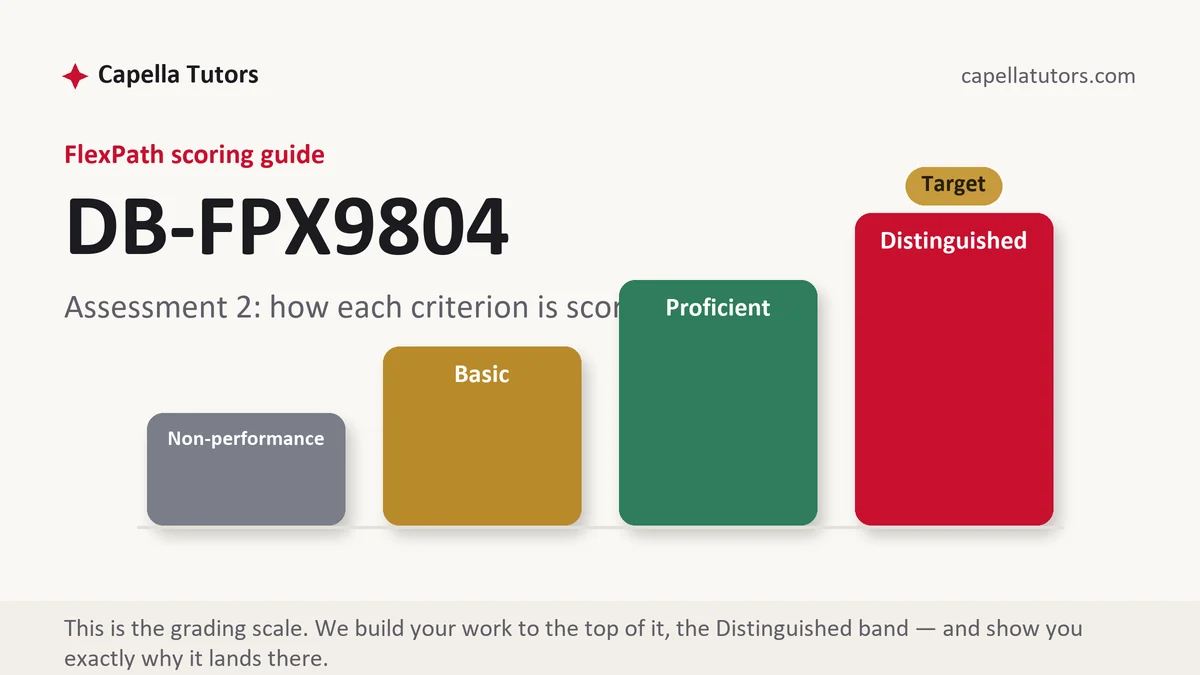
How DB FPX 9804 Assessment 2 is scored
There are no letter grades in FlexPath. Each criterion on the scoring guide lands on one of four levels, and the level language is the writing brief:
| Level | What it means on a manuscript artifact submission |
|---|---|
| Distinguished | Nothing is left for a reviewer to correct, so reading attention goes to the argument, and the abstract names design, sample, principal finding and practice implication in past tense. The extra move is checking twice every citation that was added late. |
| Proficient | The template is followed and the references reconcile. Tidy, and still carrying an abstract that summarizes the chapters rather than the study. |
| Basic | Formatting corrected wherever somebody happened to look, with heading levels drifting and the reference list checked in one direction only. |
| Non-performance | A required element is absent, most often a required page or an appendix label, or an abstract longer than the template allows. |
Format is inspectable in minutes, which is exactly why it is graded, and a reader who finds four errors starts hunting rather than reading. Treat it as a discrete task with the template open beside the document, and do it before the intellectual pass rather than after, so that later corrections do not reintroduce what you already fixed. Citations added during revision deserve their own suspicion, since late sources are where mismatched years, missing entries and half-remembered attributions collect, and the presentation stage inherits every one of them on a slide where the room can read it.
The DB FPX 9804 Assessment 2 method, step by step
-
Write the abstract from the finished study
Design, setting, sample, the principal finding with its magnitude, and the practice implication, all in past tense and inside the length the template allows. An abstract with a sentence per chapter has no room for the finding a reader opened it to get.
-
Check the required pages and their order
Title page, approval page, dedication, acknowledgements, table of contents, list of tables, list of figures, then the chapters, exactly as the template sequences them. Page order errors are the cheapest possible way to lose a criterion.
-
Walk the heading levels in outline view
Every level used in sequence with none skipped, formatted as the template formats it. A level three sitting under a level one is a structural error, and the table of contents displays it from across the room.
-
Standardize tables and figures
Numbering in order of first mention, titles and notes positioned as the template requires, no table broken awkwardly across a page, and a source line on any figure or benchmark you did not produce.
-
Reconcile the reference list in both directions
Every in-text citation present in the list, every entry cited in the text, DOIs resolving, and one convention for organizational authors and retrieval statements throughout. Follow the reference rules your own template sets rather than the conventions you learned in an earlier program.
-
Audit the citations you added last
Anything cited in the discussion should already appear in the literature review, and the legitimate exception is a source brought in to explain a surprise the data produced, which belongs in both chapters. Check every late addition twice and fix the year first.
A structure that maps to the criteria
The figures below are our tutors' planning targets for an artifact submission, not Capella requirements; your template and scoring guide govern the real ones.
| Section | What it must do | Guide |
|---|---|---|
| Abstract | Design, sample, the principal finding with magnitude, and the practice implication, in past tense inside the limit. | ~250 words |
| Front matter and page order | Every required page present, in the template's sequence, with headings matching the table of contents. | as needed |
| Heading hierarchy | Levels used in order, formatted to the template, with none skipped anywhere in the document. | ~150 words |
| Tables and figures | Numbering, titles, notes, placement, and source attribution on anything borrowed. | ~250 words |
| Appendices | Labelled and ordered as first mentioned, holding instruments, permissions and the consent document. | ~150 words |
| Reference list | Current APA, reconciled both directions, DOIs resolving, one convention throughout. | as needed |
Annotated sample excerpt
An original model excerpt from our team, written on a credit union scenario, showing an abstract that describes a finished study rather than a set of chapters. Learn the shape and write your own.
This quantitative correlational study examined the member and channel characteristics associated with digital self-service adoption at a single-state credit union serving 61,400 members, using 12 months of transaction records and a survey of 486 members.1 Adoption stood at 38.2 percent of active members, and tenure with the institution was associated with adoption more strongly than age was, with the association reversing above 15 years of membership, an interaction the branch-closure literature had not reported.2 The findings support directing onboarding effort at members in their first two years and retaining assisted channels for long-tenured members, and they do not support the inference that closing branches accelerates adoption, which this design cannot test.3
- 1Design, setting, data sources and sample in the opening sentence, in past tense, because the study is finished and the abstract has to sound finished.
- 2The principal finding with its magnitude, plus the one surprise worth twenty words, rather than a sentence apiece for every chapter.
- 3Closes on the practice implication and on the inference the design refuses, which is what stops a reader over-reading the abstract.
The full premium sample for your exact assessment, written fresh to your scoring guide and setting, is free to request. Study it, revise it into your own voice, and submit work you understand.
The five mistakes that cost Distinguished
- An abstract that summarizes chapters. Five sentences each describing a section leave no room for the finding anybody opened it to find.
- Heading levels that drift. A level three under a level one is a structural error, and the table of contents advertises it.
- Borrowed figures with no source. An industry statistic shown without attribution invites the one question you have no answer for.
- References checked in one direction. Confirming every citation appears in the list is half the job, and the other half is what a reviewer samples.
- Late sources trusted. A citation added during revision is the likeliest place in the whole document for a wrong year.
Pre-submission checklist
- Abstract names design, sample, the principal finding with magnitude and the practice implication, in past tense inside the limit
- Every required page present and in the template's order, matching the table of contents
- Heading levels used in sequence, with none skipped anywhere in the document
- Tables and figures numbered, titled and noted to the template, with sources on anything borrowed
- Appendices labelled and ordered as first mentioned, instruments and permissions included
- Reference list reconciled in both directions, DOIs resolving, one convention for organizational authors
Template compliance eating the week you needed for the argument?
Send the manuscript, the template and the guide. Inside 24 to 48 hours a premium original sample returns with the abstract rewritten from the finished study, page order and heading levels corrected, tables and figures standardized, and the reference list reconciled in both directions with every late addition checked twice. Revisions run free until the criteria clear, and faculty comments re-enter the same queue at no charge.