This manual is for BHA FPX 4020 Assessment 4, start to submission. This is the stage where the pieces become one document, and the criteria stop grading sections and start grading whether they interlock: the budget reflecting the staffing the operational plan requires, the operational plan respecting the regulation named in the compliance section, the measures drawn from data the information section says the organization can produce. It also carries the executive summary, which has to work as a standalone page, and a stakeholder analysis that names who can block this. The assembly method is below, followed by a structure drawn from the criteria and an annotated sample excerpt. Prefer to hand the assembly to us? A premium original sample of the finished document returns in 24 to 48 hours, revised free until every criterion is cleared. Capella's catalog lists the course as BHA-FPX4020, and some courserooms print BHA4020; both point to this same Assessment 4.
One honesty note before the manual: Capella revises courses and scoring guides over time, so always write to the exact scoring guide attached to your assessment in the courseroom. The course identity above is verified on capella.edu; the method and structure below are our tutors' approach to it, not Capella's official rubric text.
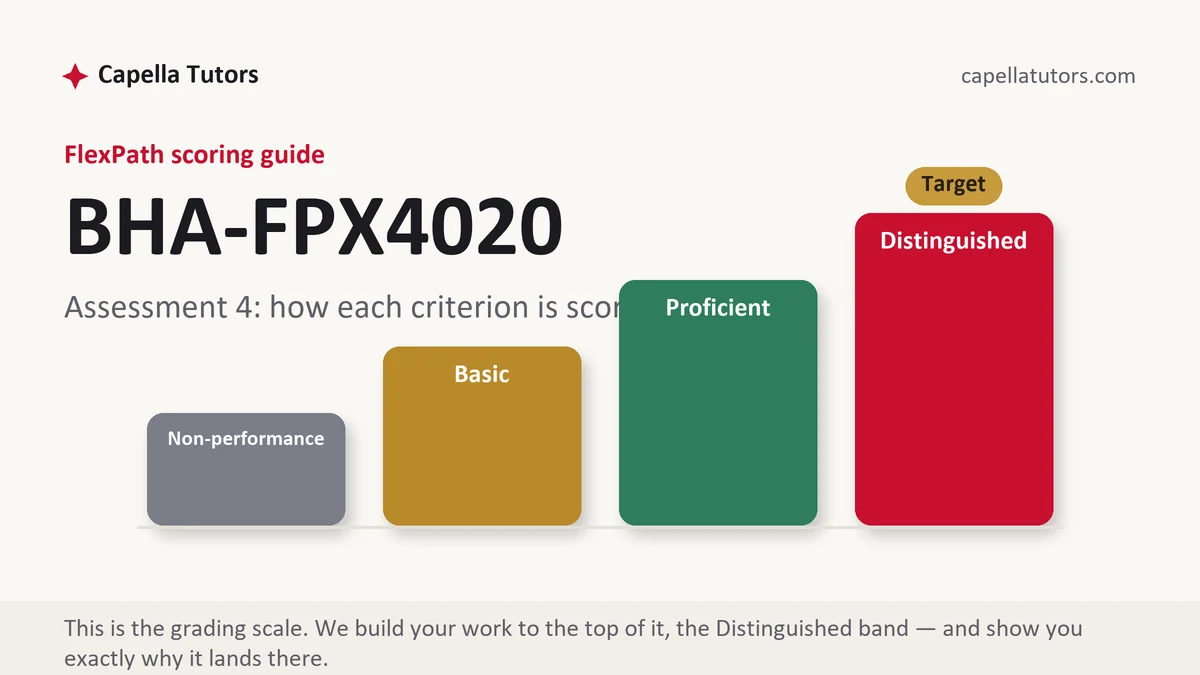
How BHA FPX 4020 Assessment 4 is scored
The levels work as they do everywhere in FlexPath, and at this length the integration language is the part to read closely:
| Level | What it means on the assembled project |
|---|---|
| Distinguished | The domains depend on each other rather than sitting side by side, the executive summary stands alone and leads with the ask, stakeholders are named with what each needs in order not to object, and the recommendation holds its limits without weakening. The extra step is always somewhere in the criterion; find it and make it. |
| Proficient | Every required domain is present and internally sound. Complete work whose sections could be reordered without loss. |
| Basic | One strong earlier section stretched to length, with the other domains added as short passages that could be removed without changing the argument. |
| Non-performance | A required element is absent, most often the stakeholder analysis or a genuine executive summary. |
There is one reliable test for the integration criterion. Remove any single section and ask whether the argument still stands. If it does, that section is a passenger, and the criterion has already been lost.
The BHA FPX 4020 Assessment 4 method, step by step
-
Rebuild the outline from the guide, then assemble in argument order
Problem and evidence first, then the intervention, then the budget, then implementation, measurement and risk. Write the executive summary last, because it can only summarize something that already exists.
-
Wire the domains to each other deliberately
Make the budget cite the staffing the operational plan requires, make the operational plan cite the rule the compliance section names, make the measures cite the data source the information section claims exists. Cross-references are the visible form of integration.
-
Write the executive summary as a standalone page
Open with the ask, not with background. A reader who stops after page one should still know the problem, its size, what you propose, what it costs, what it returns and what decision you want. Most students write an introduction and label it a summary, which is the single most common formatting loss here.
-
Name who can block this and what they need
Identify each stakeholder by role, say what they gain or lose, and say what would have to be true for them not to object. A stakeholder analysis that lists departments without naming interests is a directory of the organization.
-
Hold the recommendation and its limits together
Say what the evidence supports, why the effect here may be smaller, what you will measure to find out, and what decision you are asking for now. Overclaiming and hedging both fail, and the sequence above satisfies the criterion that asks for a recommendation without inviting the one that asks for rigor.
-
Read once for numbers only, then self-score
At capstone length the most damaging error is a figure appearing twice with two values, so read the whole document for figures alone before anything else. Then mark every criterion D, P, B or N and submit early in the week.
A structure that maps to the criteria
These are planning targets our tutors use when assembling a capstone rather than Capella rules, and your guide decides the format, the length and the required sections.
| Section | What it must do | Guide word target |
|---|---|---|
| Executive summary | Problem, size, proposal, cost, return and the decision requested, on one standalone page. | ~350 words |
| Integrated body | The domains assembled so each one depends on at least one other, with cross-references. | ~400 words |
| Stakeholder analysis | Each role, what it gains or loses, and what it needs in order not to object. | ~300 words |
| Recommendation and limits | What the evidence supports, why the local effect may differ, and the decision requested. | ~250 words |
| Consistency and format | Figures reconciled across tables and narrative, headings matching the guide, APA throughout. | ~150 words |
| References | The whole reference list spanning the domains the argument crosses, in current APA. | as needed |
Annotated sample excerpt
An original model paragraph from our team, set at the level a capstone evaluator reads for. Study material: take the construction and assemble your own document.
This proposal asks the board to approve 71,400 dollars in first year funding to establish enrolled chronic care management for the clinic's 612 eligible patients, and to accept a nine month payback rather than a first year surplus.1 Of those 612 patients, 148 currently have two or more chronic conditions and no visit in the last eight months, a figure taken from the practice management system in April and consistent with the county assessment's finding on transportation among adults over 65 in this service area.2 The program funds 1.4 positions, uses the care plan template the electronic record already supports, respects the documentation and consent requirements the billing rules attach to the enrolled service, and will be judged on enrolled patients with a completed care plan and on the same eight month contact gap that defines the problem, so the measure and the problem are the same quantity throughout.3
- 1The ask arrives in the first clause with the amount and the condition attached, and the payback expectation is set before anyone can misread it.
- 2The size of the problem is sourced twice, once internally and once externally, which is what makes a summary figure defensible on one page.
- 3Staffing, information systems, compliance and measurement appear in one sentence and refer to each other. That is the integration criterion in visible form.
The full premium sample for your exact assessment, written fresh to your scoring guide and issue, is free to request. Study it, revise it into your own voice, and submit work you understand.
The five mistakes that cost Distinguished
- An earlier section made longer. The integration criterion looks for domains that depend on each other, not domains placed next to each other.
- An executive summary written as an introduction. Without the ask, the cost and the return on that one page, the section has not done its work.
- Stakeholders listed without interests. The criterion wants to know who can block this and what they need in order not to.
- One figure with two values. At this length a mismatch between a table and the narrative is the error most likely to cost more than one criterion.
- A recommendation with no limit, or a limit with no recommendation. Overclaiming and hedging fail the same criterion from opposite sides.
Pre-submission checklist
- Headings match the guide's criteria and their order
- The executive summary stands alone and opens with the ask
- Every domain cross-references at least one other domain
- Each stakeholder carries an interest and a condition for support
- The whole document read once for figures alone, with every value reconciled
- Recommendation stated with its limits, and every criterion self-scored D
Assembling the final document?
Send everything you have written so far along with the scoring guide. One entire pass exists to check internal consistency at capstone length, which means confirming that the budget figure matches the narrative and that the measure in the evaluation plan is the measure in the problem statement. Back in 24 to 48 hours, revised free until the guide is satisfied, planned backward from your submission date.