This manual is for BHA FPX 4020 Assessment 1, start to submission. The assessment usually asks you to establish the problem your capstone will solve, which is graded harder here than anywhere else in the degree. A capstone problem needs a site, a magnitude, a period and a source, and it has to be small enough that one department could deliver the solution and large enough to be worth a director's attention. This is a written project rather than a field assignment, so everything rests on how well the problem is sized on the page. The method for scoping it is below, with a criterion-mapped structure and an annotated sample excerpt. Would you rather scope it with us? A premium original sample for this stage comes back inside 24 to 48 hours, revised free until the guide is satisfied. Capella's catalog lists the course as BHA-FPX4020, and some courserooms print BHA4020; both point to this same Assessment 1.
One honesty note before the manual: Capella revises courses and scoring guides over time, so always write to the exact scoring guide attached to your assessment in the courseroom. The course identity above is verified on capella.edu; the method and structure below are our tutors' approach to it, not Capella's official rubric text.
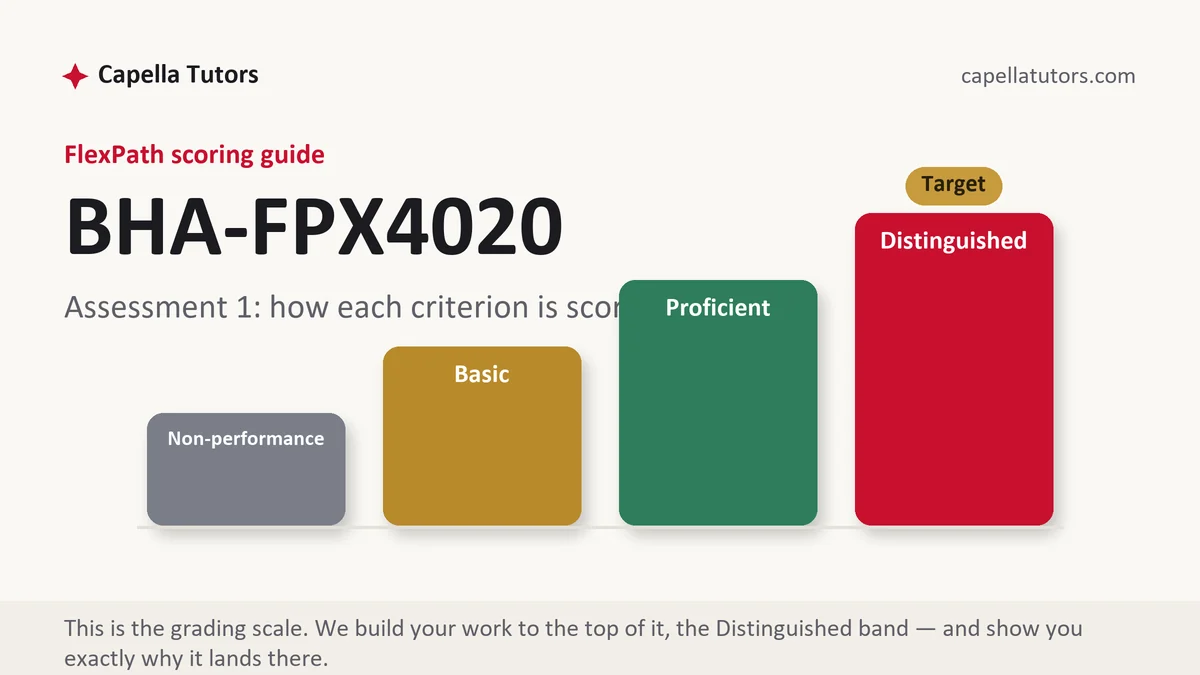
How BHA FPX 4020 Assessment 1 is scored
Capstone criteria are long, numerous and unusually explicit, and each one lands on one of four levels:
| Level | What it means on a capstone problem statement |
|---|---|
| Distinguished | The problem is sited in one named department, sized with a figure, a denominator and a period, benchmarked against a target or an external value, and scoped so a reader can tell when it has been solved. The criterion always wants one further move; find it and make it. |
| Proficient | The problem is clear, evidenced and relevant. Sound work whose magnitude a reader cannot verify. |
| Basic | An important issue described at system level, with national statistics standing in for a local baseline. |
| Non-performance | A required element is absent, most often the data establishing that the problem exists at the size claimed. |
Most capstones that go badly went badly here, and every hour afterward was effort spent in the wrong place. A problem that fails the site test, the size test or the closable test will read as ambitious and score as unfocused.
The BHA FPX 4020 Assessment 1 method, step by step
-
Read the guide as a specification and build to it literally
Turn every criterion into a heading and keep them in the guide's order unless the prompt says otherwise. An evaluator scoring criterion by criterion should never have to hunt, and the beautiful reorganized version costs marks it cannot earn back.
-
Apply the three tests before you write a word
Can it be sited, meaning is there one named department where it lives. Can it be sized, meaning is there a figure, a denominator and a period. Can it be closed, meaning could the people and budget available inside a year plausibly deliver the fix. A problem failing any one of them needs replacing now, not later.
-
Find the denominator, then the numerator
Decide what population or volume the problem sits inside before you count the events. A capstone that reports a count with no base has produced a fact rather than a magnitude, and the evidence criterion is graded on magnitude.
-
Label anything you had to construct
Where the figure you need is not available to you, build it from what is observable, say it is constructed, and show the basis. A transparent estimate is treated far better than a confident number with no origin, and the criteria are written by people who know which is which.
-
Set the figure against something
An internal target, the same department a year earlier, a comparable facility, or a published external value with its collection year. A baseline with nothing beside it cannot establish that anything is wrong.
-
Write the solved sentence, then self-score
Finish with one sentence describing what the department looks like when the problem is gone, expressed as a number and a date. Then mark each criterion D, P, B or N, rewrite anything under Distinguished, and submit early in the week.
A structure that maps to the criteria
Treat these as planning targets our tutors use at the scoping stage of a capstone rather than Capella rules, and expand whichever criterion the guide weights.
| Section | What it must do | Guide word target |
|---|---|---|
| Organization and setting | The facility, its size and ownership, the department, and who leads it. | ~200 words |
| The problem stated | The problem in one sentence carrying a site, a figure, a denominator and a period. | ~200 words |
| Evidence of magnitude | The data behind the figure, its source, and any part of it you constructed and labeled. | ~350 words |
| Comparison | The target, prior period or external value the figure is set against, with its year. | ~250 words |
| Scope and stakes | What is inside and outside the project, who is affected, and why it merits attention now. | ~300 words |
| References | Internal reports named and dated, external series cited with collection year, current APA. | as needed |
Annotated sample excerpt
An original model paragraph from our team, written where the top of the capstone guide sits. Study material: take the construction and site your own problem.
In the four-room surgical suite of this 180-bed community hospital, 411 of 5,240 scheduled cases across the last four quarters were cancelled on the day of surgery, a rate of 7.8 percent against the hospital's own internal target of 4.5 percent and against 5.1 percent reported by the two comparable facilities in the same regional group.1 The figures come from the perioperative scheduling module and were reconciled against the monthly block utilization report, with the reason field populated in 336 of the 411 cases, so the 75 cancellations carrying no recorded reason are treated as unclassified rather than distributed across the known categories.2 Closing the gap to the internal target means preventing about 173 cancellations a year, which at the suite's average of 2,900 dollars in contribution per case is a magnitude the perioperative director can act on and the surgical services committee can approve.3
- 1Site, numerator, denominator, period and two comparisons in one sentence. A reader can recalculate the rate and check the claim immediately.
- 2The data source is named and its weakness is disclosed rather than smoothed over, which is the honesty the evidence criterion rewards.
- 3The gap is converted into cases and dollars, and both the owner and the approving body are named, which settles the site and scope tests together.
The full premium sample for your exact assessment, written fresh to your scoring guide and issue, is free to request. Study it, revise it into your own voice, and submit work you understand.
The five mistakes that cost Distinguished
- A problem that no single department could own. A scope spanning an entire system leaves no one leader able to accept the recommendation.
- National figures instead of a local baseline. A capstone problem has to exist at this site, at a size taken from this site's data.
- A count with no denominator. Four hundred of anything is not a magnitude until the base and the period are attached.
- Estimates presented as measurements. A constructed figure is acceptable and an unlabeled one is not, and the difference is visible to a reader.
- No comparison at all. Without a target, a prior period or a peer value, nothing establishes that the current figure is a problem.
Pre-submission checklist
- Every criterion has its own heading, kept in the guide's order
- The problem statement names a site, a figure, a denominator and a period
- The data source is named, dated and its weaknesses disclosed
- Constructed figures are labeled with the basis shown
- The figure is set against a target, a prior period or a peer value with its year
- One sentence describes the solved state as a number and a date, and each criterion is self-scored D
Capstone scoping conversation?
Send the prompt, the scoring guide and whatever data you can reach. The first thing we do is test the problem for site, size and closability, because that is where capstone drafts are won, and then the sample comes back inside 24 to 48 hours with revision free until the criteria clear. This is the work standing between you and the degree, so we plan backward from your submission date.