This manual is for BHA FPX 4020 Assessment 3, start to submission. The assessment usually asks for the three sections that turn a proposal into a plan, and it asks for them separately: implementation as a sequence with dates, owners and dependencies; evaluation with measures fully specified against a baseline taken before the change; and risk as a set of named failures each carrying a response. Merging them is how capstones lose criteria they had already earned. What follows is the method, a structure mapped to the criteria, and an annotated sample excerpt. Rather we drafted this stage? A premium original sample for this part of the project lands inside 24 to 48 hours, with revision free until the guide is met. Capella's catalog lists the course as BHA-FPX4020, and some courserooms print BHA4020; both point to this same Assessment 3.
One honesty note before the manual: Capella revises courses and scoring guides over time, so always write to the exact scoring guide attached to your assessment in the courseroom. The course identity above is verified on capella.edu; the method and structure below are our tutors' approach to it, not Capella's official rubric text.
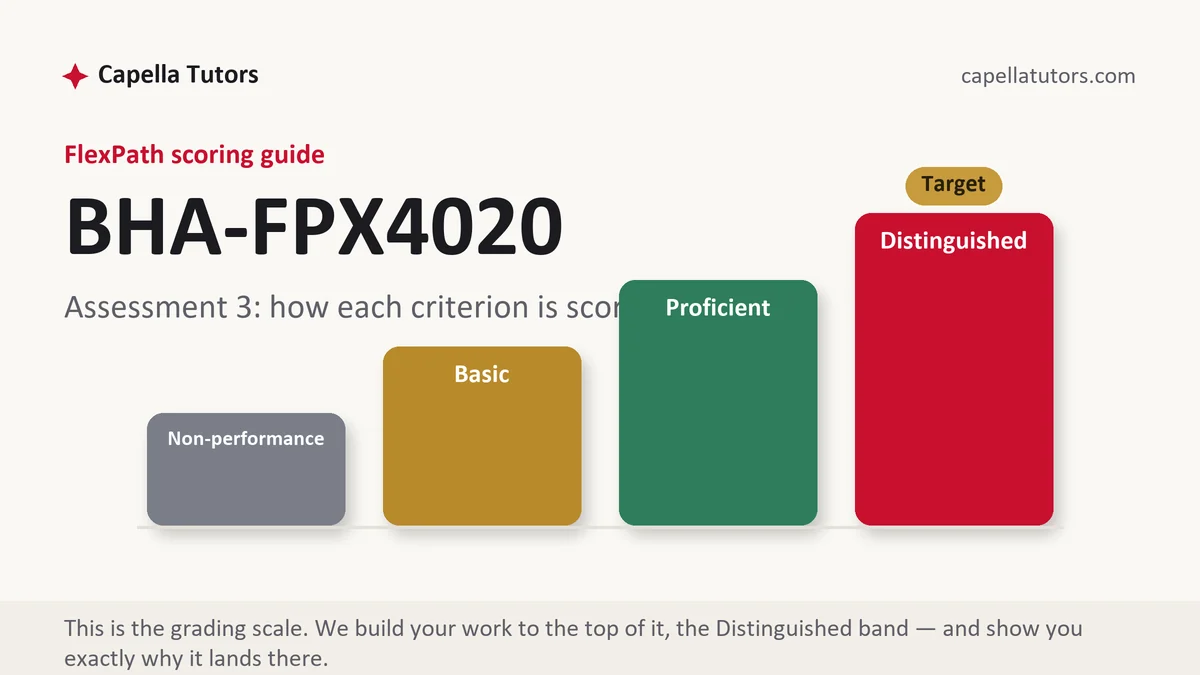
How BHA FPX 4020 Assessment 3 is scored
Four levels per criterion, no letter grades, and the level text is the specification for the section beneath it:
| Level | What it means on implementation, evaluation and risk |
|---|---|
| Distinguished | The first thirty days are specified rather than the year described, measures name numerators, denominators, sources and a baseline taken before the change, and every risk carries a response rather than a reassurance. One further move is written into the criterion; find it and make it. |
| Proficient | All three sections are present and coherent. Complete work whose timeline stays at the level of phases. |
| Basic | A timeline in quarters, a promise to track outcomes, and a risk paragraph noting that challenges may arise. |
| Non-performance | A required section is absent or folded into another, which is the most common way to lose a criterion at this stage. |
Risk is where undergraduate capstones are weakest, and it is also the cheapest criterion to win. Naming what happens if the position stays vacant, if clinical staff will not adopt the new step, or if the data turns out not to exist takes four sentences and moves a level.
The BHA FPX 4020 Assessment 3 method, step by step
-
Three headings, kept apart on purpose
Give implementation, evaluation and risk their own sections and resist writing them as one narrative. Each has its own criterion, and a measurement sentence buried in a timeline paragraph gets read once and credited once.
-
Write the first thirty days in detail
Name the tasks, the dates, the person by role and what each task depends on. A plan describing a year in the abstract is a plan nobody can start on Monday, and the criterion is written to distinguish the two.
-
Make dependencies explicit
Say what cannot begin until something else finishes: the build waits on the workflow decision, the training waits on the build, the go-live waits on the training. Dependencies are what turn a list of tasks into a sequence a project manager could run.
-
Specify measures the way a steward would
Numerator, denominator, exclusions, source, frequency and a named reviewer, for each measure. Then take the baseline before anything changes, because a value measured after the fact cannot demonstrate that the change did anything.
-
Give every risk a trigger and a response
Four or five named failures, each with what you would actually do: the fallback if recruitment stalls, the workaround if the data field is empty, the escalation if a department refuses the new step. A risk without a response is a worry.
-
Name the stop condition, then self-score
Say what result would tell you the intervention is not working and what you would do then, since a plan with no revision trigger is a plan nobody intends to revisit. Then mark each criterion D, P, B or N and rewrite whatever falls short.
A structure that maps to the criteria
Use these as planning targets our tutors work to at this stage of a capstone rather than as Capella requirements, and expand whichever section the guide weights.
| Section | What it must do | Guide word target |
|---|---|---|
| Implementation overview | The phases, their span, and the single owner accountable for the whole sequence. | ~200 words |
| The first thirty days | Tasks, dates, owners by role and dependencies, at a level somebody could start from. | ~300 words |
| Resources and dependencies | What has to exist before each phase can begin, and who supplies it. | ~200 words |
| Evaluation plan | Each measure fully specified, the baseline taken beforehand, the review date and reviewer. | ~350 words |
| Risk and response | Named failures with triggers and responses, plus the result that would stop the project. | ~300 words |
| References | Standards and evidence cited to their source with dates, current APA both directions. | as needed |
Annotated sample excerpt
An original model paragraph from our team, written where the capstone guide's top column sits. Study material: take the pattern and sequence your own project.
Days one through ten belong to the practice operations manager, who confirms the referral workflow with all five clinic leads and freezes the specialty list; days eleven through twenty belong to the applications analyst, whose build of the shared work queue cannot start until that list is frozen; days twenty-one through thirty are training for the six schedulers, delivered in two sessions so no clinic loses coverage, with go-live at one pilot clinic on day thirty-one.1 The primary measure is the proportion of referrals with a scheduled appointment within five business days of order entry, denominator all outbound specialty referrals excluding self-referred and urgent orders, taken weekly from the referral module by the analyst, against a baseline of 43 percent measured across the eight weeks before go-live, reviewed by the network director on the last Friday of each month.2 The largest risk is that two clinics keep scheduling locally rather than sending referrals to the hub, which would leave the hub with volume too low to justify the position, so the response is a weekly report of referrals routed by origin clinic from the first week and a standing item at the practice managers' meeting until the routing rate holds above 90 percent for a month.3
- 1Dates, owners by role and one explicit dependency. A project manager could begin from this paragraph without asking a question.
- 2The measure carries numerator, denominator, exclusions, source, frequency, a pre-change baseline and a named reviewer with a cadence.
- 3The risk is specific, its consequence is financial, and the response is a monitoring routine with a numeric exit condition rather than a reassurance.
The full premium sample for your exact assessment, written fresh to your scoring guide and issue, is free to request. Study it, revise it into your own voice, and submit work you understand.
The five mistakes that cost Distinguished
- The three sections merged. Implementation, evaluation and risk each carry their own criterion, and folding them together forfeits at least one.
- A timeline in quarters. Phases described in the abstract cannot be started, and the criterion asks for the first thirty days.
- Tasks with no owner. A sequence where nobody is named by role is a wish list arranged in date order.
- A baseline measured after go-live. Without a value taken beforehand, no result can be attributed to the change.
- Risk written as comfort. Saying that obstacles will be managed is not a response, and the criterion is looking for what you would actually do.
Pre-submission checklist
- Implementation, evaluation and risk each have their own section
- The first thirty days carry tasks, dates, owners by role and dependencies
- Every measure names numerator, denominator, exclusions, source and frequency
- The baseline is measured before the change, with its window stated
- Each risk has a trigger and a response, and one stop condition is named
- A reviewer and a review cadence are named, and each criterion is self-scored D
Implementation and risk sections due?
Send the scoring guide and the intervention you have already proposed. We write the three sections separately, price the dependencies, and give every risk a response, then run one pass whose only job is checking that the measure named in the evaluation plan is the same measure named in the problem statement. Back in 24 to 48 hours, revised free.