This manual is for BHA FPX 4020 Assessment 2, start to submission. The assessment usually asks for the intervention and what it costs, which means an intervention matched to the cause you identified rather than to the symptom you described, and a budget built as lines rather than as a total. Staffing gets costed with benefits, one-time costs sit apart from recurring ones, time borrowed from another department appears as a real line even when no money changes hands, and every assumption is stated where a reader can argue with it. Below is the method, the structure we build the section to, and an annotated sample excerpt. Prefer to hand the budget over? A premium original sample with the arithmetic shown returns in 24 to 48 hours, revised at no cost until the criteria clear. Capella's catalog lists the course as BHA-FPX4020, and some courserooms print BHA4020; both point to this same Assessment 2.
One honesty note before the manual: Capella revises courses and scoring guides over time, so always write to the exact scoring guide attached to your assessment in the courseroom. The course identity above is verified on capella.edu; the method and structure below are our tutors' approach to it, not Capella's official rubric text.
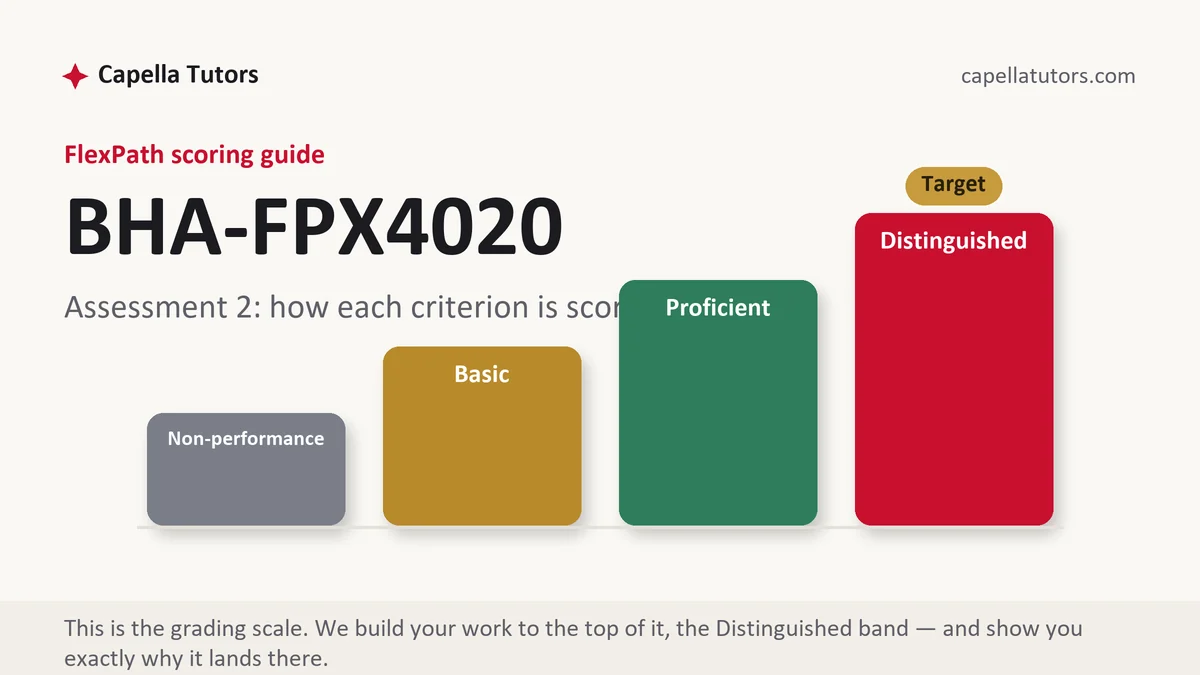
How BHA FPX 4020 Assessment 2 is scored
Each criterion sits at one of four levels, and at capstone length the level wording is worth reading twice:
| Level | What it means on a solution and budget |
|---|---|
| Distinguished | The intervention answers the cause rather than the symptom, the budget shows rates, hours and a benefits load, borrowed time appears as a line, and the paper says which figures are firm and which are estimates. The criterion adds a move; find it and make it. |
| Proficient | The solution is evidence-based and the budget is complete. Sound work whose assumptions are not exposed. |
| Basic | A sensible program described in general terms, with a single total figure offered as the budget. |
| Non-performance | A required element is missing, most often the cost detail or the evidence behind the intervention. |
A total is not a budget and the criterion knows the difference. Lines, rates, hours and a benefits load are what make a number reviewable, and reviewable is the whole test a finance office would apply.
The BHA FPX 4020 Assessment 2 method, step by step
-
Headings from the guide, then the cause restated
Open the section by naming the cause your problem statement established, in one sentence. An intervention chosen before the cause is settled is how capstones end up recommending a program that would not touch the mechanism they described.
-
Choose the intervention against the evidence and the constraint
Name the studies supporting it with their design and setting attached, then check the choice against the regulation, the licensure limits and the systems your organization actually runs. An intervention that cannot legally or technically be delivered fails on first review.
-
Cost the staffing first, and cost it correctly
Hours, hourly rate, wages, then a benefits and payroll tax load stated as a percentage. A position costed at wages alone understates the real figure by roughly a third, and a finance reader notices that immediately.
-
Separate one-time from recurring, and name the borrowed time
Equipment, training and setup are one-time. Licenses, materials and supervision are recurring. Analyst hours or clinical time borrowed from another department is a cost to the department lending it, so give it a line and a rate even when no invoice exists.
-
State the return in dollars where dollars exist
Quantify what you can, describe the rest as operational consequence, and do not stretch the dollar case to cover the gap. Saying the financial case falls short by a stated amount and arguing the remainder on outcome grounds is stronger than a total that arrives suspiciously even.
-
Mark the estimates, then self-score
Label every figure as firm or estimated and give the basis for each estimate. Then mark each criterion D, P, B or N, rewrite anything below D, and read the section once for numbers alone so no figure appears twice with two values.
A structure that maps to the criteria
These counts are planning targets our tutors use for the solution and budget stage of a capstone, not Capella rules; expand what the guide emphasizes.
| Section | What it must do | Guide word target |
|---|---|---|
| The cause restated | The mechanism the problem statement established, in one paragraph, with its evidence. | ~200 words |
| The proposed intervention | What changes in the work, drawn from research whose designs and settings are named. | ~350 words |
| Constraints respected | Regulation, licensure and system limits the design has to satisfy, each named. | ~200 words |
| Budget as lines | Salary with hours, rate and benefits load, one-time costs, recurring costs, borrowed time. | ~350 words |
| Return and assumptions | What comes back in dollars, what comes back operationally, and which figures are estimates. | ~250 words |
| References | Studies cited with design and setting, wage benchmarks dated, current APA both ways. | as needed |
Annotated sample excerpt
An original model paragraph from our team, written at the register the capstone guide rewards. Study material: take the line structure and cost your own proposal.
The proposal funds one full time nurse navigator for the breast program at 2,080 paid hours and 38.50 dollars an hour, which is 80,080 dollars in wages, and applying the organization's benefits and payroll tax load of 29 percent brings the position to 103,300 dollars a year.1 One-time costs are 4,200 dollars for the workstation, telephone line and initial training; recurring non-salary costs are 5,400 dollars for the patient education materials and the tracking software seat; and 104 hours of decision support analyst time at 34 dollars appears as a 3,536 dollar line even though no money leaves the department, because borrowed time is a cost to whoever lends it.2 Against a first year total of 116,436 dollars, the firm return is the 22 patients a year the referral audit shows leaving the system between diagnosis and surgery, worth about 105,600 dollars in contribution, so the dollar case is short by roughly 10,800 and the remainder has to be argued on time from abnormal imaging to biopsy, which is an outcome the committee has already asked about twice.3
- 1Hours, rate, wages and the benefits load are all visible, so the position cost can be recalculated rather than believed.
- 2One-time and recurring costs are separated, and borrowed analyst time carries a line and a rate. That line is what most undergraduate budgets omit.
- 3The shortfall is stated rather than closed with a flattering estimate, and the rest of the case is moved onto ground the committee already cares about.
The full premium sample for your exact assessment, written fresh to your scoring guide and issue, is free to request. Study it, revise it into your own voice, and submit work you understand.
The five mistakes that cost Distinguished
- A budget delivered as one total figure. Without rates, hours and a benefits load, nothing in the figure can be reviewed.
- Positions costed at wages only. Benefits and payroll taxes are roughly a third of the real number, and leaving them out is the error finance spots first.
- Borrowed time treated as free. Analyst or clinician time taken from another department is a cost, and the criterion expects it priced.
- An intervention aimed at the symptom. If the program would not touch the mechanism you described, the integration criterion is already lost.
- A return stretched to cover the cost. A stated shortfall with an outcome argument beside it reads as competence; a suspiciously even total reads as invention.
Pre-submission checklist
- Each criterion has a heading, kept in the guide's own sequence
- The cause is restated before the intervention is chosen
- Every study cited arrives with its design and its setting
- Salary lines show hours, rate, wages and a stated benefits load
- One-time, recurring and borrowed-time costs appear as separate lines
- Estimates are labeled with their basis, and every criterion is self-scored D
Budget section stalling the capstone?
Send the scoring guide, the problem you established and any rates your organization uses. We build the budget as lines with the arithmetic visible, and one full pass exists to confirm that the figure in the table matches the figure in the narrative. Returned inside 24 to 48 hours, revised free until the guide is met.