How to write PSY-FPX7310 Assessment 3

The short answer

This manual is for PSY-FPX7310 Assessment 3, start to submission. The final deliverable in Biological Basis of Behavior is the synthesis one, and the assessment usually asks you to hold a physiological system, its measurement and a behavioral pattern together in one argument, and to say what the measurement is worth before you say what the system explains. Your guide sets the criteria and the four levels, and the register is graduate explanation inside a non-licensure degree. What follows is the method our tutors run, a structure keyed to the criteria, and an annotated excerpt on measuring a hormone properly. Would you rather it was handled? A premium original sample for your prompt returns in 24 to 48 hours and is revised free until the guide is satisfied. Your courseroom may print this as PSY FPX 7310 Assessment 3 or PSY7310 Assessment 3; it is the same deliverable, and PSY-FPX7310 Assessment 3 is what this manual walks through.

One honesty note before the manual: Capella revises courses and scoring guides over time, so always write to the exact scoring guide attached to your assessment in the courseroom. The course identity above is verified on capella.edu; the method and structure below are our tutors' approach to it, not Capella's official rubric text.
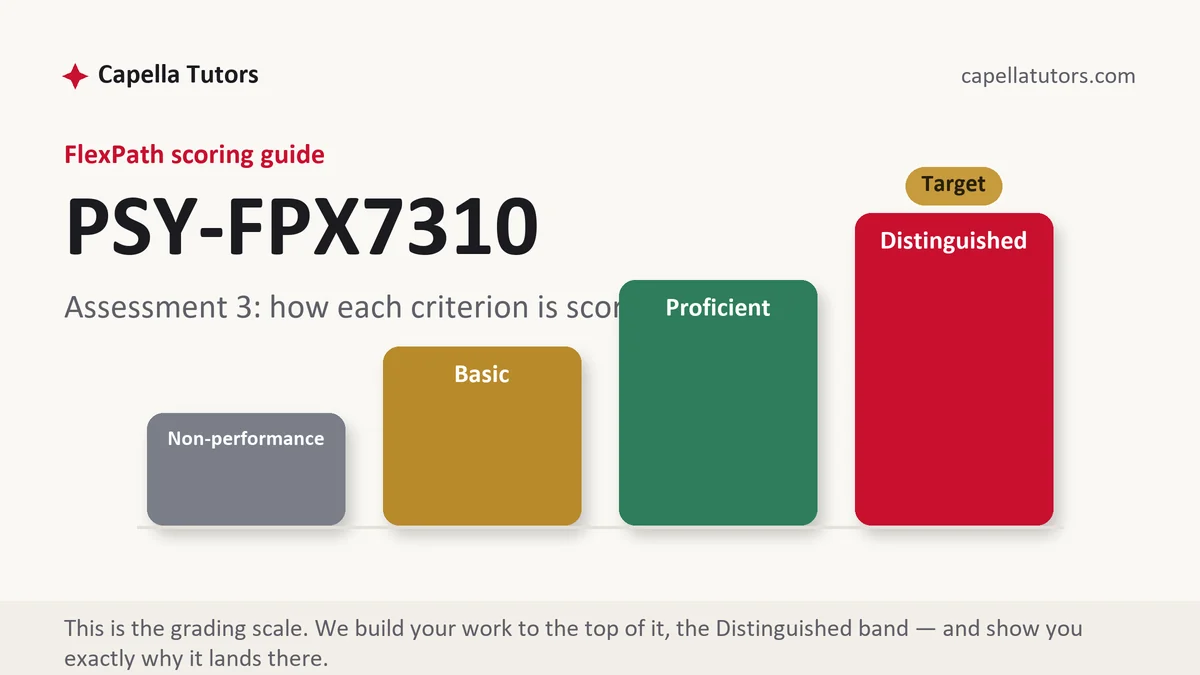
PSY-FPX7310 Assessment 3 grading scale at Capella FlexPath, the criterion levels this assessment is scored on, from Capella Tutors
How Capella FlexPath grades PSY-FPX7310 Assessment 3, visualized by Capella Tutors.

How PSY-FPX7310 Assessment 3 is scored

One level per criterion, four to choose from, and at the synthesis end the top level asks you to judge a measure rather than to trust it:

LevelWhat it means on a systems synthesis
DistinguishedThe system is described accurately across its fast and slow arms, the sampling protocol is specified tightly enough to be repeated, and the paper states how well the marker discriminates between the states it is being asked to distinguish.
ProficientSound physiology, a sensible measure and a coherent behavioral account. Complete, and inclined to treat the marker as more informative than it is.
BasicA correct description of the axis, a hormone reported without a sampling time, and a behavioral conclusion drawn from the pair.
Non-performanceThe measurement detail or the evaluation of the marker never appears, which turns a physiological argument into an assertion in physiological clothing.

Attribute the theory as well as the physiology. Selye's general adaptation syndrome is where the stress-response framing begins, and the allostatic load account developed by McEwen is what modern work uses to describe the cost of repeated activation, so a paper citing neither is describing an idea without saying whose it is.

The PSY-FPX7310 Assessment 3 method, step by step

  1. Draw the system before you argue from it

    Set out the fast autonomic arm and the slower hormonal cascade separately, with the timescale of each, and say which one your behavioral pattern would implicate. Papers that merge the two end up explaining a week-long change with a mechanism that resolves in minutes.

  2. Attribute the framework to the people who built it

    Cite Selye for the original account of a nonspecific response to demand, cite the allostatic load literature for what repeated activation costs, and cite the consensus documents on overreaching for what expert groups recommend. Each supports a different kind of statement.

  3. Specify the sampling protocol as though somebody else will run it

    Time of day, waking time, number of samples per day, days per block, medium collected, storage, and what the athlete was doing beforehand. A hormone with a diurnal rhythm cannot be compared across people or across weeks unless the protocol pins all of that down.

  4. Report denominators, not just means

    Say how many samples came from how many athletes across how many days, and how many were lost. Four samples a day for three days is twelve per athlete per block, and a mean built from seven of those twelve is a different number that deserves to be labeled as one.

  5. Ask how well the marker separates the states you care about

    A measure can be physiologically real and still be a poor discriminator. Resting cortisol overlaps heavily between well-adapted and overreached athletes in published work, so it belongs in a panel alongside training load and self-reported recovery rather than standing alone as a diagnosis.

  6. Write the conclusion as a panel, then self-score

    Recommend what to monitor, what would count as a signal across two or more measures, and what you would not conclude from any single value. Then grade yourself criterion by criterion and rewrite whatever is not yet at the top level.

A structure that maps to the criteria

These are planning figures from our tutors for a synthesis of this size; the guide attached to your own assessment decides what belongs in it.

SectionWhat it must doGuide word target
The pattern to explainThe behavioral or performance pattern, its timescale, and the population it was observed in.~200 words
The systemThe fast and slow arms of the stress response, their timescales, and the framework attributed to primary sources.~350 words
Measurement protocolMedium, times, samples per day, days per block, handling, and what could contaminate a value.~300 words
What the marker can distinguishOverlap between the states of interest, within-person variability, and the panel the marker sits inside.~300 words
Interpretation and limitsThe account the data support, the rival explanation, and what no single value could establish.~250 words
ReferencesCurrent APA, primary physiology for mechanism, consensus statements for recommended practice, method papers for assays.as needed

Annotated sample excerpt

An original model paragraph from our team on writing a measurement section that an evaluator can trust. The protocol figures belong to a constructed monitoring block.

Sample excerpt: a hormone measured properly Original model · Capella Tutors

Salivary cortisol follows a diurnal pattern, rising to a peak within roughly half an hour of waking and declining across the day, so a value collected in the afternoon cannot be compared with a morning value from another athlete, and neither means much without the waking time recorded beside it.1 The constructed protocol here collects four samples on each of three days in a block, on the same days of the training week, at waking, 30 minutes after waking, mid-afternoon and before sleep, giving twelve samples per athlete per block, of which two were lost to handling and are reported as lost rather than replaced.2 Even with the protocol held that tightly, resting values overlap substantially between athletes who are coping with their training and athletes who are not, so this marker is presented as one input beside session load and a recovery questionnaire, and no single value is used to say an athlete is overreached.3

  • 1The measurement window comes first, with the reason it matters. A hormone described without its rhythm is a number that cannot be compared to anything.
  • 2Samples per athlete per block stated as arithmetic, and the missing values reported rather than quietly dropped. Denominators are what let a reader recompute a mean.
  • 3Says what the marker cannot discriminate, then places it in a panel. Declining to diagnose from one value is the restraint this course is built to teach.

The full premium sample for your exact assessment, written fresh to your scoring guide and issue, is free to request. Study it, revise it into your own voice, and submit work you understand.

Get the full sample free

The five mistakes that cost Distinguished

  • A hormone value with no collection time. For any measure with a daily rhythm, the time of day is part of the number, and without it the comparison is meaningless.
  • Fast and slow systems merged. Explaining a change across a training block with a response that resolves in minutes mismatches the mechanism to the timescale.
  • A marker promoted to a diagnosis. Overlapping distributions mean a single value cannot classify an individual athlete, however real the underlying physiology is.
  • Framework used without attribution. Writing about the stress response without citing where the account originated leaves the theory floating and the criterion unmet.
  • Missing samples silently dropped. A mean computed from fewer observations than the protocol specified is a different quantity, and not labeling it that way misreports the data.

Pre-submission checklist

  • Fast and slow arms of the system described separately, with timescales
  • Theory attributed to primary sources, consensus documents cited for recommendations only
  • Sampling times, medium and handling specified well enough to repeat
  • Samples per athlete per block reported, with losses counted
  • Overlap between the states of interest stated explicitly
  • Conclusion written as a panel, with what one value cannot establish

Systems synthesis to write?

Send the guide, the pattern you have to explain and the population. Eight people build the draft, one of them confirming that every physiological claim is stated at the strength its source allows, and the premium original returns inside 24 to 48 hours with free revisions until the criteria are met.

Keep going

Online now